
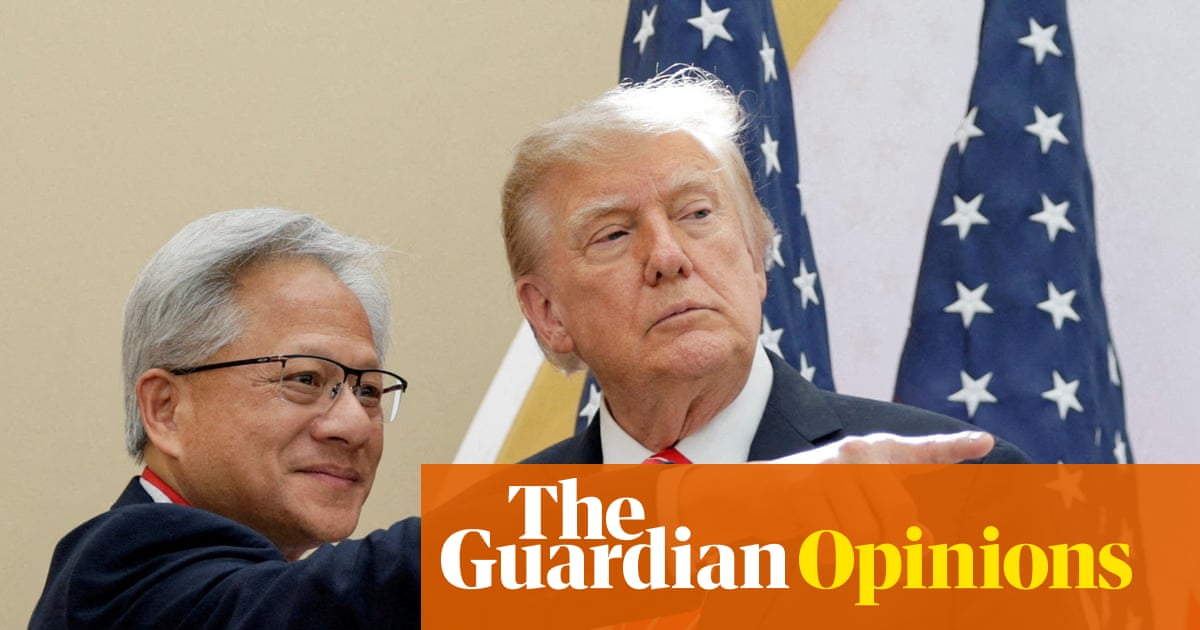
It could be the plot of a spy thriller. One of the most powerful figures in the AI revolution admitted to having an affair with a Chinese businesswomen said to have passed intelligence to Beijing. When Donald Trump was briefed about the Nvidia co-founder Jensen Huang’s liaisons with Alice Huang, he took no action. Perhaps he thought only marriage vows had been broken. Or perhaps Mr Trump was willing to overlook the conduct of a friend who championed his unpopular datacentre expansion, whose company donated to his White House ballroom and who echoed his opposition to AI safeguards against expert advice.Nvidia became the cornerstone of AI by supplying brute computing power. As tech giants scrambled for the firm’s graphics processing units (GPUs), Mr Huang sold the picks and shovels for the AI gold rush – and amassed a $160bn fortune. When China joined the race for tech supremacy, Nvidia’s microchips became a national security issue. In October 2022, the US slapped export controls on GPU sales to China. Thirty months later, Nvidia was effectively banned from selling to Beijing. Mr Huang lobbied for looser controls. Such was his sway with Mr Trump that the White House scrapped Biden-era global AI chip restrictions and then permitted sales of Nvidia’s prized H200 processors to Chinese customers.Alice Huang. Photograph: Obtained by ReutersDemocrats, buoyed by their midterms’ success, will be looking for answers. Asked whether he should have acted on the intelligence, the president replied: “No, I don’t think so.” That makes the question of his reasons unavoidable. There could be trouble at Mr Trump’s commerce department if it backed Mr Huang’s policy agenda and loosened export controls despite knowing of his affair with a Chinese spy. Reports suggest that the commerce department’s probe was halted after Nvidia called investigators. Congress clearly has grounds to investigate whether the Trump administration knowingly disregarded a foreign intelligence threat. Whatever happens next, Mr Huang’s admission is likely to be the beginning, not the end, of the saga.Rumours had swirled for months that Nvidia’s boss had been in a “special relationship” with Ms Huang – an executive at Megaspeed, a Singapore-based company that in 2025 was revealed to be under investigation for suspected diversion of restricted Nvidia chips to China. What makes this extraordinary is the possibility that Mr Huang’s romantic and commercial relationship exposed him to a Chinese intelligence operation. In May, analysts at Culper Research argued that Megaspeed brought Nvidia substantial revenues, allegedly backed by Chinese financing. Then Nividia’s boss publicly defended Megaspeed while secretly conducting an affair with its top executive. More than $300bn was wiped off Nvidia’s valuation as soon as Wall Street opened.Industrial espionage is nothing new. Richer nations often block the export of their commercial secrets to prevent others from catching up. These challengers often go to extraordinary lengths to obtain new technology. Historically, diplomatic or military so-called honeytraps – spies sent to seduce victims to gain confidential information – have been more common than commercial ones. But in 2008, British spy agencies accused Beijing of a campaign to target businesses, using sex to pressure targets into cooperating. Whether that has happened here is unknown. But a president who promised to get tough on China needs to explain why his administration eased chip export controls despite warnings that the businessman lobbying for it might be compromised. Do you have an opinion on the issues raised in this article? If you would like to submit a response of up to 300 words by email to be considered for publication in our letters section, please click here.
The Guardian view on Jensen Huang’s affair: why did Trump ignore the warnings? | Editorial
Full Article
Original Source
Read the full article at Theguardian →KhanList aggregates and links to publicly available news content. We do not host full articles from third-party sources. Always verify important information with original sources.