
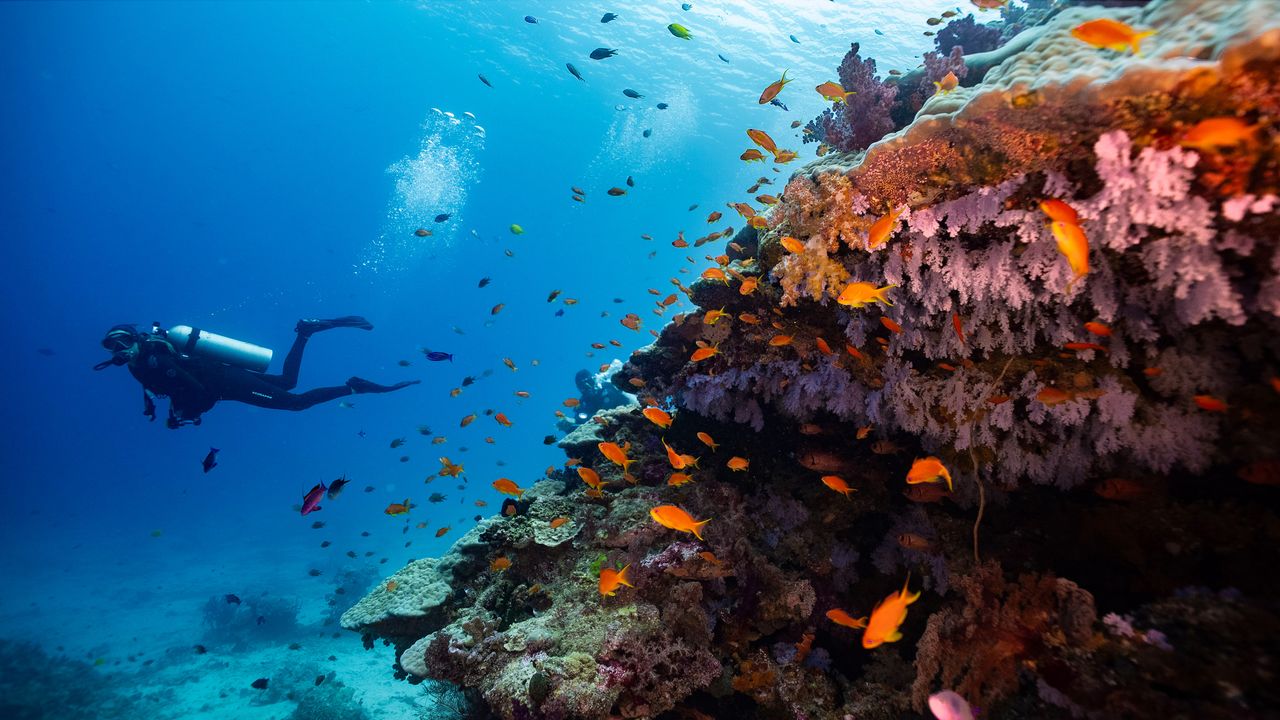
At Fiji's Great Sea Reef, writer Samantha Falewée encounters more sharks than fellow travelers.The bull shark appeared out of the blue in an instant. And it was … fat.Floating 60 feet below the surface in the South Pacific Ocean, I gave a shout of excitement through my scuba regulator when I saw it. Flanked by two remora fish, like bodyguards, the nine-foot bull shark turned in the water with surprising speed given its bulk, swimming just above the sandy sea floor. Deep water beckoned to its left. To the right, a wall of coral stretched upward above me in a mosaic of neon green, milky orange, and soft pink. A fellow diver floated nearby, clad in a speckled cerulean camouflage wetsuit, with wild hair floating around his mask. He flattened the side of his hand and placed it to the top of his head, the universal symbol for one of the biggest-ticket sightings a diver can hope for: shark. We’d be logging the bull into our census for sure.Author Samantha Falewée jumping in to dive the Great Sea Reef in Fiji. Will StrathmannI was scuba diving in the Great Sea Reef (traditionally named Cakaulevu in Fijian), a 280-mile-long underwater paradise in northeast Fiji. Relatively unknown, with only a single scuba diving lodge that has direct access to it, this place is the third-largest coral reef system in the world. More than three-quarters of all coral species known to science live and grow here, as do more than half of all recognized fish.The Great Sea Reef, nicknamed the GSR, is also a growing hub of conservation research. In July 2026, a new partnership between the Professional Association of Diving Instructors (PADI), PADI AWARE (the affiliated NGO), and the World Wildlife Fund (WWF) was launched to push community-backed ocean conservation. A key part of this is PADI AWARE’s new Global Shark & Ray Census, an ambitious project to collect data that PADI and WWF can use to inform governments, in Fiji and beyond, for the creation of new Marine Protected Areas. This recent collaboration made our morning shark sighting even more exciting—and meaningful.“We are bringing together PADI’s 30-million-plus certified divers and 6,600 dive centers with WWF’s conservation work in over 100 countries,” says Ian Campbell, a driving force behind the collaboration and the programs director of PADI AWARE.In visiting the GSR, I was experiencing firsthand how travelers can experience this ecosystem and be a part of an innovative approach to protecting coral reefs. When I saw the lone bull shark, I wrote “bull shark: 1” in my waterproof notebook. The scribble was below my other excited notes from that same dive that read: “leopard shark! Amazing: 1” and “white-tipped reef shark: 2”. This underwater note-taking is the first step of the shark and ray census; the logging would happen when we returned to land.When our dive ended a few minutes later, I rose to the surface, joining a group of scuba divers who were scrambling aboard our aluminum boat. Everyone, including Leone Vokai, founder of Great Sea Reef Divers and the diver who’d signaled the shark, was grinning. We stripped out of our gear and soaked wetsuits, whooping and chattering, as Leone’s crew passed out mugs of warming lemongrass tea and ginger cookies. The boat angled toward the shoreline and picked up speed: it was time to get back to the resort for a seafood lunch and logging.Nukubati Resort, the sole property located on the Great Sea Reef. Will StrathmannAwaiting us, past a sandy beach and the angled heights of coconut trees, was Nukubati resort (pronounced Noo-koom-bah-ti). As the sole property located on the Great Sea Reef, Nukubati is the labor of love of two Fijian generations: It was opened in 1992 by Fiji-born Jenny Leewai and her Australian husband, Peter Bourke; and is now helmed by their daughter, Lara, with her husband, Leone, who was born and raised on the nearby Mali Island. Set against the slow pulse of the waves, styled in classic, custom-ordered cane palm furniture atop gleaming wooden floors, this little haven delivered a peaceful welcome after every dive.Following a hot shower in my private bure, or bungalow, I rejoined the others at the broad open-air lounge, nicknamed the pavilion, which serves as the heart of this intimate resort. Jenny was already there, barefoot in a caftan with Champagne-colored pearls at her ears and fingers. Lara was there too, a red hibiscus flower tucked behind her ear. Lara and Leone’s young son, Masei, pattered past on the shining wooden floor, followed by a russet, tail-wagging dog, Bēbē.Fijian tatavu, aka a traditional Fijian barbecue, served at Nukubati Resort. Will StrathmannIn this deeply relaxed atmosphere, alfresco lunches can last hours. But as soon as we finished the meal—spicy pawpaw soup, followed by skewers of whitefish, pineapple, onions, and peppers in a bed of peanut sauce—I gathered with the other divers around a coffee table, where a weatherbeaten copy of Tropical Pacific Fish lay.There, PADI regional manager Robyn Vincent and Leone led us through a lecture on sharks and rays, which ranged in topics from biology (many sharks are late bloomers: the remarkable greenland shark, for example, doesn’t reach sexual maturity until it’s 100 years old) to shark tourism (each year, roughly 500,000 people dive specifically to see sharks around the world, creating an industry valued at $314 million USD).Then, we logged the sharks we’d just seen on the PADI AWARE app. Tapping through the details took just me six minutes as I marked our location (a dive site called “Fish Market”), our activity (options include diving, snorkeling, boating, fishing, and others), our maximum underwater depth (60 feet), and the number and species of sharks I’d seen (one bull shark, two gray reef sharks, one whitetip reef shark, and one zebra shark).Since the census launched in April 2026, more than 212,000 people have participated, submitting thousands of sightings from around the world. That data is vetted by employees at PADI AWARE, with scientific support from the James Cook University Centre for Sustainable Tropical Fisheries and Aquaculture in Australia. And what’s been logged so far is already being used: According to the university, some data has been implemented in a scientific paper currently under review, and verified images submitted to the app have helped confirm the presence of four shark and ray species in the neighboring country of Vanuatu. One of those four, the great hammerhead shark, is listed as ‘Critically Endangered’ on the IUCN Red List. These awe-inspiring animals can grow up to 20 feet long and engage in mysterious mating rituals, swimming in synchronous, ascending spirals. Their very existence off the reef-fringed, tropical shores of Vanuatu had been debated by scientists—until now.During the author's five-day stay, she saw multiple species of sharks and rays on every single dive. Will StrathmannThanks to PADI’s presence in remote natural places like these, the census’s fast-accumulating data could also have ramifications in PADI and WWF’s efforts to help reach the UN Convention on Biological Diversity’s 30x30, the goal to protect 30% of the world’s oceans by 2030.“WWF brings the political clout,” says Cheryl Bowlin, the founder of Reef Stewardship Frameworks, a community-based conservation nonprofit in Fiji. “They help encourage policy to create Marine Protected Areas.” Those Marine Protected Areas keep reefs healthy and safe for locals and travelers alike, and can provide new forms of income to communities. (An academic paper published in 2025 found that turning unprotected dive sites into fully protected marine areas could generate more than $2 billion globally in direct tourism revenue—an income stream that largely incorporates dive centers owned and run by locals.)Places like Nukubati Resort are a prime example of the reach and impact that travelers can have, even if they might not realize it at first. During my five-day stay there, I saw multiple species of sharks and rays—utterly wild, without human influence of feeding or baiting—on every single dive. Stats like that make scuba diehards and casual passersby alike take notice, especially since diving on the GSR is an option for all skill levels, from snorkelers to beginner divers (like me) to advanced. Visitors can experience top-notch diving and contribute helpful data at the same time.“I’ve been working as a PADI scuba diving instructor since 2013, and I’ve traveled and dived extensively all over the world,” Vincent said as we motored out to a dive site the following day, where a gentle current carried us over seawalls coated with hard corals and neon fish. “The fact that we’ve seen sharks on every single dive, and we are the only boat here, is incredible. There could be 50 dive centers here, 50 other dive boats.”The reef holds significance in local heritage, too. “The name of the Great Sea Reef in our northern dialect is Bainivualiku, which means the fence of the north,” said Leone. We sat at Nukubati, along with Leone’s wife and business partner, Lara, not far from the beach one afternoon, after another morning of glorious diving. “In the old days, the reef protected our community from sailing invaders who wanted to come in,” he said. The Great Sea Reef has been celebrated in songs and stories amongst regional communities for generations. Today, Leone and other locals are recognized as traditional stakeholders in the GSR’s future. To them, “The reef is our heart and soul,” Leone said.That unshakable faith is evident in the family’s nurturing of Nukubati, which has withstood cyclones, a fire, the COVID-19 pandemic, and more. Throughout the trials the property has come out the other side, a timeless hideaway that accommodates a maximum of just 14 guests. The strong family and community bonds have kept it going; 100 percent of the Nukubati staff are local. Sustainability is another defining aspect, as Nukubati has run on solar panels, a system hand-engineered by co-founder Peter, since its opening day in the 1990s. Fast forward to now: In September 2026, Nukubati and its in-house operator, Great Sea Reef Divers, were recognized as a PADI Eco Center, a designation awarded to properties that demonstrate a significant commitment and investment to conservation and sustainability.Now, after their dives, Leone and his team log the sharks and rays they’ve seen in the new global census, and encourage visitors to join. “There's no looking back now,” Leone said, rubbing his hands together. Ahead of him, the Great Sea Reef—colossal, colorful, teeming with sea life and yet empty of humans—waited just below the surface.Samantha Falewée is a freelance travel journalist with over a decade of experience working across print, digital, and social platforms. She seeks enriching stories at the intersection of luxury travel, wildlife conservation, and Indigenous culture. Her work has taken her to the unceded Algonquin Anishinabeg Territory in Ottawa, Ontario, to ... Read MoreMore hotels nearby$$ | Fiji, Mamanuca Islands,Relaxing, beautiful, exclusive, private resort designed to work with the natural beauty of the island$$$ | Fiji, Malolo Island,
The Great Sea Reef Is Fiji’s Wildest Dive, and a New Frontier for Conservation
Full Article
Original Source
Read the full article at Cntraveler →KhanList aggregates and links to publicly available news content. We do not host full articles from third-party sources. Always verify important information with original sources.