
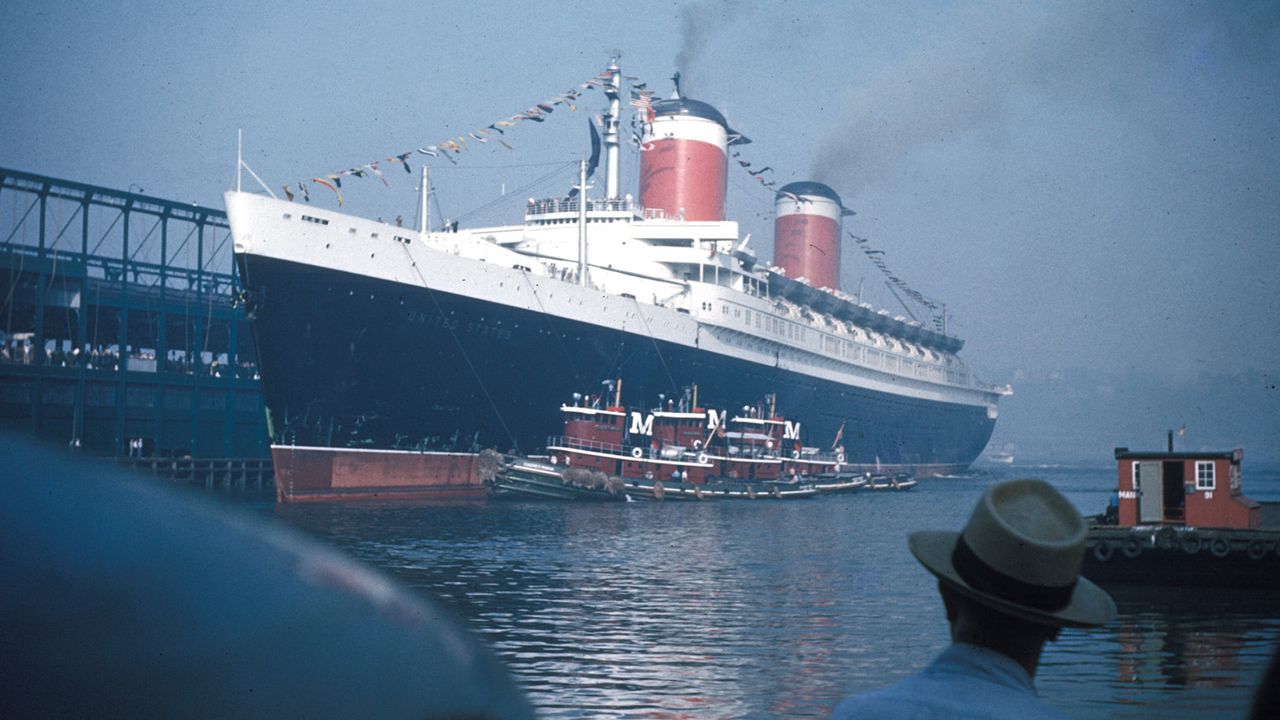
The SS United States has been sunk off the coast of Destin, Florida, transforming the storied ship into the world’s largest artificial reef.SS United States ConservancyIn a secluded corner of Mobile, Alabama, past train tracks, deserted lots, and a county jail, sits a treasure of American history: the SS United States. The country’s flagship ocean liner, once proudly painted red, white, and blue, is now faded and marred by rust. Today, rather than sailing the silver swell of Atlantic waves, it sits in the flotsam-filled murk of the Mobile River. Yet even in the ship’s diminished state, I was awestruck by the sheer force of her towering presence when I paid her a visit on a sticky August afternoon. I wondered: What life remained in the SS United States yet?A view of the SS United States from above Courtesy of Okaloosa CountyAt nearly 1,000 feet long, the SS United States has always occupied a world of superlatives. When she was built in the early 1950s, she was the largest ocean liner ever constructed entirely in the United States, measuring a cool 100 feet longer than the RMS Titanic and boasting five more decks than the doomed British passenger liner. To this day, SS United States still holds the record for the fastest transatlantic crossing by an ocean liner, made on her maiden voyage in July 1952 when she tore from New York City to the United Kingdom in just 3 days, 10 hours, and 40 minutes. She regularly hosted the biggest names of the time, from artistic celebrities like Marilyn Monroe, Salvador Dalí, and Marlon Brando, to former presidents and first ladies like Harry Truman, Dwight Eisenhower, and Eleanor Roosevelt.Passengers on the maiden voyage included Margaret Truman and Commodore Harry Manning Bridge. SS United States ConservancyThose glory days did not last. In November 1969, the crew had just disembarked from the ship’s 400th voyage when they were abruptly informed that it had been their last. A perfect storm of affordable passenger jet travel, rising oil and labor costs, and the withdrawal of government subsidies had put the SS United States out of business after only 17 years of passenger travel. She has since spent nearly six decades bouncing from buyer to buyer, searching for a purpose.Now, the storied liner at last has a new home and calling: She’s becoming the world’s largest artificial reef.On November 12, the SS United States will be sunk off the coast of Destin, Florida, where she will shelter dozens of species of fish and other marine life, and become a major destination for recreational divers and fishers. I had come to her current home in Alabama for a behind-the-scenes tour of her labyrinthine corridors and expansive decks—one of the last ever above water.The ship has been parked in Destin. Courtesy of Okaloosa CountyAlex Fogg, the natural resources chief for Destin-Fort Walton Beach tourism, and the mastermind behind the project, was my guide for the day. Despite the blanket-like heat, we both wore long pants, closed-toe shoes, and white safety helmets. “We are going to be on a ship that has holes that have been cut in the floor, and there’s things above your head,” Fogg warned me. “So just be aware of where you’re stepping.”With that, we walked up a narrow plank leading to a small, rusted steel door on the ship’s towering port side. The light inside was dim, and came only from the gaps where glass windows and portholes once stood. We marched up a narrow spiral staircase to a deck two floors above, where the first-class cabins once were. The doors and walls had long since been removed, but outlines of the floor plans still remained etched into the metal, as did shower and toilet drains, giving an idea of how the poshest passengers lived on board.SS United States - Starboard Side Bow SS United States ConservancyWe climbed the remnants of a grand staircase, and reached a long indoor promenade deck that was once lined with floor-to-ceiling windows, but is was now exposedopen to the elements. The tour continued past empty lounges where copious martinis were no doubt served, and I imagined the ghosts of jazz bands past playing on now-hollowed-out stages. We passed the captain’s dining room, where the most elite guests took their meals, but now spiders were the only diners. On the bow, I took a photo for scale with the ship’s anchor—the largest I’d ever seen, resembling an ancient vertebra from some prehistoric leviathan. The tour wrapped up with a visit to the engine room, a jumble of pipes, catwalks and rails that were like a steampunk rendition of Chutes and Ladders.The propellors of the SS United States. SS United States ConservancyIt was surreal to imagine all of this, the entirety of the SS United States, soon underwater, given over to the crustaceans and fishes and sea turtles. Marine life will likely arrive within hours of the ship sinking, Fogg says, but it will probably take at least a year for the ecosystem to fully blossom.Unlike other parts of Florida, the aquamarine waters off Destin-Fort Walton Beach lack an abundance of reef and other habitat that encourage a greater diversity and population of marine species. But artificial reefs can provide a substitute for these natural features. Thanks in part to Fogg’s leadership, more than 600 artificial reefs, ranging from small blocks of concrete to entire sunken ships, have already been installed in Destin-Fort Walton Beach since 2017, greatly boosting diving and fishing opportunities.Fogg had been looking for an iconic vessel to become the crown jewel of this program when he received a message from a contractor about the SS United States needing a new home. After Googling the ship, he realized it more than fit the bill. “I was like, ‘Man, I really want that,’” he told me. Despite the suitability of the ship for his needs, he had little idea of how complicated it would be to turn his vision into a reality.At the time, the ship was in Philadelphia, owned and cared for by a nonprofit organization called the SS United States Conservancy. Some conservancy officers and board members had family ties or personal histories with their group’s namesake vessel, however, and sinking it was, according to Fogg, “not their number one choice.”Board member Warren Jones, for example, was a passenger in 1961 and 1962. “It was just so unforgettable, sailing past the Statue of Liberty and just thinking, ‘Wow, we are going out to sea!’” Jones told me. He was just eight years old at the time of his sailings, but he still vividly remembers his time on board, including running through the black-and-silver first-class ballroom with his sister, watching Disney movies in the theater, and almost getting blown overboard by the North Atlantic wind.The promenade deck as it once was. SS United States ConservancyJones, like others at the conservancy, originally hoped to find a developer who would refurbish the ship. But after various deals fell through—including one to turn her into a recreational destination at Pier 76 in Manhattan—their choices began to narrow. Fogg and his colleagues’ solution was much better than the alternatives, Jones admitted: “She’s not being scrapped, and she’s not just deteriorating at some pier somewhere.” Still, he said, “bittersweet is the best way to describe my feelings.”Purchasing the ship from the conservancy was only the first step. Getting her out of Philadelphia was another major feat, requiring a detailed survey and much negotiation with the Coast Guard. After finally arriving in Mobile in March 2025, the ship began an extensive environmental remediation process. The asbestos walls that once made up the cabins had already been removed years before, but a specialized team still had to spend the better part of a year cleaning out around 120 fuel tanks, scraping off loose paint, carting away debris, ripping out the old ventilation system, and responsibly disposing of toxic materials.The ship pre-sinking Courtesy of Okaloosa CountyThe ship’s dozen elevators were also removed, in part because they were covered in grease, but also to aid in sinking the ship efficiently, by opening up a path for the air to escape. “When you deploy a vessel, you want the air to get out very quickly and the water to get in very quickly,” Fogg said. “If not, it’ll weeble-wobble and could potentially end up on its side.”The sinking will be carried out not with explosives, as was the past norm, but by opening valves connected to huge, disconnected boiler pipes to allow water to flood in. A naval architect on the project calculated that the ship will be fully submerged within 45 minutes after these valves are opened. Fogg and a few others will dive the wreck that very day to survey how she settled and remove mounted IMAX cameras that will capture video of the sinking. By the next day, according to Fogg, eager recreational divers will arrive.Above the waterline, visitor center exhibits and a land-based museum will also soon keep the ship’s legacy alive, filled with artifacts and stories that the conservancy has carefully preserved. Jones said he takes comfort in the truth that, once again, the SS United States will be a source of wonder and delight for the public. Of his time on board, he said, “It was a real feeling of joy. People were just so happy to be there.”
America’s Most Famous Ocean Liner Is Sent to a Watery Grave—and a New Life
Full Article
Original Source
Read the full article at Cntraveler →KhanList aggregates and links to publicly available news content. We do not host full articles from third-party sources. Always verify important information with original sources.