
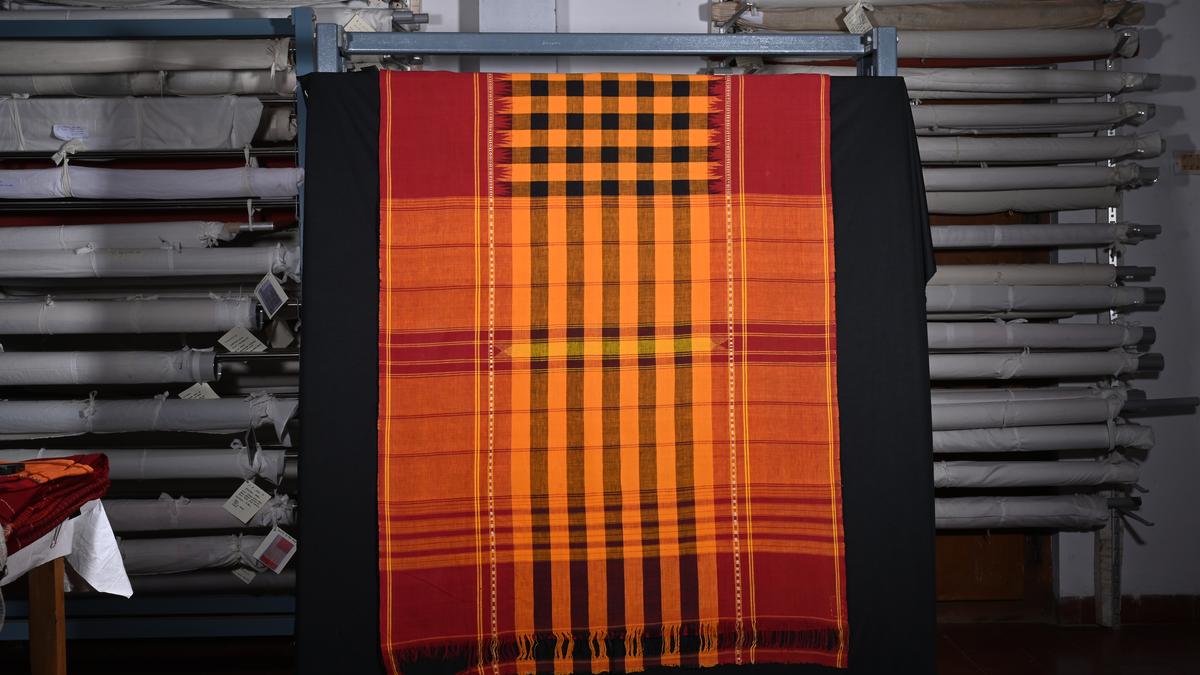
Not every sari in a Chettinad household was meant for the women of the family. Coarsely woven cotton saris were kept aside for women from neighbouring villages who came to help during family functions. Recalling these saris from her childhood, Visalakshi Ramaswamy says the women in her household wore silk saris for festivals and at home, while the cotton saris, known as Kottiyur Kandangi, were reserved for those who came to assist during family functions. Named after Kottiyur, the village where they were woven, these saris offer a glimpse into a textile tradition that has largely disappeared from everyday use.Today, more than 20 such vintage saris are on display at DakshinaChitra Heritage Museum as part of Kodu, Kattam, Korvai: The Saris from the Houses of Chettinadu, an exhibition presented in collaboration with the Indian Institute of Crafts and Design, Jaipur. The collection comprises rare heritage cotton saris collected and preserved by French textile scholar and connoisseur Julie Wayne. Initials of the women who inherited the saris, preserved as a personal mark of ownership and memory. | Photo Credit: Special Arrangement The exhibition draws attention to the distinctive visual vocabulary of the Chettinad sari tradition. Kodu refers to a line, kattam to a check or grid, and korvai to the precise interlocking technique used to join the body and border of the sari on the loom. Together, these elements create a visual language that is deceptively simple: bold lines, checks, stripes and carefully constructed borders.“The hallmark of this collection is its symmetry and mastery of construction,” says Ramaswamy, founder of the M. Rm. Rm. Cultural Foundation, which works to preserve Chettinad culture and crafts. “I have found no convincing evidence that silk was ever woven in Chettinad, but cotton weaving certainly was.” Vintage Chettinadu cotton saris from the collection on display at DakshinaChitra. | Photo Credit: Special Arrangement The beauty of these saris, however, lies not only in their patterns or colours but also in the way they were made for everyday life. According to Visalakshi, the saris were woven thick because women wore only the sari, without a blouse or petticoat. The fabric therefore had to be strong enough to withstand bending, drawing water and fieldwork, while remaining porous enough to allow the body to breathe in Chettinad’s heat. Even the two decorated ends, or double pallu, served a practical purpose. When one end wore out, the sari could be turned around and worn from the other, extending its life through its very construction.Dingdi Gangte, textile conservator at DakshinaChitra, points to another aspect of the collection: its individuality. “Each of these saris has to be appreciated like a work of art. These are handwoven masterpieces, and most of the saris in our collection bear the initials of the women who inherited them.”The saris in the collection vary in size and are characterised by a striking palette of crimson, yellow, orange, black, indigo and green. Their colours and geometric patterns give them a distinctive aesthetic, but their significance goes beyond appearance. They reveal how textile design, material and construction were shaped by the lives of the people who used them. Visalakshi Ramaswamy | Photo Credit: Special Arrangement For Bessie Cecil, professor at the Indian Institute of Crafts and Design, Jaipur, and curator of the exhibition, kodu, kattam and korvai form the fundamental design structure of many Chettinadu saris, creating an aesthetic that is at once simple, bold and deeply rooted in the region’s textile culture. Visalakshi sees something more in those recurring lines, stripes and checks. “The straight lines, stripes and checks mirror the Nagarathar women themselves — disciplined, orderly and precise,” she says.In that sense, the saris are more than remnants of a vanished textile tradition. Their geometry, construction and durability preserve something of the lives and values of the women and communities for whom they were made.Kodu, Kattam, Korvai, is on till August 31. 10am to 5pm. @Kadambari Gallery, DakshinaChitra, Muttukadu. For details, call 9841020149.
The geometry of memory: Vintage Chettinadu saris on display at DakshinaChitra, Chennai
Full Article
Original Source
Read the full article at Thehindu →KhanList aggregates and links to publicly available news content. We do not host full articles from third-party sources. Always verify important information with original sources.