
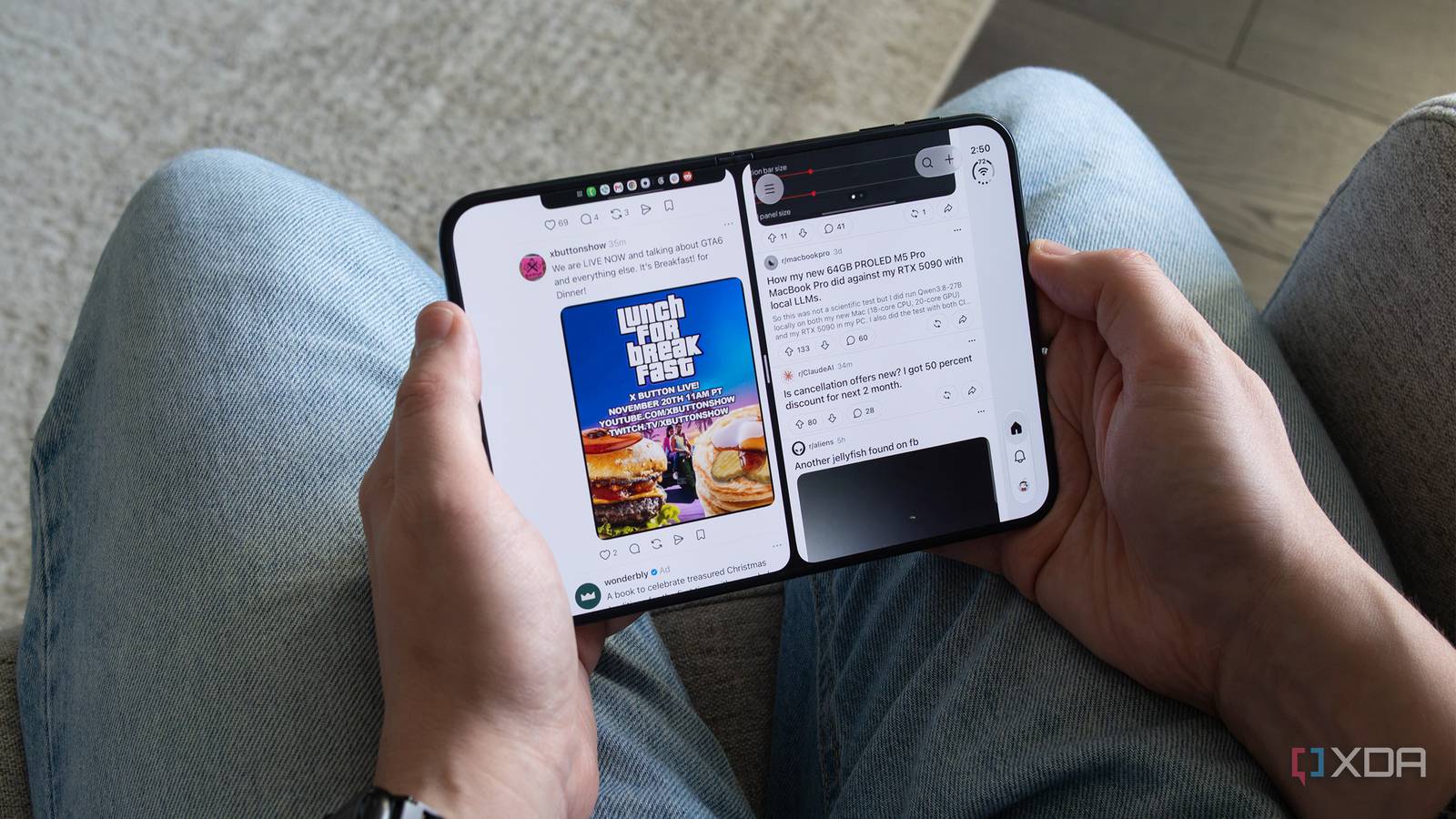
Published Nov 21, 2026, 9:00 AM EST Patrick O'Rourke is XDA's News Editor and Entertainment Segment Lead. Previously, he was Pocket-lint's Editor-in-Chief, the Editor-in-Chief of Canadian tech publication MobileSyrup, and earlier in his career, he worked as the technology editor at the Financial Post and Postmedia. He's based in Toronto. Over the past 15 years, he's written thousands of articles. Patrick has also interviewed dozens of tech industry executives and covered GDC, E3, Gamescom, WWDC, Apple keynotes, Samsung Unpacked events and more. Patrick has a BA in journalism from Toronto Metropolitan University. Sign in to your XDA account The iPhone Duo is an interesting device to review because I've covered rumors about Apple's first foldable for well over a decade. For years, I assumed it didn't actually exist and would inevitably be canceled, but it's 2026, and it's finally here. On top of that, the iPhone Duo has very lofty expectations to live up to. After all, Samsung's first Galaxy Fold launched way back in 2019, and the latest Galaxy Z Fold 8 is an all-around solid foldable with a similar wide-phone design. In some ways, the iPhone Duo also needs to stack up against the several flashy foldables that aren't officially available in the US. from China-based manufacturers like Huawei and Oppo. So how do things shake out with the iPhone Duo? It's a mixed bag. While the overall design is mostly sleek and the foldable screen looks and feels great, the phone is slightly thicker and heavier than the Galaxy Z Fold 8. Additionally, though third-party app support has improved significantly since the iPhone Duo's release a few weeks ago, it still isn't where it needs to be. Then there's the lack of Face ID (Face Unlock is coming, but it hasn't arrived yet), and the dual rear camera array's somewhat disappointing specs. Still, Apple's software polish is definitely on display here in some ways, and anyone familiar with iOS will feel right at home with the iPhone Duo once they get used to the foldable's sidebar app navigation. Like many late-to-the-party Apple products, the iPhone Duo clearly does several things better than its key competition, but it also lags in other areas — and if you're thinking about dropping $2,000 on the foldable, that's important to keep in mind. iPhone Duo 7/10 Brand Apple SoC A20 Pro chip Storage 256GB, 512GB, 1TB, or 2TB Battery Up to 31 hours Pros & Cons Impressive inner 7.6-inch folding screen Overall sleek design Third-party app optimization is lackluster Very expensive Price, specs & availability Apple's iPhone Duo features a 7.6-inch foldable OLED screen with a 1878x2670 pixel resolution, coupled with a 5.4-inch outer OLED with a 1,398x2034 pixel resolution display. Both screens feature a peak brightness of 3,000 nits and a 120Hz ProMotion refresh rate. Other notable specs include Apple's A20 Pro chip and 256GB, 512GB, 1TB, and 2TB of storage. The iPhone Duo's rear cameras are an f/1.6 48-megapixel and an f/2.2 48-megapixel (there's no telephoto shooter). There's also an f/2.2 12-megapixel Center Stage outer camera, and a 4-megapixel inner shooter. The phone measures 3.31 × 4.64 × 0.44-inches (84.1 × 117.8 × 11.3mm) when folded and6.48 × 4.64 × 0.21-inches (164.6 × 117.8 × 5.2mm) when unfolded. The weight is 0.56lb (254g). Colors include Night Sky and Star White. The iPhone Duo is available to order now, but most shipments have been pushed back to early 2027. Pricing starts at $2,000 for the 256GB version. iPhone Duo specs Brand Apple SoC A20 Pro chip Storage 256GB, 512GB, 1TB, or 2TB Rear camera f/1.6 48-megapixel main, f/2.2 48-megapixel ultrawide Front camera f/2.2 12-megapixel Center Stage, Inner 4-megapixel FaceTime camera Battery Up to 31 hours Ports USB-C Dimensions Folded 3.31 × 4.64 × 0.44-inches (84.1 × 117.8 × 11.3mm), unfolded 6.48 × 4.64 × 0.21-inches (164.6 × 117.8 × 5.2mm) Weight 0.56lb (254g) Colors Star White, Night Sky Cellular connectivity 5G Wi-Fi connectivity Wi-Fi 7, Bluetooth 6, USB-C 3 (10Gbps) Cover screen Outer 5.4-inch OLED, 1398 × 2034 Main screen Inner 7.6-inch OLED, 1878×2670 Authentication Side-mounted Touch ID The iPhone Duo's best feature is its inner display It looks great, and you can barely see the crease. Like Samsung's Galaxy Z Fold 8, Apple designed the wide-fold iPhone Duo to be shaped like a passport. While this 5.4-inch screen size looks undeniably cool, it also feels very different in your hand than a standard phone and takes a bit of getting used to, since it can feel cramped and too wide at times. For example, I often struggle to reach across the phone's screen with certain apps when I'm using the foldable with one hand. I'm not 100% convinced a cover screen with this aspect ratio is actually that much better than the taller foldable design that's been around for years. At the same time, I also understand it results in an inner display with a wider aspect ratio that's better for 16:9 videos and side-by-side app viewing. On a side note, I find it hilarious that after using the iPhone Duo for several weeks, whenever I pick up the iPhone18 Pro or any standard slab-like phone, it feels ridiculously tall. Whatever phone I'm using obviously isn't actually that tall, but it's interesting how the wider iPhone Duo has reprogrammed my brain a bit. The iPhone Duo's best feature is, by far, its 7.6-inch inner folding screen. It's crisp, clear, and feels slightly more solid than the Galaxy Z Fold 8's interior folding display, which has that plastic feel foldables are known for. The inner screen features a replaceable nano-texture screen protector that reduces glare, especially when outside, and that makes the folding screen's crease less visible. You can definitely still feel it when you run your hands over the crease, though. I know the crease isn't a big deal to the average foldable user, but it's still worth noting for the vocal crowd that does care. On top of that, the hinge feels solid and has a satisfying snap when opening and closing that I haven't experienced with other foldables. The one issue I have with the interior screen is that you can really see the under-display camera in bright lighting conditions. It's not the end of the world, but I've found it distracting at times. Still, the inner matte display truly feels like a big step forward for foldables, and because of this, I find myself using it more often than I have with Samsung's various folding phones over the years. It's just a joy to look at and use. Understanding the utility of a foldable Sometimes I think foldables aren't for me Here's a little inside baseball to set the scene. While I've used nearly every foldable Samsung has ever released, I typically only spend a few weeks with the devices. I get my hands on a review unit, write my review in a few days, and if I'm lucky, I get to hang onto the phone for a couple of extra weeks before Samsung requests it back (I've had the Galaxy Z Fold 8 for a few months now, though). With that in mind, the roughly four weeks I've spent with the iPhone Duo is the longest I've ever used a foldable. Because of this, I've really been able to integrate its unique design into my daily life. In the mornings, I pop it open to doom-scroll TikTok while drinking my coffee, and in the evening, I find myself watching YouTube videos and Netflix with the iPhone Duo unfolded in landscape orientation. In other situations, I'll have a Google Keep note open on one side of the phone's inner display (I use Google's app to organize nearly my entire life), while cycling through Reddit and Google Discover on the other. While multitasking like this is a straightforward drag-and-drop experiuence, and you can even save app combinations by tapping the line in the middle of the screen, it's not as customizable as the Galaxy Z Fold 8's multitasking (you can also only run two apps with the Duo). There's no resizing of the split or floating windows; it's just two apps running side by side equally split. While this isn't a big deal and is usually how I multitask with Samsung's foldables, it would be nice to have the option to resize windows. Sometimes I'll even prop up one side of the iPhone Duo while doing the dishes, giving the display a makeshift stand. On the other hand, during the day, I mostly left the iPhone Duo closed and used it like a normal slab smartphone, which can be frustrating given how few apps are optimized for the foldable right now. In all these use cases except using the front screen, the iPhone Duo performs prettygreat, but none of them felt truly game-changing. Could I have just used my iPhone 18 Pro or Pixel 11 Pro to do the same thing? In most cases, yes. On that note, the iPhone Duo feels really heavy compared to the Galaxy Z Fold 8: 0.56lb (254g) vs. 0.44lb (201g). On top of that, it's pretty thick, making it kind of uncomfortable to slide into my pocket and carry around. For the pricey iPhone Duo to make sense, you really need to be sold on the concept of a foldable device and want a tablet on you at all times, and I'm not sure if I fit entirely into that category all the time. There are other nagging issues with the experience, too. For example, the side-set fingerprint sensor is slow and inaccurate (a quick tip: add several fingerprints to make the iPhone Duo easier to unlock). If you have an Apple Watch, you can get around this by enabling the Unlock with Apple Watch option. I've done this, but I still get annoyed with the fingerprint sensor in the evening when I take my Apple Watch Ultra 4 off. iOS 27.3 Developer Beta 2 adds face unlocking, which, like the Galaxy Z Fold 8, uses the iPhone Duo's front camera to recognize your face and unlock the foldable. It's unclear when this feature will get a wider release (it'll likely launch in December), but it'll likely arrive sometime in mid-December. This feature should have launched with the iPhone Duo, and it's perplexing that it didn't because it solves nearly all of my issues with unlocking Apple's foldable. Unlock with Front Camera might not be as secure as Face ID's 3D mapping, but I really don't care that much. For my purposes, I'm sure it'll be secure enough. Third-party app support is surprisingly lackluster, but it's getting better. There's some weirdness in the iPhone Duo's version of iOS 27 When I first got my hands on the iPhone Duo shortly after its release, I was shocked that so few apps were optimized for the larger inner display. You could argue that Apple should have given more third-party developers early access so the iPhone Duo could launch with more optimized apps, or that most developers don't care about the foldable, given its $2000 price tag means it'll likely have a limited audience for quite some time. Either way, the experience straight up sucked at launch. Thankfully, it's been getting better. For example, while Firefox used to open as a regular app on the foldable screen, it recently got an iPhone Duo-optimized, full-sized version. Similarly, apps like Threads, TikTok, and X have been updated, while Bluesky and LinkedIn still aren't. For the most part, Google's suite has all been optimized now, too. At this point, if it's a notable third-party app, there's probably an iPhone Duo update for it that fills the 7.6-inch inner screen. More niche apps, like the Kobo app, still show up in standard iPhone mode. This is particularly disappointing for me because all of my ebooks are in the app, and I'd love to flip the inner screen in portrait orientation (the Dyson app also isn't optimized, for example). When you flip things to the iPhone Duo's front screen, the situation is still pretty disappointing. Very few apps take advantage of the vertical space on the right side of the cover display (including many that I mentioned above); instead, there's just a useless black bar that reduces usable screen space. There are a few third-party apps I frequently use that have been updated, like Reddit, for example, and at least Firefox has ditched the black bar, but countless others haven't been given a front-screen UI facelift yet. As far as Apple's own apps go, most apps have been updated to support the bigger inner display and sidebar navigation controls, whether it's Safari, Mail, Notes, or Calendar. Even the App Store is finally optimized, though it amusingly wasn't when the iPhone Duo launched a few weeks ago. Lastly, having navigation buttons in different locations can be pretty disorienting. In a way, you have to figure out how to use an iPhone again to really get the hang of the iPhone Duo, which can be downright frustrating at times, especially when it comes to increasing or lowering the foldables volume. You'll need to compromise on camera features. The iPhone Duo still snaps great photos, but I miss the iPhone 18 Pro's telephoto zoom. Beyond the overall bulkiness, the big downgrade with the iPhone Duo is camera quality. The main f/1.6 48-megapixel sensor is smaller than the iPhone 18 Pro's and pretty much on par with the iPhone 18 Air's. This means that while it snaps solid photos in great light, low-light performance isn't the best, and in some cases, images look over-sharpened and lose fine detail. On top of that, manual controls like shutter speed and aperture aren't available on the iPhone Duo. There's also no telephoto sensor, so you'll need to rely on 2x crop zoom and 10x digital zoom to get closer to what you're snapping. This isn't the end of the world, but I've found myself missing the iPhone 18 Pro's ample telephoto zoom quite a bit. The f/2.2 48-megapixel ultra-wide is fine, but I've personally never had much use for an ultra-wide camera (I wish it were a telephoto lens instead). The f/2.2 12-megapixel front-facing Center Stage camera is passable, but images can be a bit over-sharpened, especially compared to the iPhone 18 Pro (there's also no optical image stabilization, which can make capturing a clear selfie difficult despite the automatic image stabilization). Lastly, there's the pretty abysmal under-display 4-megapixel FaceTime camera. It works just okay in solid lighting, but in low light it's often pretty bad and sometimes seems to distort people's faces in odd ways. Given Samsung seems to have ditched under-display camera tech because it just doesn't work that well, I find it odd Apple decided to stick with it. With all of that said, it's not unusual for a foldable's camera to have key drawbacks compared to other flagships. In fact, the Galaxy Z Fold 8 makes very similar compromises. Still, for a $2,000 phone, I expected more from the iPhone Duo on the camera front. Everything else Battery life, performance, and durability Given the iPhone Duo features the A20 Pro chip, I'm not surprised that performance has been extremely smooth during my several weeks with the foldable. Whether I'm brain-rotting, double doom-scrolling on the inner screen or responding to messages on the cover display, the experience has been stellar. If you care about benchmarks, the iPhone Duo hit 4,705 for single-core performance and 12,380 for multi-core performance. In terms of battery life, I'd say the iPhone Duo lasts a decent amount of time. On a normal day, which features a lot of social media, responding to texts, watching YouTube, and listening to podcasts, I'll usually have 15-20% battery left at the end of the day, which is similar to my experience with the iPhone 18 Pro. Another thing I still need to address is whether I think the iPhone Duo is durable. In short, I don't really know. What I can say is I've dropped the phone several times over the past few weeks (and so has my 16-month-old son when he manages to get his hands on it), and the foldable has survived every fall perfectly. That said, I have the device in dbrand's Grip Case, which I've found to be solid and very protective so far. Unlike Apple's various official cases, it covers the back of the iPhone Duo's hinge, and also doesn't feature any mechanical components. Should you buy the iPhone Duo? You should buy the iPhone Duo if: You've been patiently waiting for Apple to release a foldable for years. You mostly only use Apple's own apps. You think a foldable would really fit into how you use your phone. You should not buy the iPhone Duo if: You're looking to save money. You aren't interested in working through third-party app issues. You aren't 100% sold on the concept of a foldable iPhone. Will some of the iPhone Duo's issues likely be fixed soon, whether it's the third-party app situation or the annoying fingerprint sensor? You bet. However, as it stands, these are two of Apple's first foldable's most significant shortcomings. When I'm reviewing products, I do my best to focus on what's actually in front of me, not the potential a device holds. With this in mind, the iPhone Duo is a decent first-generation foldable from Apple. Its inner screen is great-looking and a genuine leap forward for foldables, but the overall software situation, whether it's the lack of sidebar cover screen support from third-party apps, or apps that just aren't optimized at all, isn't great right now. On top of that, it costs an very steep $2,000. For the iPhone Duo to be worth it, you really need to be sold on the concept of a foldable iPhone and have specific use cases in mind. Are you an iPhone user who's always wanted to carry a tablet around in your pocket? Then this is the phone you've been waiting for. Just be prepared to deal with several software shortcomings while Apple continues to figure out this whole foldable phone thing. iPhone Duo 7/10 Brand Apple SoC A20 Pro chip Storage 256GB, 512GB, 1TB, or 2TB Battery Up to 31 hours
The foldable iPhone Duo is finally here, and there's a lot to like despite a few shortcomings
Full Article
Original Source
Read the full article at Xda-developers →KhanList aggregates and links to publicly available news content. We do not host full articles from third-party sources. Always verify important information with original sources.