
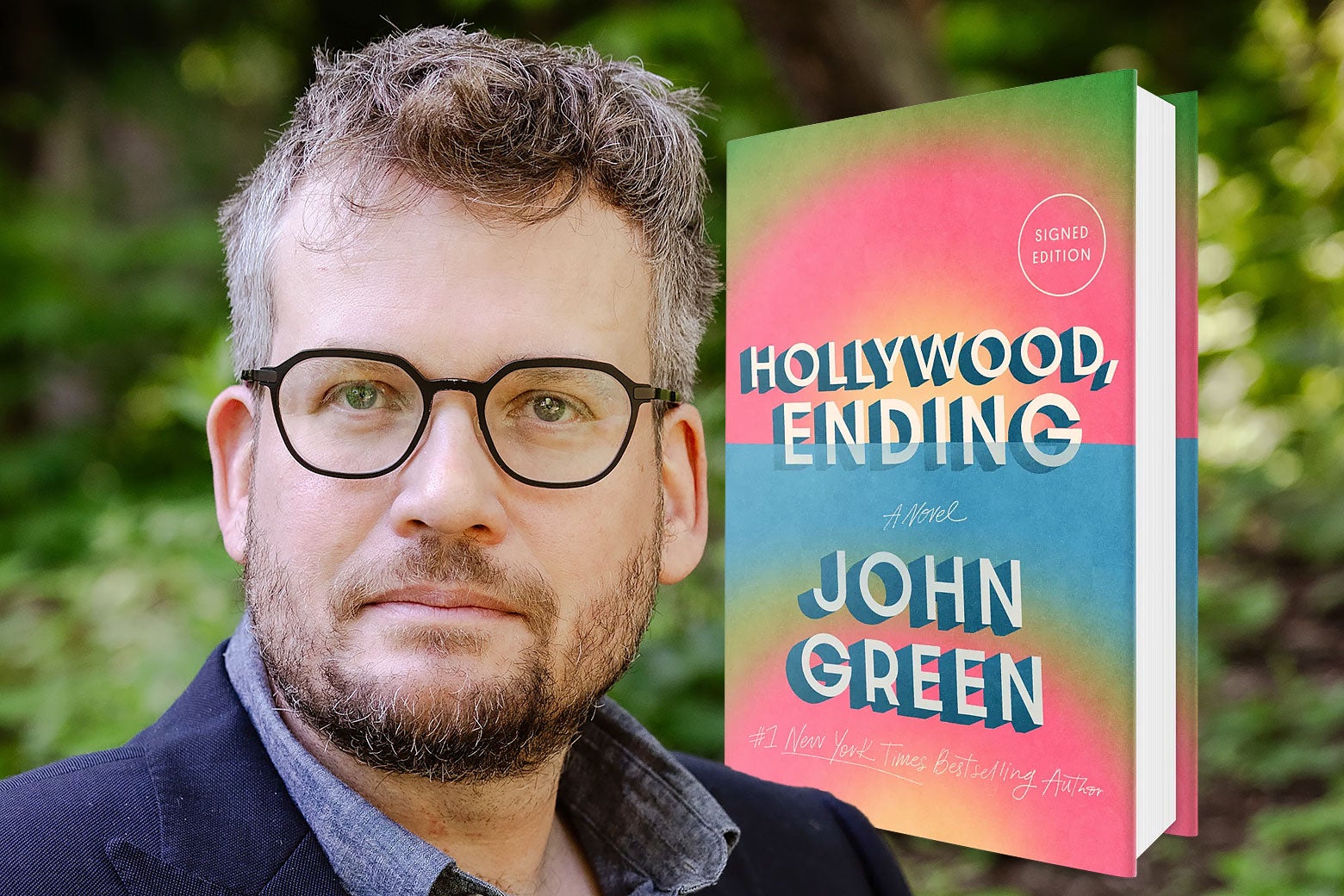
Books John Green Was Never Just for Kids. His New Novel Proves It. The Fault in Our Stars author has been breaking hearts for years. Now his first novel in nearly a decade is coming for the adults. By Enter your email to receive alerts for this author. Sign in or create an account to better manage your email preferences. Unsubscribe from email alerts Are you sure you want to unsubscribe from email alerts for Laura Miller? Sept 20, 20265:45 AM Photo illustration by Slate. Photo by Marina Waters. Sign up for the Slatest to get the most insightful analysis, criticism, and advice out there, delivered to your inbox daily. Hollywood, Ending, John Green’s first novel in 10 years, and his first adult novel ever, has the remarkable warmth that made his young-adult books (The Fault in Our Stars being the best-known example) beloved contemporary classics, only this time there’s a bit more swearing and sex. If the term YA has since become shorthand for books that spoon callow pablum and generic romance tropes into readers’ mouths, well, Green never wrote that kind of YA. His characters have faced terminal diagnoses and mental illness, yet his novels retain a deceptively light and easy tone, even as they break your heart. Hollywood, Ending is no different in that respect. It’s enough to make you wonder why anyone ever thought his earlier books were just for kids. This novel centers on two young people—movie actors in their early 20s and on the verge of stardom—striving to connect with each other in circumstances that militate against them. Or, rather, the people around Juniper Castillo and Kai Laramie would like nothing better than for the pair to become a couple, and that’s part of the problem. If The Fault in Our Stars was about how to love in the face of death, Hollywood, Ending (that comma is doing a lot of work) is about the near impossibility of being genuine in an environment founded on artifice. Hollywood, Ending is the rare novel about fame that feels solidly situated inside the experience, rather than like speculation from the outside. Green has some knowledge of fame, but not the kind that makes it impossible to take a walk in the park without being recognized, or the kind that requires living in a cocoon designed by the industry to profit from it.Persuasively imagining yourself into someone else’s life is what good novelists—as well as good actors—do, however. Hollywood, Ending is in part a writer’s tribute to the sister art of acting, which Kai describes as “feeling like you aren’t stuck inside your mind, that you actually can leave your consciousness.” At the beginning of the novel, Juniper is the former child star of a six-season TV series, and Kai is a relative unknown. Their big break comes from playing secondary leads to Matthew Malone, a bona fide movie star with a bunch of superhero movies under his belt, in a small-budget biopic. Matthew plays Andy Warhol at the end of his life, and Juniper and Kai play fictional characters in his orbit who both love and are baffled by him. Andy Warhol Never Gets Old is, as one of the many deliciously hard-boiled industry folk surrounding Juniper and Kai puts it, “a movie with a five-word title about a dead artist,” not a compelling commercial proposition in a country where “Americans paid two hundred million dollars to see Paul Blart: Mall Cop.” But Matthew’s pivot toward seriousness, and transcendent performances by Juniper and Kai, have the potential to make Andy Warhol Never Gets Old a hit. The two young actors bond instantly, despite their very different temperaments. Juniper—still, in spite of herself, grieving the alcoholic stage mother who blighted her childhood—focuses ferociously on her career. Up for the lead in a potential blockbuster based on a bestselling epic fantasy novel, she buries herself in research, keeping a journal full of character notes. After the first screening of Andy Warhol Never Gets Old, she produces detailed notes on how to improve every single scene in the film. “Juniper,” a producer tells her, “I adore you. You’re going to make a great director some day. But you are not directing this film.” Kai, on the other hand, seems emotionally permeable. He cries easily, and likes to tell people he loves them after knowing them for only an hour or two. But this vulnerability is deceptive, shrouding an inaccessible, damaged core. While the details of the worst thing that ever happened to Kai emerge only later in the novel, the distinctive, devastating blend of shame and self-recrimination that afflict him can only be the result of childhood sexual abuse. She has decided that “true love cannot coexist with true ambition,” and he’s not sure he wants to be famous at all, but acting is the only thing he’s good at. She dutifully complies with the studio’s directives to fill her Instagram account with movie-related photos, and he has to be talked into handing over his friends-only account to a publicist. The bulk of the novel is narrated by Kai, a relatively naive Alice making his way through the bizarre Wonderland of the movie business. “I used to work parties like this one for extra cash,” he thinks at one event, “used to carry around nibbles for people. Now I am the people.” Green is particularly convincing at conveying the weird, synthetic texture of life during a promotional junket, being meticulously coached on how to say nothing of importance to the press, how to deflect undesirable questions and manicure a social media feed. When people ask if Kai and Juniper are a couple, he quips, “No, of course not. Juniper is married to the sea.” Meanwhile, the pair’s private conversations with industry professionals are hilariously frank and profane. Green—who has seen several of his books adapted for the screen—has evidently kept notes during his own forays in Hollywood. “It’s the next tentpole for the studio,” a publicist says of the fantasy film Juniper is up for, “and Katie is correct about it shitting money.It’ll get money norovirus and shit money while it pukes money.” In another scene, an old hand expounds on the inability of even the best male actor to become a true star unless he is great at holding a gun. “The, uh, fucking Twilight guy. Rob Pattinson. What an actor. Can’t hold a gun.” Slate receives a commission when you purchase items using the links on this page. Thank you for your support. Anyone who envies this kind of life will probably zero in on the hotel room with a miniature pool in its terrace or the free Prada wardrobe, but Kai finds himself perpetually wondering what is real. When the one thing that feels most real and most private to him becomes a news story, Green offers a scathing portrait of how even this gets exploited by both the studio and the media. Kai’s publicist tells him: “They will say You’ve been very public about your abuse, because that gives them permission to talk about it. They’re not being vultures, because you’ve been very public about it,” even though making it public was never his choice. From the ugly vampirism of celebrity culture to the venality of the movie business, Hollywood, Ending has moments that come as close as Green has every gotten to savage. At heart, though, he’s a tender writer whose abiding concern through all his work is what it takes to remain decent in a ruthless and impersonal world. Once, that might have seemed a sentimental question. Today, it is more crucial than ever, and for adults, as well as kids. Books California Movies Los Angeles
The Fault in Our Stars Made Him a Favorite for Teens. His First Book in Nearly a Decade Will Do the Same for Adults.
Full Article
Original Source
Read the full article at Slate →KhanList aggregates and links to publicly available news content. We do not host full articles from third-party sources. Always verify important information with original sources.