
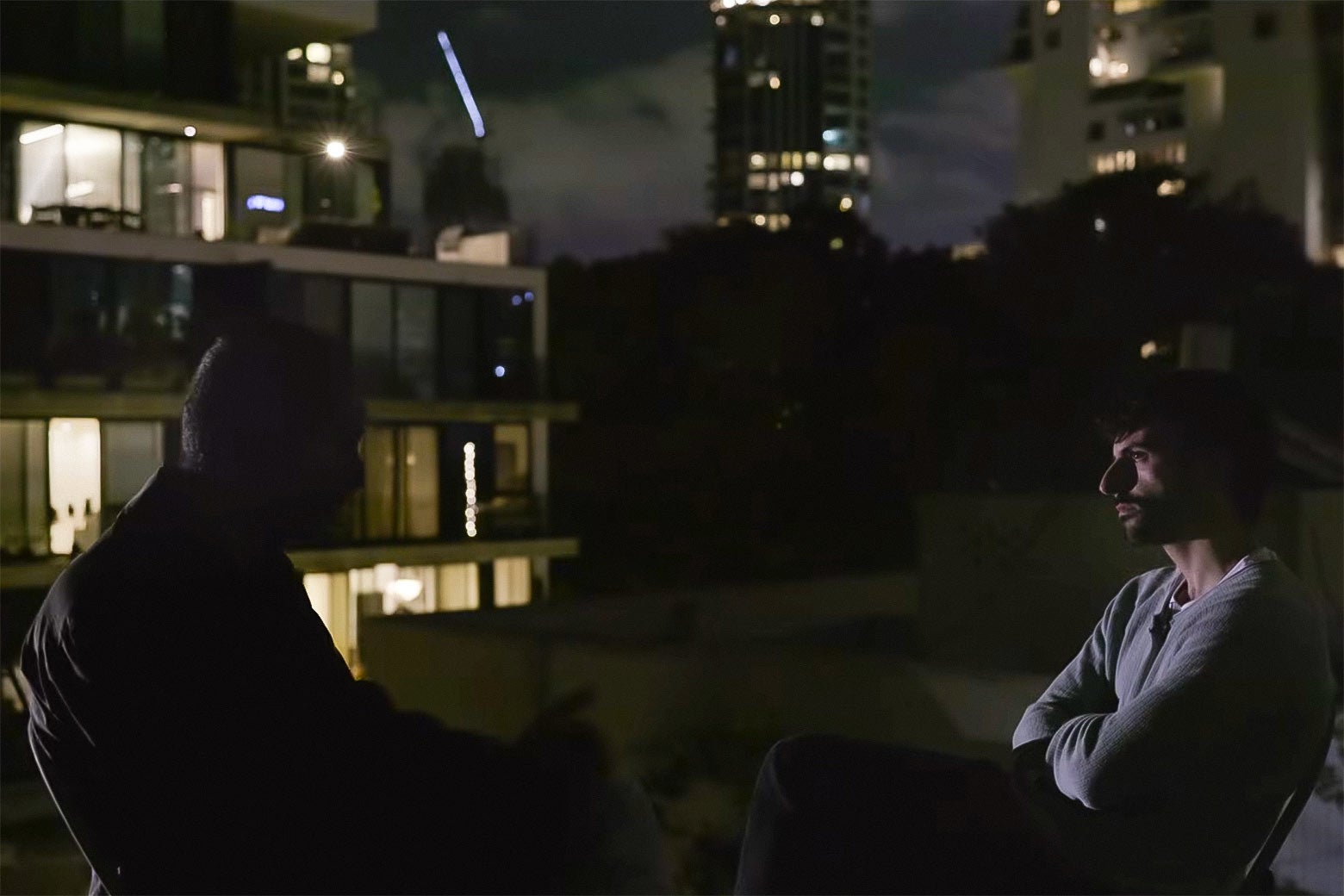
Movies The New Documentary About Israel and Palestine That’s Prompting Threats From Netanyahu Himself NAZA, from the Oscar-winning directors behind No Other Land, is just as urgent, and even more controversial. By Enter your email to receive alerts for this author. Sign in or create an account to better manage your email preferences. Unsubscribe from email alerts Are you sure you want to unsubscribe from email alerts for Sam Adams? Sept 30, 20265:29 PM The Guardian/JW Films Sign up for the Slatest to get the most insightful analysis, criticism, and advice out there, delivered to your inbox daily. Between its premieres at the Venice and New York film festivals, the Israeli documentary NAZA has been seen by something on the order of a few thousand people in the world. But that hasn’t stopped many more from having their own, often extreme, opinions about the film, its makers, and whether it should exist in the first place. Yuval Abraham and Rachel Szor, who shared last year’s best documentary Oscar with Palestinian filmmakers Basel Adra and Hamdan Ballal for No Other Land, keep their cameras on Israel’s side of the border this time—confining themselves, in fact, to the rooftops of Tel Aviv, where their subjects, who have served in the country’s military and intelligence services, gaze out at the city around them. Their bodies shrouded in darkness, their faces and voices digitally obscured, those subjects, 24 in all, describe a state that acts with a near-total disregard for Palestinian life, and a system that allows them to know with stunning precision how many civilian casualties each military strike might cause. Their term for those casualties, derived from the Hebrew for “collateral damage,” is NAZA. The system the film’s subjects describe is as sophisticated as it is terrifying, a frictionless killing machine of virtually unlimited lethality. According to the film’s subjects, the Israeli military uses an A.I. program called Lavender to identify and track suspected members of Hamas, listening in on their families’ cellphones for signs that their targets have returned for a visit. (They also imply that virtually every cellphone in Gaza is subject to surveillance.) Bombing targets in their homes virtually assures that family members and neighbors will be killed alongside them, but that’s where NAZA comes in. The technology is sufficiently advanced to provide a precise estimate of how many additional people will be killed, and below a certain threshold, those deaths are simply considered acceptable. After Oct. 7, the standard number of NAZA allowed was raised to 20. In one case, the documentary tells us, it was 500. As Abraham somberly concludes, there are enough targets that the acceptable collateral damage could potentially include “all of Gaza.” Abraham is also a print journalist, and NAZA builds upon his years of reporting for the Guardian and Tel Aviv’s +972 Magazine. But some critics have seized in advance on the film’s use of anonymized subjects as a means of discrediting—or, more precisely, dismissing—it. The rebuttals range from a lengthy account of the film’s errors and omissions (some legitimate, some seemingly trivial) in the Times of Israel to a sarcastic cartoon viewers began to report seeing on streaming services earlier this week, which shows an animated version of Abraham overturning a box labeled “FACTS” and finding only a cloud of dust. Outside the New York Film Festival screening, protesters showed footage from the Oct. 7 Hamas attacks, with a spokesperson claiming the movie failed to “show all the facts.” In Israel, Szor’s family home was targeted by demonstrators, some of whom called for the directors’ execution, and Prime Minister Benjamin Netanyahu said he was moving to introduce laws allowing Abraham and Szor’s citizenship to be revoked. Meanwhile, on social media, a less organized faction attacked Abraham and Szor from the opposite direction, accusing them of platforming their fellow Israelis instead of Arab voices and of soaking up adulation from film-festival audiences, including the record 25-minute ovation the movie received at Venice, when Palestinians have been livestreaming evidence of the devastation in Gaza for years. Not all of the criticisms of NAZA are valid, or offered in good faith. (As with billionaire Robert Kraft, who banned Macklemore from his stadiums for advocating for a free Palestine, the push for “facts” seems to be less about acknowledging the horrors of Oct. 7—which NAZA in fact does—than about using them to justify everything the Israeli military has done since.) But it’s true that the movie, which runs a scant 80 minutes, does omit much and that its presentation makes it difficult if not impossible to fully vet the truth of its subjects’ claims. Not only do we not know who we’re hearing from, but their uniform presentation—they appear only as silhouettes, so black they’re practically two-dimensional—makes it hard to tell if we’ve even heard them earlier in the film. (Not just their voices appear to be altered but also their speech patterns—their lips don’t always match their words—perhaps to reduce the risk of being identified by a telltale turn of phrase.) The use of anonymous sources is a well-established part of investigative journalism, and the film’s subjects have ample reason to fear that their participation could make them a target. (Netanyahu said the film was the equivalent of launching “dozens of ballistic missiles” at the state of Israel, and its subjects know well how the state typically deals with those threats.) Even with the techniques used to disguise their identity, less than a quarter of the more than 100 sources Abraham says contributed to his print journalism agreed to appear in the movie. But in print, his sources have been reinforced by other methods of reporting, and the process of verification has been more transparent. In NAZA, we are left to take the subjects at their word. Those words are, in fact, supported by Abraham’s reporting, as well as the reputations of the publications in which it’s appeared, and others that have confirmed some of its elements. But simply laying out facts doesn’t make for an effective documentary. So while the film’s accounts are gripping, at least to those not predisposed to believing that they were invented out of whole cloth, its real strength—a strength that is particular to filmed documentary—is in X-raying the psyches of the people onscreen. It seems reasonable to assume that NAZA’s subjects are taking the risk of speaking to the filmmakers because they feel some sort of remorse. And yet their testimonies are almost emotionless, even as they describe hearing the last breaths of a dying child over a hacked cellphone. It would be standard practice to intercut their words, spoken atop still-standing skyscrapers, with footage of Gaza’s flattened cities. But Abraham and Szor hold those images in reserve until the movie is almost over, almost challenging the audience to remember what is happening only a few dozen miles away. One of their subjects identifies himself as left wing, and none of them express any particular zeal for the wanton killing of civilians. But neither do they express much in the way of contrition. Even when one subject agrees with Abraham’s suggestion that he’s been taking part in a genocide, the admission is almost matter of fact. Perhaps Abraham and Szor just don’t want to make their subjects’ regret the center of their film—it’s not, after all, of much consolation to the dead. But the effect is to keep the audience, too, at a distance from their actions, and to contemplate how easy it can be to countenance, or even applaud, the deaths of people we’re not allowed to see. No matter how we might struggle, we’re limited by its subjects’ field of vision—stuck inside the abstract, automated reality of 21st-century warfare—until the movie’s final images confront us with everything that’s been left out, a shift that has left some audiences too stunned to do more than sit in silence as the credits roll. In a sense, NAZA forms a diptych with No Other Land; it’s not difficult to imagine one of the rockets launched by the new movie’s shadowy subjects finding its way to the West Bank community of Masafer Yatta, where No Other Land was shot. But after a frustrating experience getting theatrical distribution for their previous film, Abraham and Szor are taking a different route this time. NAZA opens at New York’s IFC Center on Wednesday and will expand to Los Angeles and other cities on Oct. 9. By late November, it will be streaming for free on the Guardian’s website, where it will presumably sit side by side with the paper’s print reporting. That might be the best place for it, where factual questions can be answered with a simple click, and the deeper and more troubling ones are left for us to answer for ourselves. Israel Documentaries Palestine War
A New Documentary About Gaza Is Prompting Threats—Including From Netanyahu Himself. I Can See Why He Wants to Silence It.
Full Article
Original Source
Read the full article at Slate →KhanList aggregates and links to publicly available news content. We do not host full articles from third-party sources. Always verify important information with original sources.