
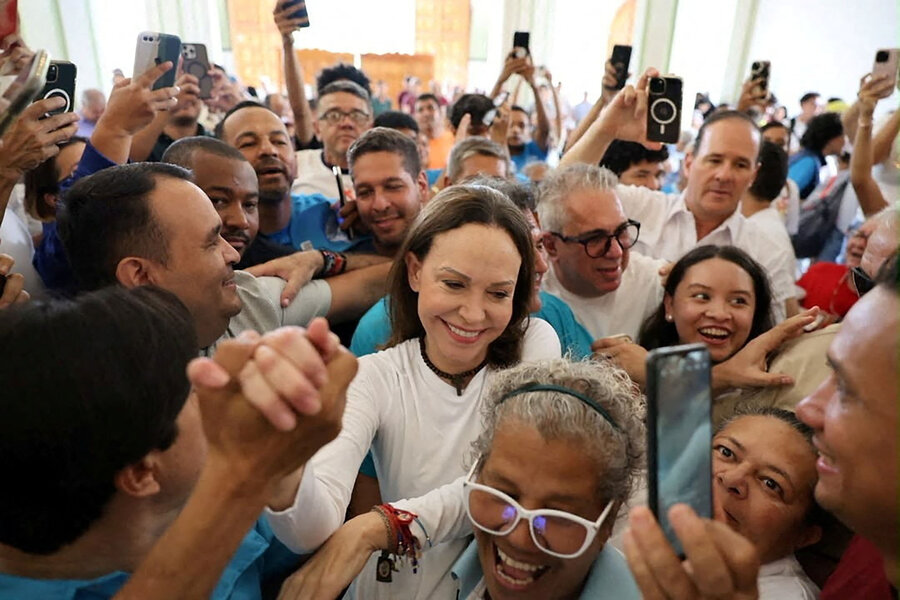
When María Corina Machado unexpectedly appeared at a Catholic church in western Venezuela on Sunday morning, worshippers erupted in applause. Some embraced her and burst into tears. Others handed her rosaries or began singing the national anthem.After nearly a year in exile, the opposition leader was home. As she traveled to Caracas, hundreds of miles away, supporters lined highways and crowded town squares to welcome her.It was a striking contrast to the circumstances of her departure just 10 months earlier. Back then, Ms. Machado was living in hiding, moving between safe houses to evade arrest after leading a movement that challenged Nicolás Maduro’s claim of victory in Venezuela’s disputed 2024 presidential election. She eventually slipped out of the country in secret to receive the Nobel Peace Prize in Norway.Now, Mr. Maduro is in a Brooklyn jail cell. His former vice president, Delcy Rodríguez, leads the government as acting president. Hundreds of political prisoners have been released. Washington has gained extraordinary influence over the country’s affairs, while negotiations over electoral reforms have begun.But whether Ms. Machado’s popular support can translate into political influence remains uncertain. Her return could reshape Venezuela’s political future, says Benigno Alarcón, founder and former director of the Center for Political and Government Studies at Andrés Bello Catholic University in Caracas. “I would venture to call it the most important event since January 3,” he says, referring to the day U.S. forces captured Mr. Maduro. Remo Casilli/ReutersActing President Delcy Rodríguez of Venezuela speaks during the World Food Forum in Rome, Oct. 12, 2026. Ms. Machado emerged as Venezuela’s leading opposition figure in the 2023 presidential primary. Barred from running in Venezuela’s 2024 election, Ms. Machado rallied millions behind a substitute candidate movement, traveling across the country to mobilize voters. The campaign succeeded by winning the election, according to independent assessments, but Mr. Maduro claimed victory, triggering protests and a government crackdown.Mr. Maduro’s removal has opened space for grievances that Venezuelans previously struggled to voice publicly, says Oscar Murillo, who heads the human rights organization, Provea.In September alone, the Venezuelan Observatory of Social Conflict documented 1,101 protests over wages, public services, and political freedoms. That’s six times the number recorded a year earlier.“The inertia has been broken,” says Mr. Murillo.In Maracaibo, in western Venezuela, Gabriela Pérez, a teacher, joined recent protests over power outages lasting more than nine hours a day. “We are not happy with how the country is being run. We urgently need change,” she says.Many of the institutions and political figures that sustained Mr. Maduro’s rule remain in place. The government has yet to set a date for presidential elections, and key political freedoms have not been fully restored.Ms. Rodríguez, meanwhile, has sought to downplay Ms. Machado’s return.Speaking to reporters on Monday, the interim president dismissed the opposition leader’s homecoming as a “show” and called for a more serious approach to politics. She also suggested that Ms. Machado express remorse for her past political positions while defending the government’s ongoing dialogue with opposition groups. Gaby Oraa/ReutersSupporters of María Corina Machado line up along a highway in Maracay, Venezuela, waiting for the opposition leader to pass by on her way to Caracas, after she returned to the country following nearly a year in exile, Oct. 25, 2026. Ms. Machado’s movement has not been included in those talks.For months, the Trump administration has maintained a close working relationship with Ms. Rodríguez, a longtime Maduro ally, despite its stated goal of bringing free elections to Venezuela. The arrangement has helped Washington secure influence over the country’s oil industry while allowing much of the previous government’s leadership to remain in power.Asked about Ms. Machado’s return on Sunday, President Donald Trump said he knew nothing about it. He called her “a very nice woman.”“But we’re doing really well in Venezuela,” he said.U.S. Secretary of State Marco Rubio offered a more explicit endorsement of Ms. Machado’s right to return. He has insisted that the administration remains committed to free and fair elections in Venezuela. But he says the country must first stabilize its economy, rebuild institutions, and establish political freedoms.“That approach reflects a central dilemma for Washington,” Mr. Alarcon says. “Cooperation with Rodríguez has helped advance U.S. economic interests, but it also relies on political leaders whose government has not yet faced a competitive election.” Ariana Cubillos/APSupporters of opposition leader María Corina Machado rally to demand that a date be set for presidential elections, in Caracas, Venezuela, Oct. 22, 2026. For Ms. Machado, who has called for elections by July 2027, the challenge is to maintain U.S. support while pressing for a transition that could replace Washington’s current governing partner.José Ignacio Hernández, a constitutional lawyer and former special attorney general under Venezuela’s opposition-led interim government, says the country must overcome years of institutional deterioration. “The challenge is not simply to elect a new president but to rebuild a functioning state capable of upholding the rule of law,” he says.That means restoring the independence of the courts, ensuring that police and military forces answer to civilian authorities, and dismantling the influence of armed groups and criminal networks over public institutions.Under pressure from the United States, Ms. Rodríguez’s government and a faction of the opposition have started talking about reforms. Washington expects a new Supreme Court to be established by the end of the year, followed by a new National Electoral Council in early 2027.But no date has been set for presidential elections.For many Venezuelans, Ms. Machado’s return brings a renewed sense of possibility. Deepen your worldviewwith Monitor Highlights.Politics with respectGet political stories with respectful analysis.There‘s a world of new ideas in everyBooks newsletter.There‘s more to life, enrich yours withCulture & Learning weekly.Follow humanity‘s discoveries withScience & Nature stories in your inbox.Gain a spiritual perspectivefrom the stories in your inbox.Want to understand the deeper impact of critical events? Learn the Monitor‘s insight.Already a subscriber? Log in to hide ads. Luisana Carrero is a Caracas resident who lost her 2-year-old son in circumstances she attributes to hospital shortages. She hopes her older son might have a different future.“This is the greatest happiness I’ve felt in years,” she says. ALREADY A SUBSCRIBER? LoginReal news can be honest, hopeful, credible, constructive.The Christian Science Monitor was founded in 1908 to lift the standard of journalism and uplift humanity. We aim to “speak the truth in love.” Our goal is not to tell you what to think, but to give you the essential knowledge and understanding to come to your own intelligent conclusions. Join us in this mission by subscribing.
The face of Venezuela’s opposition returns, testing fragile democratic transition
Full Article
Original Source
Read the full article at Csmonitor →KhanList aggregates and links to publicly available news content. We do not host full articles from third-party sources. Always verify important information with original sources.