
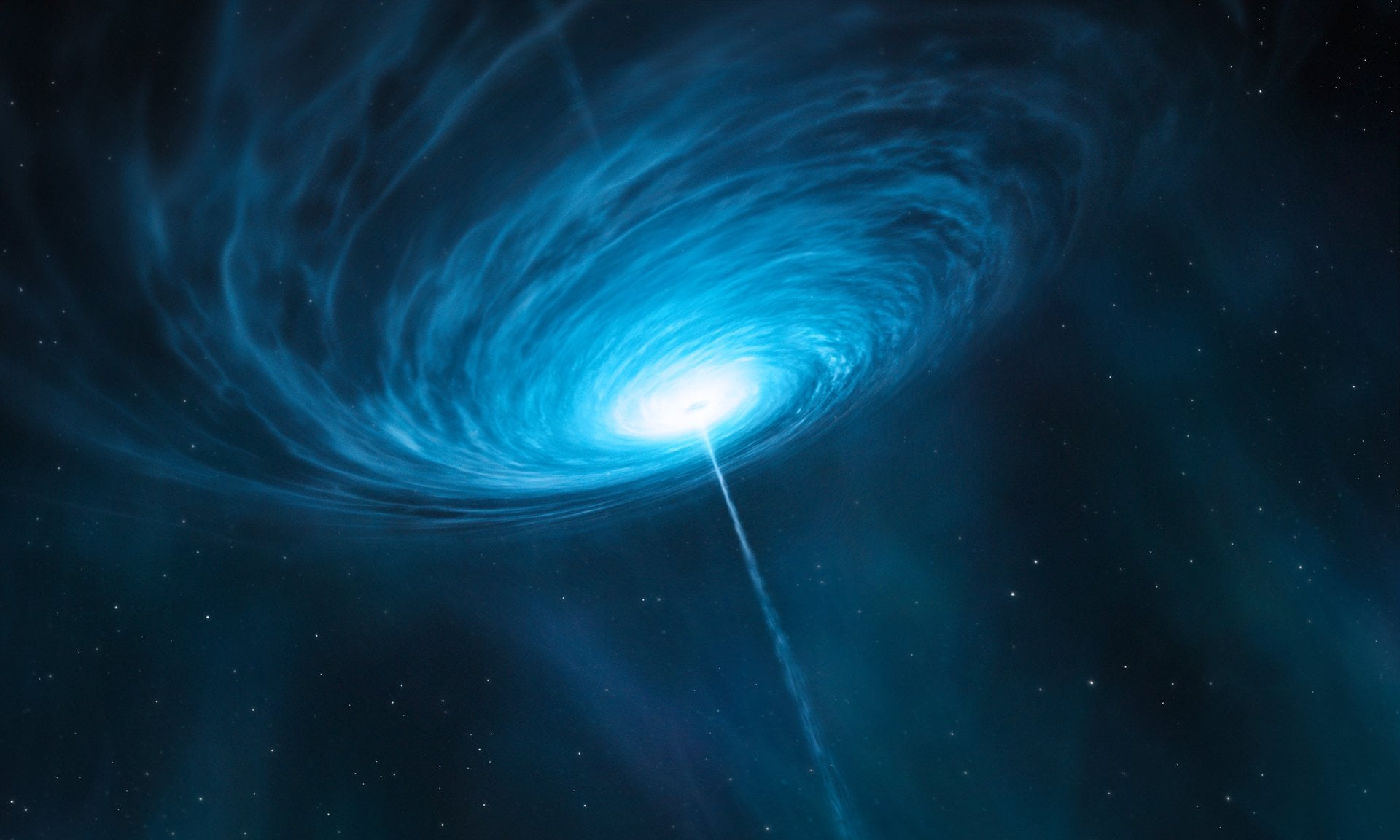
The Event Horizon Telescope (EHT), a massive international collaboration of scientists and radio observatories, is like the gift that keeps on giving. In 2019, the EHT Collaboration gave us the first image of a black hole: the supermassive black hole (SMBH) at the heart of the M87 galaxy (M87*). In 2022, it provided the first image of Sagittarius A*, the SMBH at the center of the Milky Way. Between 2024 and 2026, the international array also produced detailed images of the relativistic jet emanating from 3C 84 and M87*. Meanwhile, EHT observations in 2021 also resolved the innermost jet region of the blazar 3C 279 in unprecedented detail. These efforts, described in a paper that appeared in Astronomy & Astrophysics, revealed the jet's dynamics and geometry at sub-parsec scales, suggesting it bends toward Earth-based instruments on these scales. Combined with earlier EHT campaigns and multifrequency data, the EHT team's latest results are helping astronomers identify its nature and the mechanisms driving it. By definition, blazars are bright galaxies with an SMBH at their centers - Active Galactic Nuclei (AGNs) - that have relativistic jets of ionized matter directed straight toward Earth. Located approximately 538 million light-years away, the jet coming from its center is powered by an SMBH with an estimated mass of about 800 million solar masses (by comparison, Sagittarius A* is about 4.3 million solar masses). Because of its brightness, 3C 279 is considered a prime target for Very Long Baseline Interferometry (VLBI) and is frequently used for calibration. An image of the core region of Messier 87, a supermassive black hole, processed from an array of radio telescopes known as the EHT with colours indicating brightness temperature (Credit: Event Horizon Telescope) The 2021 campaign represents the largest EHT array configuration published to date, with the addition of two new sites. These were the 12-m telescope at the Kitt Peak Observatory in Arizona and the Northern Extended Millimeter Array (NOEMA) interferometer in the French Alps. These additions provided crucial intermediate baselines that significantly improved coverage, especially at intermediate scales, enabling constraints on specific angular scales. These constraints were essential for probing both compact and extended structures in the jet. Hendrik Müller, a staff scientist in the Data Management and Software (DMS) group at the National Radio Astronomy Observatory (NRAO) and a former researcher with the Max-Planck-Institut für Radioastronomie, was the lead author of the paper that appeared in the journal Astronomy & Astrophysics. As he told Universe Today via email, the EHT is continuously growing and adding more telescopes every year, including the Greenland Telescope in 2018. But as he noted, the Kitt Peak and NOEMA observatories were especially important to these observations: The physical baseline between two antennas in the array determines the spatial scale that this baseline can resolve. That is, for example, the reason why the Very Large Array (VLA) in New Mexico is built on railway tracks: When you move the antennas closer to each other, you zoom out of the image and see the larger field of view. If you move them closer to each other, you zoom into the image, achieve higher resolution, but see only a small view of the sky. The locations of the radio telescopes in the EHT could of course not be changed, but Kitt Peak and NOEMA were important because they are relatively close to other telescopes in the array (NOEMA in the French Alpes to Pico Veleta close to Granada, Spain. They added information that was not available to us in previous years. To process the volumes of data gathered by the EHT arrays, the team relied on Comrade, DoG-HiT, kine, and Difmap imaging software, a strategy similar to the one used to reconstruct the famous M87 black hole image in 2019. As Müller explained, the team used different software packages that make different assumptions about the image to build confidence in the result by checking for consistency across methods. Beyond imaging, many more collaborators and software were used during early data-processing steps, like correlation or calibration. Illustration of the multiwavelength 3C 279 jet structure in April 2017. The observing epochs, arrays, and wavelengths are noted in each panel. Credit: J.Y. Kim/MPIfR/VLBA and GMVA/EHT The results, as noted, suggest that the jet curves so that one section of it points closer to Earth. While the jet is already oriented towards our instruments, Müller explained how this small change can have two visible effects: Because the plasma is moving close to the speed of light, its radiation is concentrated in the direction it's traveling. When that direction lines up more closely with Earth, we see brighter emission. At the same time, features in the jet are moving more nearly straight toward us, so they can appear to move more slowly across the sky. Think of a car coming almost head-on: it can be moving fast while barely shifting left or right in your field of view. That's what makes the bend a useful explanation for 3C 279. Farther along the inner jet, we see brighter emission and slower apparent motion. Both can result from a change in direction, even if the plasma keeps moving just as fast. That also means the brightest spot in the image can be downstream from the black hole, where the jet points most directly at us. What's more, the EHT images show that the direction of the inner jet changes over time, providing clues as to what is driving the jet. From the images, the team also noticed features that appeared to move more slowly along a farther, particularly bright stretch of the jet. The bending towards Earth could explain both effects, as the flow can keep moving just as fast while looking brighter and shifting less laterally. Said Müller: We also found a clue about where the jet picks up speed. Even close to the apparent base of the jet, some features are already moving across the sky at apparent speeds comparable to those much farther downstream. If those features travel with the plasma, that suggests the jet gains much of its speed over a short distance near its base. As the fast flow narrows again, it may form a shock that adds to the brightness we see near the bend. While 3C 279 is one of the best-studied quasars in radio astronomy, the mechanisms driving its central jet are still a mystery, and future observations could reveal behaviors that have not yet been seen. Astronomers have decades' worth of observations on how its jet behaves on larger scales, but only a few images on how it behaves at the sub-parsec level. Nevertheless, the EHT Collaboration is extremely useful because it enables deep surveys and high resolution, allowing astronomers to detect details in the jet's innermost region that weren't available before. Said Müller: This paper is just the beginning. We have EHT observations from several years, as well as observations at other frequencies that we scheduled around the same time, that are currently [being] analyzed. Observing at different frequencies lets us see different parts of the jet. Taking those observations close together helps us tell which differences come from the frequency we're using and which come from the jet itself changing. We expect a series of results from these data over the next few years. Very few quasars have been studied in this much detail. That makes 3C 279 one of our best opportunities to understand how a black hole launches a jet and how that jet gets up to nearly the speed of light, and the current manuscript is just the beginning of that journey. Further Reading: Astronomy & Astrophysics
The Event Horizon Telescope Views the Dynamics and Geometry of a Black Hole Jet in Extreme Detailelescope
Full Article
Original Source
Read the full article at Universetoday →KhanList aggregates and links to publicly available news content. We do not host full articles from third-party sources. Always verify important information with original sources.