
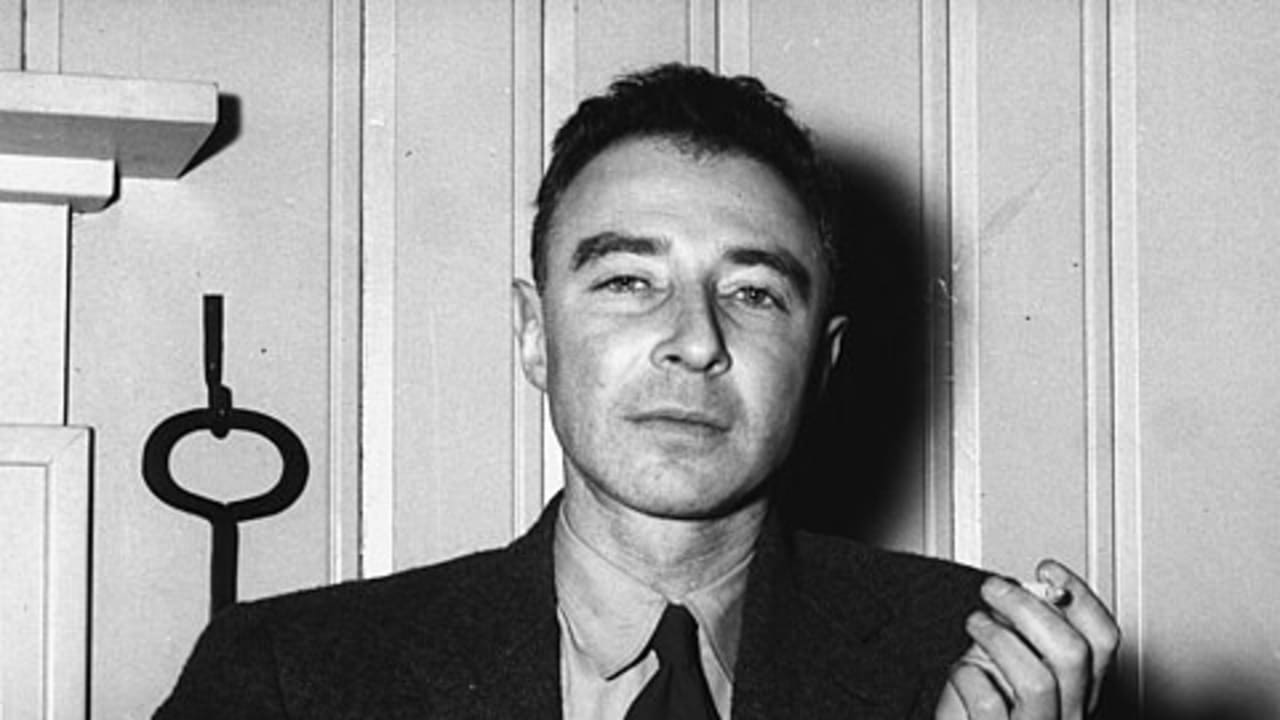
NOVEMBER 8, 2026 02:10Robert Oppenheimer, the scientific director of the Manhattan Project, is often portrayed as an “American Prometheus,” a brilliant physicist who gave humanity the 20th century equivalent of fire, suffered from guilt when nuclear bombs were dropped on Hiroshima and Nagasaki, and lost his national security clearance during the Red Scare of the 1950s.In the biography, Robert Oppenheimer: The Sphinx Without a Secret, journalist David Rieff (whose many books include In Praise of Forgetting: Historical Memory and Its Ironies) focuses on his subject's formative experiences, such as his ambivalence about his Jewishness, to explain his enigmatic personality and behavior.Rieff acknowledges a “Rashomon effect,” in which people who knew Oppenheimer “hewed to their own version of how he felt.” But the author identifies “a certain consistency” beneath his apparent lack of affect. A person “of establishments – first cultural, then scientific, and then governmental,” Oppenheimer was determined “to live his life inside the center,” which created an imperative for him “not to mind, to do his duty at whatever cost.”Oppenheimer's Jewishness contributed to his 'opacity and enigmatic strangeness'ALTHOUGH HAMPERED at times by cumbersome prose – one sentence contains 108 words and half a dozen parenthetical clauses – Rieff’s book provides an informative, illuminating, and provocative analysis of “the father” of the atomic bomb.Many of Oppenheimer’s biographers, Rieff indicates, claim that his “opacity and enigmatic strangeness” stemmed from his denial of his ethnic identity. Notably, at the Ethical Culture School in New York City (founded by Felix Adler, who had presided at the wedding of his parents – who were Reform Jews), Oppenheimer’s only friend was a gentile from New Mexico. 'Robert Oppenheimer: The Sphinx Without a Secret' by David Rieff. (credit: Courtesy)At a summer camp in upstate New York for children of affluent German Jews, the 14-year-old was mocked for his puny physique, lack of interest in sports, and ignorance about sex. When his parents complained to the staff, several campers beat him up, poured green paint over his genitals, and locked him in an icehouse for the night. Oppenheimer’s refusal to identify his abusers, and his decision to remain at the camp for the rest of the summer, Rieff suggests, is consistent with the development of a personality “at ease in a psychic self largely of his own creation.”His “reticence on steroids” is at least “of a piece” with his refusal to defend himself at the US Atomic Energy Commission hearings in 1954 that led to the removal of his security clearances.That said, in 1934, Oppenheimer – who had studied at the University of Goettingen as a graduate student – sent three percent of his professorial salary to the University of California, Berkeley, to assist German Jewish scientists in leaving Nazi Germany.Oppenheimer's 'continuing, smoldering fury about the treatment of Jews in Germany'During the 1930s, what he described as his “continuing, smoldering fury about the treatment of Jews in Germany,” accompanied by sympathy for working-class victims of the Great Depression in the United States – along with enduring sexual relationships with committed political radicals Jean Tatlock and Kitty Harrison – led him to support Communist front organizations and initiatives.Though Oppenheimer did not join many Jewish radicals and reverse course when the USSR and Nazi Germany signed a non-aggression pact in 1939, when France surrendered and the Battle of Britain began, “the patriot in him was mobilized to the core.”He redoubled his efforts to play “a central role” in the war that almost everyone saw coming and “washed his hands” of the Communist Party – but still maintained contact with Tatlock, as well as with his own brother Frank, a physicist and CP member, who had been Communist for a period during the 1930s.At Los Alamos, Gen. Leslie Groves, director of the Manhattan Project, overrode objections from the FBI and army intelligence and ordered a security clearance for Oppenheimer. Groves believed that Oppenheimer’s “overweening ambition” and his loyalty to the United States guaranteed he would do almost anything he was ordered to do to get and keep the job.FOLLOWING THE atomic bombing of Nagasaki, Rieff points out, Oppenheimer did not experience a “What have I done?” moment. Throughout his life, however – while he continued to defend the development and use of the bomb – in what critics dubbed his “Prince Hamlet” side, he told an unsympathetic president Harry Truman that he “felt he had blood on his hands,” and he reflected on the disturbing implications of the dawn of the nuclear age. After the war, from his position as director of the Institute of Advanced Study at Princeton University, Oppenheimer made collective international control over nuclear weapons his preeminent intellectual and moral cause.Rieff reports that Oppenheimer’s colleagues were never sure whether, when controversial issues were discussed, he would give voice to his “tragic intellect” or “the good soldier.” Indeed, Oppenheimer often declared that in life we “need the ambiguity to get by.”Oppenheimer died in 1967. The popularity of the 2023 film, Oppenheimer, written and directed by Christopher Nolan, supports Rieff’s claim that the “spell he cast has not waned.” Not least “because of our absolutely legitimate and sane terror” of a nuclear holocaust. And because almost everything that’s been said about the man Rieff calls the “sphinx,” is, as one critic put it, “true sometimes, and not true other times.”The writer is the Thomas and Dorothy Litwin Emeritus Professor of American Studies at Cornell University.■ROBERT OPPENHEIMER: THE SPHINX WITHOUT A SECRETBy David RieffYale University Press304 pages; $28Follow us on Google
The enigma of Robert Oppenheimer: New biography revisits the man behind the atomic bomb - review
Full Article
Original Source
Read the full article at Jpost →KhanList aggregates and links to publicly available news content. We do not host full articles from third-party sources. Always verify important information with original sources.