
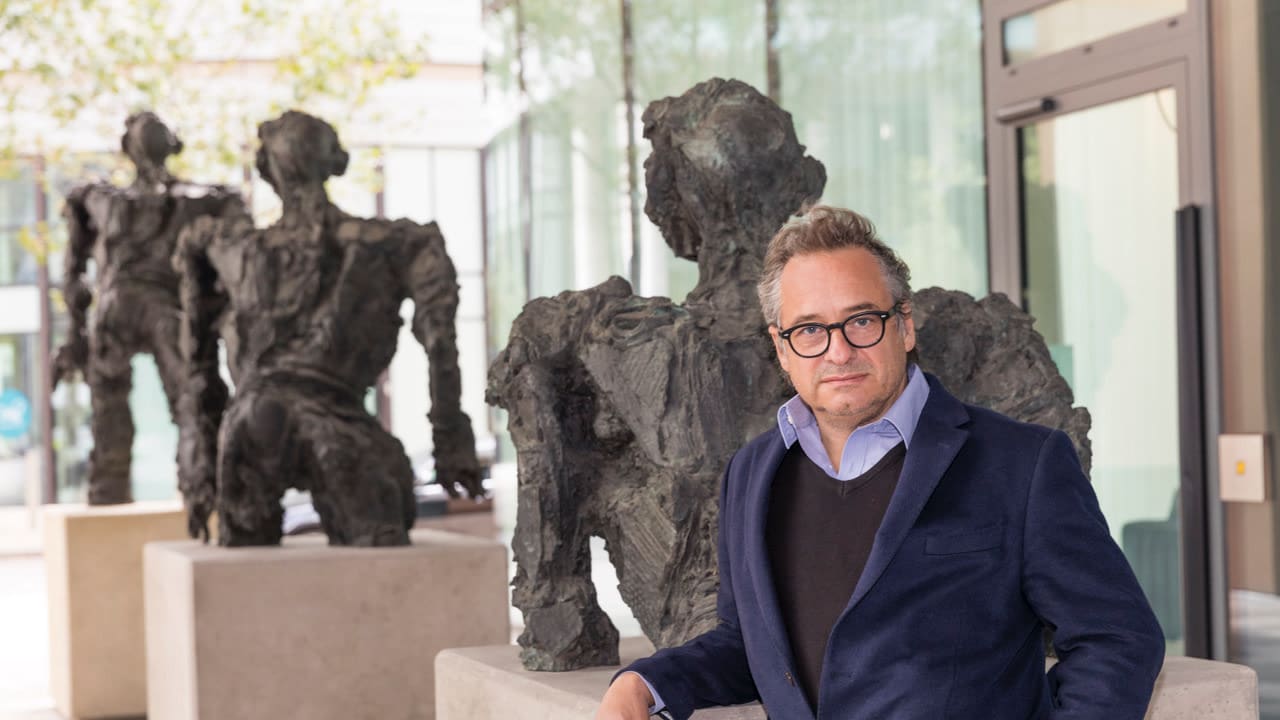
NOVEMBER 8, 2026 02:09David Breuer-Weil’s father was named George as a child, after the king, so that a Jewish boy from Vienna would have an easier time getting into England. He fled in 1938, ahead of the Nazis, and found refuge first in London and then in Letchworth.“England saved his life, basically,” says the London-born artist. “So there’s a certain love for England, because they actually saved our family.”Eighty-eight years later, the refugee’s son has brought his first solo exhibition in Israel to Tel Aviv, at a time when British Jews are asking whether that refuge still holds. Achdut (Unity) opened recently at the Sheetrit & Wolf Gallery in Neveh Tzedek.The exhibition brings together his response to the Hamas-led massacres in Israel on Oct. 7, paintings of the hostages coming home, and a question about Jewish unity that he is not sure anyone can answer.'Aliens that have crash-landed'On London’s Park Lane, his monumental Visitor V shows two giant feet sticking upside down out of the ground. Other figures in the series, called Alien or Visitor, have crash-landed headfirst, leaving only their legs or the tops of their bodies in view.‘VISITOR’, London. (credit: COURTESY OF THE ARTIST)“A lot of my work has a sort of Monty Python double edge,” he says. “At first, it may be quite amusing, but there’s a deeper thing behind it.” His father and grandfather had, in a sense, crash-landed in England themselves, and were officially classed as aliens.“That theme is very deep in my work, the idea of being an outsider, an alien. And I love the idea that they’re all over London, these aliens that have crash-landed.”BREUER-WEIL grew up religiously observant, with a strong grounding in Talmud that still shapes his work, “the philosophy, the deepest elements,” he says. At Central Saint Martins, his teacher was Shelley Fausset, one of Henry Moore’s main assistants, and the young student visited Moore’s studio while the sculptor was still alive. “I feel the English sculptural tradition very powerfully, but it has merged with a Jewish sensibility,” he says. “I suppose it’s a unique mixture.”You can see that mixture in Blessings, a series he recently showed at the Treasure House Art Fair in Chelsea, a part of London he calls “not at all Jewish.” The sculptures are based on an image of a father and son blessed together under one tallit.“Only Jews would realize what it is, but it’s still a powerful image of connection for everybody,” he says. “That’s the essence of what I like to do: take symbols that are quite particular, Jewish, and they’re actually totally human and universal. Let’s not forget, Jewish ideas are the bedrock of Western culture.”Israeli audiences have been living with this approach for years, often without knowing his name. In Jerusalem’s Teddy Kollek Park stands Jerusalem, Centre of the World, a globe commissioned by the Jerusalem Foundation as a tribute to map collector Aaron Laor. It follows an antique map that places Jerusalem at the center of the world. “A lot of people get engaged under there,” he says.At Shaare Zedek Medical Center, his sculpture Soul is a whole world that is also a human being. “It’s a very famous Talmudic concept,” he says, “that if you save one person, you save the whole world.”That idea was behind the painting he began immediately after Oct. 7. He made Morning to the exact dimensions of Picasso’s Guernica, 3.76 x 6.88 m., and finished it on October 25, 2023.“I feel it’s a similar time,” he says. “Guernica was when the fascists bombed Guernica, but for me, Oct. 7 was of that magnitude, at least.” Guernica holds nine figures. Morning holds hundreds, perhaps thousands, and they appear as worlds.“The painting shows the sun coming up, and all these worlds are there,” he says. “Each person who was destroyed is a whole world. There were so many people, 1,200. That’s 1,200 worlds.” The canvas is packed with symbols. “You can spend hours just reading them.”The title carries the sunrise and the mourning that followed it. He painted day and night. “Guernica was painted very fast, and I was inspired by that idea. Something has happened, you have to do it,” he says. “I didn’t know what would happen with it. I just had to do it.”In London, Morning was shown at a private event with British Friends of the Art Museums of Israel, as part of a large exhibition called This Time in Cavendish Square. It never reached the press. “We didn’t hide it. It was a security thing,” he says. “It’s so explosive. Which is terrible, that it should be explosive. It’s a very human thing.”The paintings that followed look at the Britain around him. There are vast paintings of burning newspapers, about the way the media distorted what happened, as well as paintings of books. “They bring to mind the burning of books in earlier times,” he says. “When you distort the truth, it’s a very dangerous thing. I think it’s important for artists to engage with their own time.”For him, it is not an intellectual exercise. “It’s something I need to do, physically.”Britain’s memorial to Oct. 7 for the Jewish communityIN WHERE Will I Go, on view in Tel Aviv, he draws on a Renaissance prototype to confront a question many British Jews are now asking about their future in the country. The work also reaches back to his father’s flight from Vienna.“England has been a wonderful refuge for Jewish people, and to some degree continues to be,” he says. “But we’re living in a very difficult time, as we all know.”Breuer-Weil is also creating Britain’s memorial to Oct. 7 for the Jewish community, a project endorsed by the Israeli Embassy and Chief Rabbi Sir Ephraim Mirvis, among others. It will stand in Brighton, home to a new Jewish community center and to families who lost relatives on Oct. 7, among them the family of Adam Ma’anit, a prominent advocate for Israel in Britain.During the long months that the hostages were in captivity, Breuer-Weil painted the yellow ribbons that London’s Jewish community tied to trees across the city. “In a hundred years, people won’t know what these trees are, but it’s an iconic symbol of our time,” he says.“You’d drive around London, and the yellow ribbons would be blowing in the wind, and most of society is against it. These are little acts of support, or rebellion. I wanted to capture that.”When the released hostages came home, he watched the photographs of families holding one another. “First of all, your heart breaks,” he says. “And then you’re thinking, this is the most powerful image I’ve ever seen. A very deeply human image.”The result is Home, a series of 18 gold paintings and four sculptures of people embracing. “These are the good stories,” he says. “Not in all cases, but in some cases, the story ended with being reunited.”It was Ruth Sheetrit, the gallery’s co-owner, who looked at the embracing figures and suggested the exhibition’s title. Breuer-Weil would add a question mark. “Everyone means different things when they say achdut,” he says. “We’re not just saying everybody’s together. We know it’s difficult, the contradictions. What does it mean to us as Jewish people nowadays? Is it possible?”He had been thinking about the idea of connection since his teens. His sculpture Brothers, shown at Marble Arch, depicts two people sharing one mind. It grew from a dream he shared with his brother, night after night. “That’s the ultimate achdut,” he says.His newest pair, finished just before the exhibition, is called Left and Right: Two Legs. “Maybe they’re separate,” he says, “but then they’re connected somewhere.” The exhibition also contains the possibility of something larger than a gallery.Breuer-Weil wants to give Morning to Israel, “as a statement of support for Israel, empathy, if you like,” he says. “I want to give it. I don’t want to receive anything.”The painting comes in four parts and needs a very large wall. Sheetrit is looking for a permanent home for it, as well as for a related sculpture of a world that Breuer-Weil hopes will stand in Tel Aviv.Morning is on view in Tel Aviv, along with studies and related works he made around it, as Picasso did around Guernica.“Lehavdil (excuse the comparison!),” he adds.He has one more dream for Israel: a sculpture park, perhaps in the Negev, where people could sit among monumental works under the open sky.“I need the patron,” he says. “Artists often have a very hard time, but artistic work is often what creates cities. I’ve just been to Florence. What would Florence be without the Renaissance?”■‘Achdut’ (Unity) is on view at the Sheetrit & Wolf Gallery, 35-37 Shabazi Street, Neveh Tzedek, Tel Aviv.Follow us on Google
From Nazi-era escapes to October 7 memories: David Breuer-Weil's art comes to Israel
Full Article
Original Source
Read the full article at Jpost →KhanList aggregates and links to publicly available news content. We do not host full articles from third-party sources. Always verify important information with original sources.