
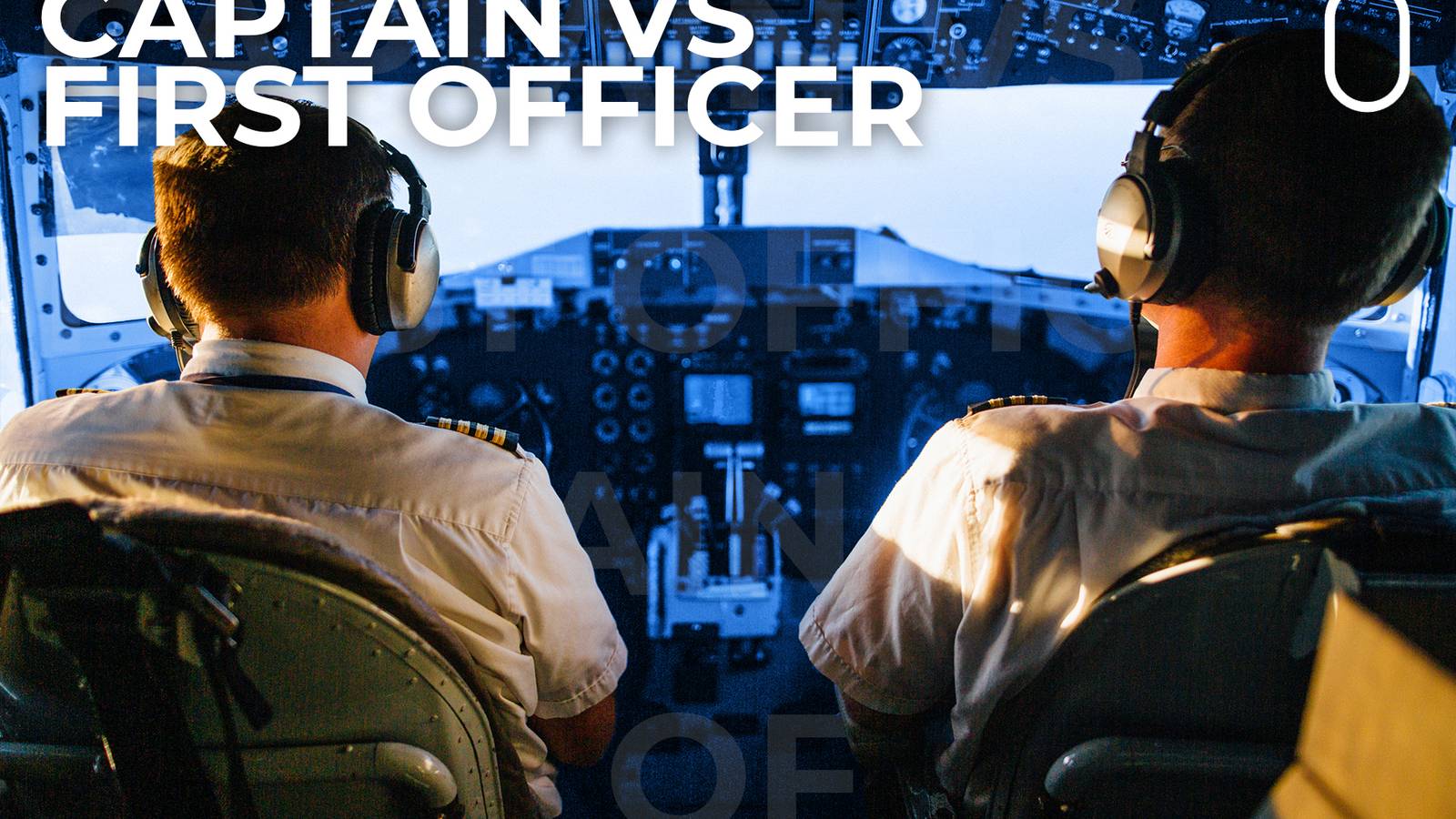
Updated Nov 9, 2026, 10:36 AM EST Editorial team @ Simple Flying. Bringing you the latest aviation news and insight! Many airlines have one of the two cockpit pilots make an announcement before takeoff, welcoming passengers and briefing them on the flight plan. Often, pilots also make subsequent announcements about the flight. Is it always the Captain making the welcoming and subsequent announcements? Or is it the first officer? Have you ever wondered who was in the front seat of the plane you were on? Moreover, what are the differences between the duties of captains and first officers? Some people automatically assume that it is the captain doing the bulk of the work, as they are the higher-ranking pilot. However, that is not always the case. As such, we thought we would take a look at the differences between the captain and the first officer. Both The Captain And First Officer Fly The Plane Credit: Leonard Zhukovsky | Shutterstock Long-haul flight crews in the late 1950s and 1960s consisted of the captain, first officer, relief first officer, flight engineer, navigator, and radio operator. However, as aviation advanced, planes became easier to fly with fewer people. As such, nowadays, nearly all commercial passenger flights are flown by two people: a captain and a first officer. However, longer flights will still have relief pilots onboard. While both the captain and the first officer are licensed pilots, the former bears primary responsibility for the flight, and is the person in overall command. To recognize the captain and the first officer, look at the sleeves of their uniforms. The captain will have four stripes on their uniform, while the first officer will have three. Age and gender do not determine who the captain and the first officer are. Generally speaking, the flight's captain will always occupy the left seat while the first officer sits on the right. We will examine the historical reasons behind this operational quirk later on. Sometimes, the captain may sit in the right seat, but it is for training and monitoring. Before each flight, the captain decides whether they will fly the aircraft or whether the first officer will be the pilot flying (PF). Whoever is PF controls the plane, performs the takeoff, sets the autopilot, and does the landing. The pilot not flying - known as the Pilot Monitoring (PM) - fills out the flight log and communicates with air traffic control (ATC) while supporting the PF. Usually, over the course of the working day, to divvy up the duties, the captain and the first officer take turns as the PF, flying one leg as the pilot flying and the second leg as the pilot monitoring. On longer flights, the captain and first officer may make multiple rotations, particularly on ultra-long-haul flights where a relief pilot will be involved too. Captains and first officers can use this downtime to catch up on some sleep - known as "controlled rest" - which is a common practice on long-haul operations. When Is The First Officer Not Allowed To Fly The Aircraft? Credit: Delta Air Lines During adverse weather and often at the end of the day, the captain will fly the aircraft when fatigue may start to play a role in decision-making. There are also some airports, like Funchal Airport (FNC) on the Portuguese island of Madeira, where only the captain can land because of difficulties associated with the airport. There is a multitude of different reasons as to why the captain isn't always the pilot in command of the aircraft. To list just a few, these include: To prevent or alleviate fatigue, as it is best if both pilots take turns being the PF. Piloting the plane is not necessarily the best use of the captain's experience. Allowing the first officer to be the PF helps them gain confidence and experience. In the case of a system malfunction, it may be better if the captain is not the PF, as they can then concentrate on what actions to take. Why Do Captains Sit On The Left? Credit: Hawaiian Airlines Ultimately, the responsibility of ensuring the safety of a multi-million-dollar aircraft and its passengers rests with the captain. Because of this, they are compensated accordingly, with salaries varying depending on their level of seniority and aircraft type. A captain at a major airline in the USA will usually start on more than $300,000 a year, rising to upwards of $450,000 annually for the most senior pilots. A first officer with a major US airline can expect a starting salary of at least $100,000, but this may rise above $250,000 for senior officers on larger aircraft. As mentioned, airline captains generally sit in the cockpit's left-hand seat. Simple Flying explored the reasons behind this, finding that it dates back to the era of rotary-driven aircraft. The torque of these planes meant that it was easier for them to turn left, and thus, captains sat there so that they would be on the inside of the turn when flying left-turn traffic patterns. This tendency later played a role in forming the practice of boarding airliners from the left-hand side. When aircraft used to park parallel to terminals, it made sense to keep the buildings on their left due to the captain sitting there. Transitioning From A First Officer (Co-Pilot) To A Captain Credit: YAKOBCHUK VIACHESLAV | Shutterstock Aerotime Hub highlights some criteria that allow first officers to transition to the position of captain. Accumulating more flying hours: The required qualification may differ based on regulations applicable at the location. Pilots aim to gain a substantial number of flight hours, building their knowledge and skills. Meet airline-specific requirements: Be eligible for an upgrade to a captain's position based on the airline's criteria. The criteria may include minimum number of flight hours, completion of specific training programs, and satisfactory performance evaluations. Entrance tests and qualifications: Additional qualifications and certifications may be required, including advanced training courses and type ratings. Leadership and decision-making skills: Develop leadership qualities and decision-making abilities in any capacity. Effective communication, handling complex situations, and effective decision-making abilities are some examples of these skills. Network within the industry: Networking within the aviation industry is valuable for career advancement. Attending industry events, joining professional organizations, and establishing connections will provide new opportunities for promotion. Ultimately, both pilots are fully licensed and share the flying, but the captain holds overall command. That is why captains wear four stripes to the first officer’s three, sit in the left seat, and earn far more. Duties are split between pilot flying and pilot monitoring rather than by rank, and first officers can move up to captain by building hours and meeting airline requirements.
The Difference Between A Captain & A First Officer
Full Article
Original Source
Read the full article at Simpleflying →KhanList aggregates and links to publicly available news content. We do not host full articles from third-party sources. Always verify important information with original sources.