
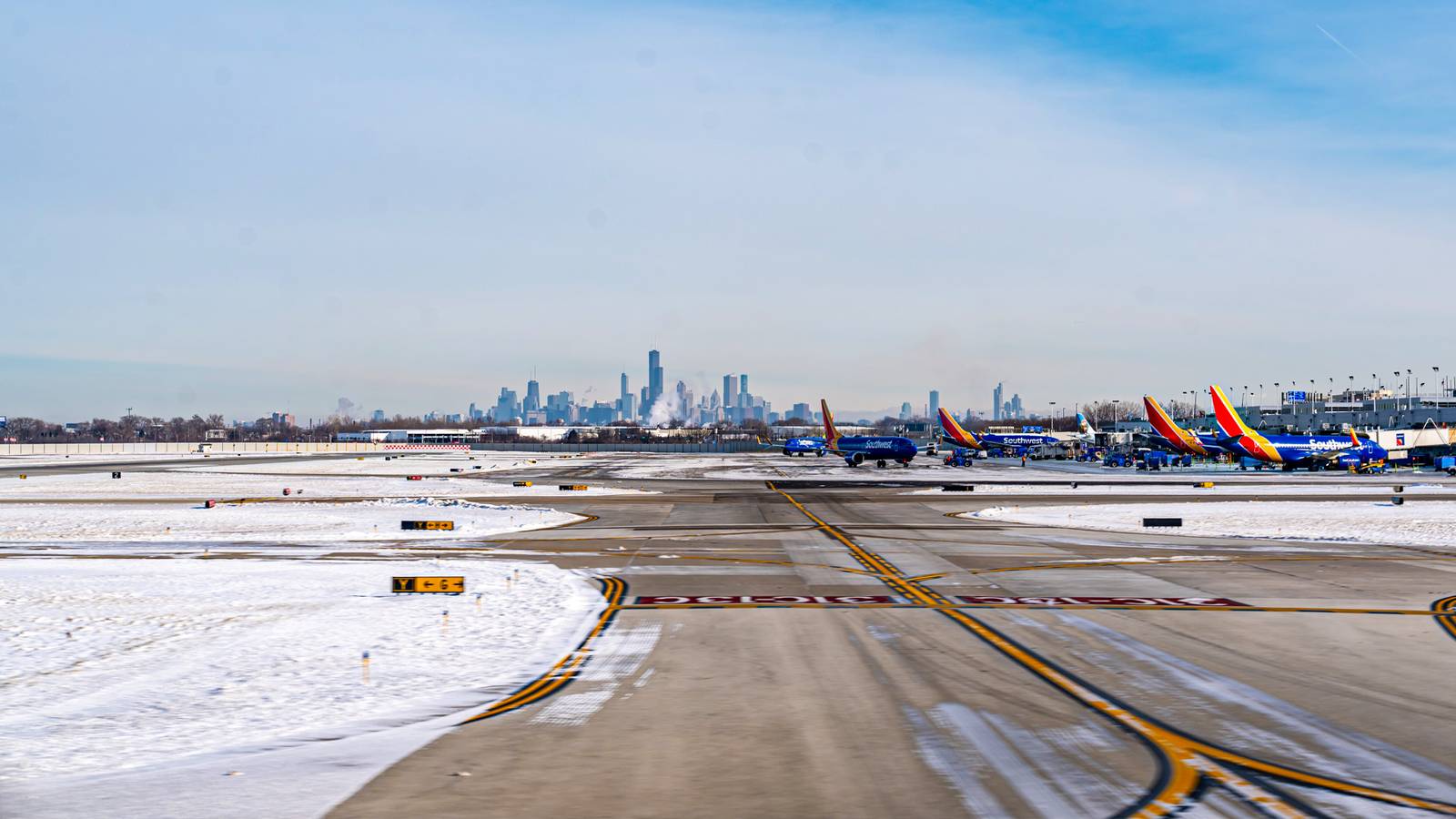
Credit: RebeccaDLev | Shutterstock, Simple Flying Published Nov 9, 2026, 11:00 AM EST Chris earned a Master’s degree in Defense and Strategic Studies (Highest Honors) from the University of Texas at El Paso. His graduate work concentrated on Global and National Security, Low-Intensity Conflict, Modern Warfare, and US grand strategy. He also undertook extensive regional studies, analyzing how key regions integrate into the broader US security architecture. This rigorous program provided him with a comprehensive understanding of U.S. military operations, global strategy, and weapons systems. Additionally, he gained a strong appreciation for great power competition.—an increasingly central force shaping international relations and conflict for the foreseeable future. Sign in to your Simple Flying account The Windy City is home to two major commercial airports, Chicago O'Hare International Airport (ORD) and Midway International Airport (MDW). Although both serve the market, the facilities play distinctly different roles in connecting the region to the rest of the country and the world. ORD is a major global aviation hub, handling extensive domestic and international traffic, while MDW primarily serves domestic travelers alongside select international leisure destinations. Their differences extend beyond route networks. From passenger volumes and airline operations to runway infrastructure, terminal capacity, and ongoing modernization projects, O'Hare and Midway offer two distinct approaches to serving one of America's largest metropolitan areas. A Little History Behind Chicago's Two Airports The Windy City is home to two busy airports: Chicago O'Hare International Airport and Chicago Midway International Airport. The Chicago Department of Aviation's (CDA) 2026 Annual Report states that the two facilities combined "...served more than 104 million passengers to over 280 destinations. From July 1, 2025, through June 30, 2026, O’Hare and Midway offered access to over 290 destinations through more than 50 commercial airlines." According to the CDA's airport website, the city's first airfield, Chicago Municipal Airports, opened on May 8, 1926, and by 1929, it was recognized as the busiest aviation hub in the United States (US). In 1949, the air terminal changed its name to Midway in remembrance of the crucial Battle of Midway, which was a turning point in the Pacific Theater of World War II. Midway's days as the nation's busiest airport would not last, as O'Hare eventually eclipsed its now-little brother. In 1962, all scheduled airline operations were transferred to O'Hare, and passenger numbers rose to 10 million, making it the "World's Busiest Airport," according to the CDA. To highlight the disparity, the O'Hare complex encompasses more than 7,200 acres, while Midway occupies a much smaller 775.4 acres. Chicago O'Hare International Airport Today Credit: Wikimedia Commons | Chris Martin In the US, O'Hare is among the busiest airports in the country, owing to the sheer number of aircraft that pass through the facility daily. The CDA stated that in 2025, ORD recorded " . . .857,392 aircraft operations, equivalent to one takeoff or landing every 37 seconds." Further, the agency notes that O'Hare had approximately 1,000 daily direct flights to over 190 US cities and around 120 daily direct flights to more than 70 international destinations, serviced by 48 airlines last year. Cargo operations cannot be overlooked either, as the facility handled 2.1 million tonnes of cargo during the same period. Regarding the swift movement of passengers, the CDA states that O'Hare has four terminals: 1, 2, 3, and 5. Within these terminals are 11 concourses with a total of 165 gates. Of that number, United Airlines operates 99, while American Airlines operates 66. In terms of the most recent operational data, over the last approximately 30 days, ORD has processed 2.8 million departures and 512,000 international arrivals, according to Passenger Index. The substantial gate allocation held by United and American reflects O'Hare's importance as a major connecting hub for both carriers, supporting extensive domestic and international route networks. Both domestic and international flights rely on the airport's eight runways for takeoffs and landings. The longest is Runway 10L/28R, which measures 13,000 feet (3,962 meters) long and 150 feet (45.7 meters) wide. It was originally built in 1968 and extended in 2008. Of the three shortest runways, all measuring 7,500 feet (2,286 meters) long and 150 feet (45.7 meters) wide, Runway 4L/22R is the oldest, having been built in 1943. The airport's extensive runway infrastructure allows it to accommodate a high volume of aircraft movements, including the wide range of narrowbody and widebody aircraft operating through its terminals. As one of the busiest airports in the country and the sixth busiest globally, handling millions of passengers annually, the economic impact of this facility cannot be overstated. O'Hare generates $70 billion per year, making it not only an economic engine for the state of Illinois but also for the surrounding region, according to CDA data. Beyond direct airport operations, this economic contribution supports employment, commercial activity, tourism, and the movement of goods throughout the Chicago metropolitan area. Chicago Midway International Airport Compared to the dual domestic and international functionality of O'Hare, Midway is largely focused on flights within the continental US. However, it does handle select international flights. The CDA states that in 2025, the facility, located 20 minutes southwest of Chicago's downtown, handled 200 daily direct flights to 80 US cities and 11 international ports of entry, and served 19.4 million passengers. The primary carrier based at Midway is Southwest Airlines, and Midway is its Midwest flight hub. According to its One Report 2024, the airport recorded around 200 daily departures. Further, according to Passenger Index, Midway handled 595,000 departing passengers and 20,900 international arrivals within about the last 30 days. Of the 95 airports mapped in the CDA report, covering the contiguous United States, approximately 63 (66%) are located in the eastern half of the country, encompassing the Midwest, South, and Eastern Seaboard. This distribution underscores O'Hare's strategic position as a major connecting hub, particularly for travelers moving between the Midwest, South, and East Coast. Its central location also allows airlines to connect passengers traveling between major metropolitan areas without requiring direct service between every city pair. Regarding international routes, The Aviation Hub reports that Cancun was the busiest foreign destination with approximately 134,000 passengers. Southwest and Frontier Airlines serve Mexican resorts, Punta Cana and Montego Bay, while Volaris links Morelia, Guadalajara, and other prime destinations in central Mexico. These routes demonstrate Midway's importance as a gateway for leisure travel, particularly between Chicago and popular vacation destinations throughout Mexico and the Caribbean. The airport itself is composed of three concourses (A, B, and C) which house a total of 43 gates. The longest of the four runways is Runway 4R-22L with a length of 6,445 feet (1,964 meters) and a width of 150 feet (45.7 meters), while the shortest is Runway 13R-31L, which has a length of 3,859 feet (1,176 meters) and a width of 60 feet (18.3 meters). Despite its considerably smaller footprint compared to O'Hare, Midway maintains substantial passenger-handling capabilities through its compact terminal layout and concentrated gate infrastructure. What Improvements Are Underway at ORD and MDW O'Hare is undergoing a major modernization through the CDA's ORDNext program, which aims to transform the airport into a more modern and efficient global aviation hub. One of the initiative's first major components is the New Concourse D, a $1.45 billion project with an estimated completion date of 2028. Construction began in August 2025, with the City of Chicago executing its Guaranteed Maximum Price construction contract in June 2026. The multilevel concourse is being built south of the existing Concourse C and west of the O'Hare Global Terminal (OGT). It will feature 19 new gates, including 18 Multiple Aircraft Ramp System (MARS) gates capable of accommodating different aircraft configurations and one narrowbody-only gate. All 19 gates will also be capable of handling international arriving flights requiring US Customs and Border Protection clearance. The flexible gate configurations are expected to improve operational efficiency while expanding O'Hare's capacity to accommodate both domestic and international travelers. Midway is also undergoing infrastructure improvements, with the CDA investing in projects designed to improve aircraft circulation, reduce congestion, and modernize existing airfield facilities. One of the largest initiatives is the Central Terminal Pad project, a $184 million development with an estimated completion date of the first quarter of 2029. The project involves removing, replacing, and repurposing existing pavement while constructing new pavement and infrastructure to create a centralized aircraft staging area between Taxiways T, G, Y, and E1. The new facility will accommodate overflow aircraft and relocate most deicing operations away from the terminal area, helping reduce congestion and improve aircraft turnaround times. Midway is also undertaking a $27 million pavement rehabilitation project covering Taxiway Y South, Taxiway Y3, and Taxiway Y4, with completion expected in the second quarter of 2027. The work involves replacing existing pavement and base courses and installing new Portland cement and asphalt concrete surfaces. Construction will require temporary taxiway configurations and aircraft detours, with daily coordination to maintain normal airfield operations throughout the project. Together, these improvements are intended to enhance Midway's operational efficiency while maintaining its existing airport footprint. O'Hare & Midway: Two Airports, One Connected Future Although O'Hare and Midway serve the same metropolitan area, their contrasting operations demonstrate how Chicago's aviation network accommodates a wide range of passenger needs. O'Hare's extensive domestic and international connections, substantial passenger volumes, and large-scale infrastructure make it a major gateway for both the United States and overseas markets. Midway, meanwhile, offers a more compact alternative, concentrating primarily on domestic services while maintaining connections to popular international leisure destinations. The two facilities also differ considerably in their physical footprints, airline presence, and ability to accommodate different aircraft and passenger volumes, reflecting their distinct roles within the region's transportation network. Both airports are also investing in improvements to accommodate future demand and enhance operational efficiency. From O'Hare's expanding concourses to Midway's airfield rehabilitation and aircraft staging projects, these developments highlight the continued importance of Chicago's two-airport system. Together, they provide the capacity, connectivity, and flexibility needed to support the region's travelers, businesses, and broader economy. As passenger demand and airline networks continue to evolve, maintaining and modernizing both facilities will remain essential to preserving Chicago's position as a major domestic and international aviation center.
Chicago O’Hare Vs. Midway: How The Windy City's 2 Airports Split Its Flyers
Full Article
Original Source
Read the full article at Simpleflying →KhanList aggregates and links to publicly available news content. We do not host full articles from third-party sources. Always verify important information with original sources.