
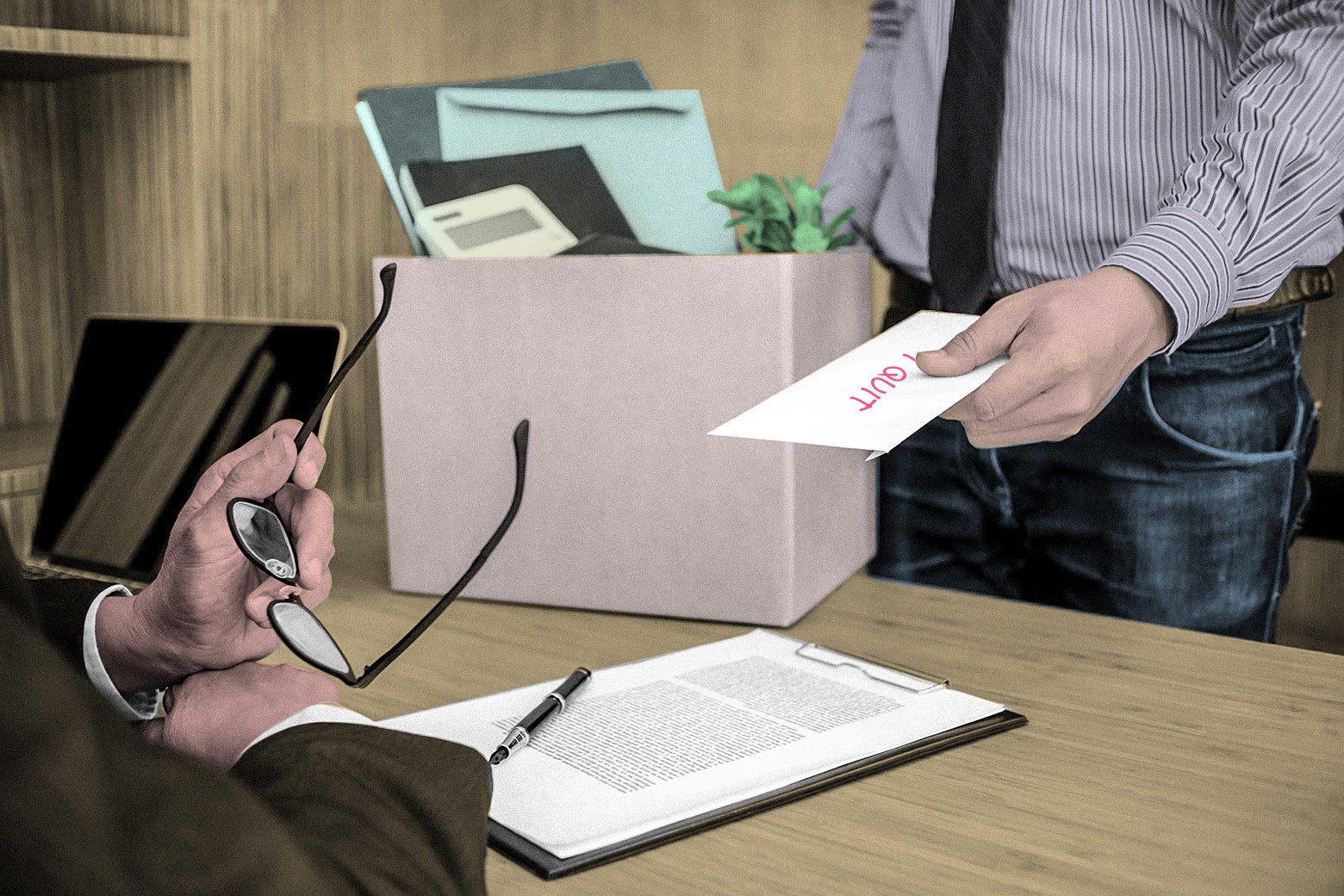
Work No Country for Polite Quitters The courteous two-week notice is … on notice. Photo illustration by Slate. Photo by mojo_cp/Adobe Stock. Sign up for the Slatest to get the most insightful analysis, criticism, and advice out there, delivered to your inbox daily. The last time I gave a formal two weeks’ notice, I spent the final days of my job doing absolutely no work. The company I worked for was infamous for obsessive, long hours and a legion of overworked showoffs. I was one of those showoffs. But before I left, I spent two dignified weeks as a sitting duck, a noble professor emeritus at 27. I went on time-theft-long coffee walks with colleagues along the Hudson. My favorite editor hosted a white-tablecloth-and-white-wine lunch for me that lasted the whole afternoon. Later that night, I threw myself a party at a dive bar and felt such a swell of generosity that I invited even my most annoying colleagues, and I didn’t act annoyed at all. What a stable work environment, I could have thought, that let me give two weeks’ notice with such courteous inefficiency. Several years later, the two-week notice is in peril. The workplace ecosystem seems as if it’s staggering, blindly, from the one-two punch of a global pandemic and the upheavals of A.I. Hiring practices are faceless and dehumanizing; office etiquette is turbulent at best; layoffs are mass, rapid, and seemingly random. And the way people quit reflects the way they’ve been treated: with uncaring efficiency. “We no longer have etiquette around notice of any kind,” Tessa West, a psychology professor at New York University and author of the book Jerks at Work, told me. “It’s a shit show out there, to be honest. People are getting fired with no notice, en masse, due to reorgs and A.I.—and people are also quitting with no notice en masse.” Jada Love, who works in the financial trust industry, has quit on the spot three times. She recently left a job because the company started tracking “productivity,” and her manager said Love had been idle for too long, even though she was hitting quotas. “I felt like a number and hated both the work and work environment, so it was an easy decision to leave,” she told me. “I remember closing my laptop at the end of the day and just leaving it there. And they messaged me, ‘Hey, you left your laptop.’ I was like, ‘No, it’s yours. You can have it.’ ” West and other experts theorize that a retaliatory stance is jeopardizing the customary two weeks’ notice. The corporate reverence of efficiency—responsible for strategic mass layoffs and overwork—has understandably infected employees’ attitudes. They’re now spinning the revolving door ever faster. Annie McKee, a professor at Penn Graduate School of Education who specializes in emotional intelligence in the workplace, confirms that “there’s a movement toward brutality in the way people are actually treating each other, and particularly in the way people are being managed and led.” But if employers are more ruthless (likely), the ruthlessness has increased only by a degree. Corporations have been inconsiderate, famously, forever and always. They are, by design, heartless. And the firing-vs.-quitting dynamic has always been asymmetrical. Even really wonderful employers almost never cease employment with a kind offer to let you keep working there until you find a new source of income. But employees matching this type of disrespectful behavior is new. In March 2025, the job board Monster published a report about “revenge quitting,” saying that half of the people working in the U.S. had revenge-quit the year before. In 2023 the BBC covered the TikTok trends of people posting live videos of quitting jobs dramatically, a maneuver often called “loud quitting,” in response to the practice of “quiet quitting” (doing the bare minimum at a job, often considered to be “just doing your job”). This gesture seems, to West and McKee, to be spurred by the particularly dehumanizing way that people not only are treated on the job but are fired from their jobs. It’s a culture in which employees feel interchangeable. They’re burned out until they can be replaced, or then fired without warning, reason, or a meeting. Earlier this summer, West went to lunch with a friend who works at Google, on a day the company enacted a round of layoffs. West’s friend repeatedly refreshed her email, not to see whether she’d gotten a new message about the status of her employment, but to learn whether her email account itself was inactive. “It’s the easiest way to know,” she told the professor. “The problem has gotten worse,” said West. “Both sides are contributing to it. We’ve lost the muscle to deal with discomfort in the workplace, including letting people go in a humane, interpersonal way, in person, instead of over email.” Tiffany—who requested to be identified by just a first name—works in IT service management. She told me that she’s the person tasked with shutting off a colleague’s email account before they even know they’re fired. And she detests this practice. “Corporations are intentional about blindsiding people, in my opinion,” she said. She’s seen this treatment directly translate into abrupt departures. “We’ve made the shift from being so dedicated to a company to saying, ‘You guys don’t care about us. So why should we care enough to give you the courtesy of a two weeks’ notice?’ ” This is why Love regrets the time she gave a whopping 30 days’ notice to one employer. She’d felt guilty about leaving because of how much her team relied on her. And then, within two hours of Love giving her resignation, her manager messaged her to let her know that they were posting her job listing. “It made me realize how easily we can be replaced,” she said. One of the major incentives of the two-week notice was, of course, to stay in your (soon-to-be-former) manager’s favor. But, West points out, the concept of retaining a good reference from your boss is no longer relevant to career longevity. “We don’t tend to actually work our social networks that way to get new jobs now,” West said. “We don’t use old employers. We use colleagues that we trust.” May the bridges we burn light an eternal fire in our favorite colleague’s heart so they take us with them to their next gig, etc. The two-week notice is also particularly inefficient given the way that many teams are structured now. West notes that workplaces often operate more dynamically, and that one person is rarely in total control of any one project. “Our teams are all super fluid, and they have revolving team members, and everybody’s always a newcomer,” said West. “So if you revolve off a team because you’re quitting, it’s actually not that hard for someone new to just come on. Off-loading your job to another team member doesn’t take two weeks.” The idea that you need two weeks to hand off your work is antiquated, but like other inefficiencies, that makes it an ideal setting for human connection. And why would a company just let you have that? A Reddit thread from a few weeks ago recounts someone attempting to leave a job, after four years, with dignity and a standard two weeks’ notice. Twenty minutes after they told their boss about their plan to leave, their boss cut off their access to email and Slack. They felt like “a corporate spy who had just stolen company trade secrets instead of an employee who gave them four years of dedication.” The redditor wrote, “They wouldn’t even let me say goodbye to my team or grab my coffee mug from my desk.” That post reminded me of the first time I’d really had to quit a job—a comically underpaid reporting gig at a local paper. I was 23. I wrote a firm, terse email to my editor asking to meet for coffee to discuss “next steps.” How ominous of me! By “next steps,” I meant “my two weeks’ notice.” I arrived at the bakery, known for mysterious soups and huge slabs of buttered bread, an hour early as a way to buy myself maximum composure. Ten minutes before our meeting, my editor sent me an email whose subject line is still sharp in my mind, a decade later: “The difficult thing.” It was a you-can’t-quit-we’re-firing-you email. And before I even clicked to open it, I felt a soaring, simple superiority that only a 23-year-old quitting her first big job could feel. I had more gentlemanly bravery and old-fashioned rigor than someone twice my age could muster! The “difficult thing,” I remember thinking, is saying the difficult thing in front of someone’s human face. Years later, I can clearly see that her minor cowardice was almost certainly outweighed by classic busyness. Could anyone imagine a worse way to spend an hour than ordering a mid coffee at a poky bakery and listening to a 23-year-old’s complaints? Why would she? Not that I don’t understand the impetus to can someone without holding their hand. I’ve had to “let go” a couple of people since then. It’s stomach-twisting. The rejection of someone quitting and the pain of firing someone are both really tough for a manager, said McKee. “That’s part of the reason people are so cold, I believe, because it hurts and they don’t want to feel [that], so they shut down,” McKee added. Very few people want to feel cynical about their job. The people who make decisions, said Tiffany, should prioritize kind, considerate communication—and that will be echoed in response by their employees. “We need to get back to doing the right thing and putting humanity first,” said Tiffany. If people start giving two weeks’ notice again, it will be a sign that they felt important to their workplace, that these relationships were decent enough to value, that the going there was good enough that it deserved a good farewell. This is especially true if your colleagues meant something to you. The leisurely final weeks of the last job I quit certainly weren’t a professional apex. But were they a collegial apex? I think so. My memories of my co-workers were fond. Two weeks’ notice allowed me to leave with a goodwill that I certainly did not feel at the hour of quitting. I’d spent months desperate to leave. But the slow departure restored some mutual appreciation, softened resentments, and hopefully replenished a general amorphous compassion that then transferred to other future colleagues. If there had been a culture where everyone else was quitting right away, I would have too. I probably gave two weeks’ notice because of some incoherent suspicion that I’d get fined or scolded by some menacing HR entity if I didn’t. Now I think that if you can leave with goodwill, then that goodwill comes with you. Workplace Jobs
The Death of the Two-Week Notice
Full Article
Original Source
Read the full article at Slate →KhanList aggregates and links to publicly available news content. We do not host full articles from third-party sources. Always verify important information with original sources.