
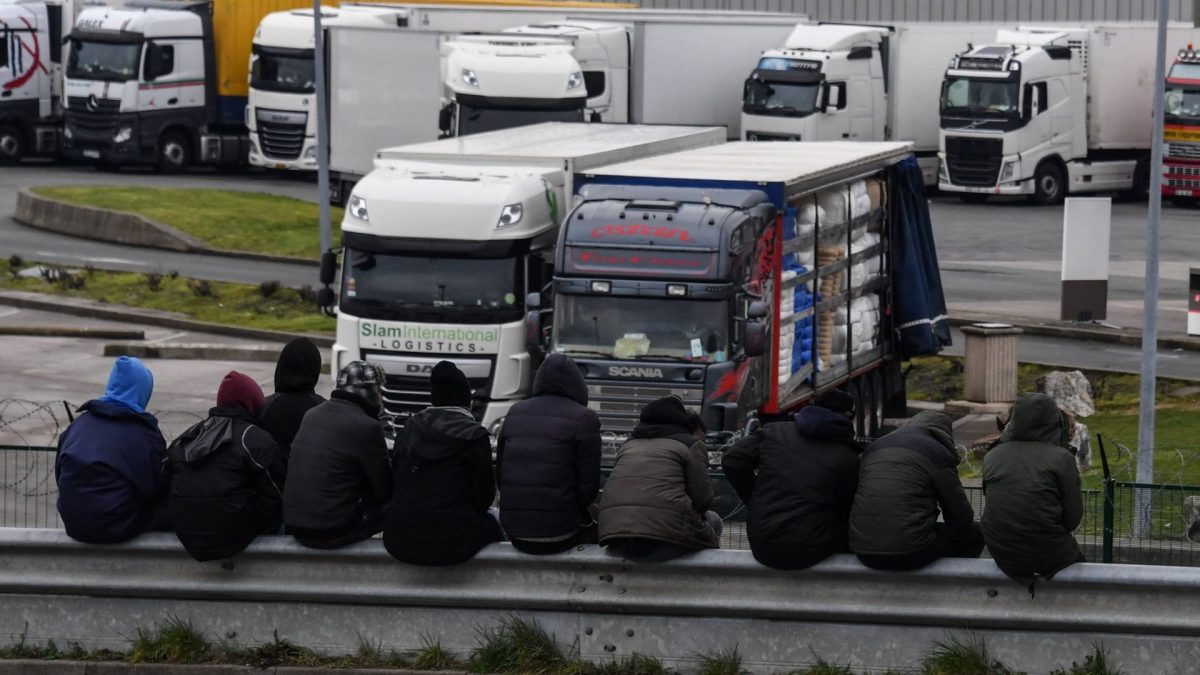
Under the cover of darkness, the two men huddled atop the motorway toll booth gantry outside Calais had a simple, if incredibly dangerous, plan. As a lorry bound for the UK slowed to pass through the toll booth, one of the men jumped and landed on the vehicle’s roof. But his companion was not so lucky, mistiming his leap and plunging more than 15 feet onto the hard asphalt below. The man, a 22-year-old migrant from Sudan, was rushed to intensive care but died from his injuries hours later. It was the third death of a migrant trying to stow away in a lorry in Calais so far this year. But the latest tragedy appears to have done little to deter others. Within hours of the unnamed man’s death on 30 August, three more Sudanese men were intercepted by French police trying to climb the same gantry at Le péage de Setques on the A26 motorway, around 25 miles south of Calais. Desperate tactics Experts and humanitarian groups say such desperate tactics are a consequence of the French and British governments’ recent crackdown on small boat crossings across the English Channel. Illegal arrivals by small boats this summer were at a six-year low, according to Home Office figures, with 6,949 migrants making the journey between June and August. In the first six months of this year there were 14,000 arrivals, 43 per cent fewer than the same period in 2025. Officials say this drop is the result of renewed French-Anglo co-operation, including £660m of UK funding for security operations in Calais and beyond. But it appears that the increased enforcement along the French coast is pushing migrants to seek alternative means of entering the UK, such as stowing away in lorries. One French law enforcement source told The i Paper that the incidents at Le péage de Setques were the first time they had seen migrants throwing themselves onto the roofs of moving vehicles. “This is a new level of risk taking – in effect, they are playing Russian roulette with their lives,” the official said. Old methods, new risks Of course, stowing away on lorry is not a new tactic for those trying to reach the UK. But after an influx of migrants via French ports and the Channel Tunnel a decade ago, security and detection at these entry points were massively ramped up – making it much more likely that stowaways would be caught before leaving France. It is widely accepted that this crackdown led to the rise in small boat crossings, which peaked at 46,000 arrivals in 2022. Smuggling gangs have adapted to recent enforcement efforts by launching so-called “mega-dinghies” – inflatables measuring 15m or more and capable of carrying in excess 200 people – further and further from the heavily policed coast around Calais and Dunkirk. But these crossings are less frequent, and more expensive. Migrants are now waiting months to make the attempt, while traffickers wanting to protect their profit margins have increased their price for reaching the English coast from an average of €1,300 (£1,100) to about €2,000 (£1,720) per person. A man carries children to a migrant dinghy to sail into the English Channel in Gravelines, France. This summer saw the lowest levels of crossings in six years. (Photo by Carl Court/Getty Images) Humanitarian groups says that those trying to reach the UK are taking increased risks in response to the latest crackdown. A spokesperson for Utopia 56, a group which helps migrants on the beaches and relays emergency calls, said: “While the dynamics of these crossings are changing, it is primarily their level of danger that is shifting. Attempts are becoming increasingly risky. “At sea, people are spending more and more time on the water as they set out from increasingly distant locations. On land, people with nothing left to lose are climbing into refrigerated trucks or, similarly, setting out from ever-more-distant starting points.” “This is due to the unsuitable response of the British and French governments by choosing repression rather than welcome.” The French law enforcement official did not want to draw a direct link between the toll booth incident and the security tactics being used for the beach departures. But this week, local officials reported an increase in the numbers of migrants approaching the Saint- Laurent motorway service station on the French-Belgian border, previously notorious for attempts to board lorries. ‘We will see further deaths’ In 2016, there more than 56,000 detections of illegal migrants at French ports. By 2023, this had fallen to 4,794 – but a 22.5 per cent jump to 5,874 in 2024 showed the problem has never fully gone away. In a report last year, the UK’s Independent Chief Inspector of Borders and Immigration said that the “threat of clandestine entry at the juxtaposed ports remains high and is unrelenting”. Experts said that migrants using lorries were often individuals whose asylum applications in the UK, or in the European Union, had previously been rejected and thereby needed to enter or re-enter Britain clandestinely. Mihnea Cuibus, a senior researcher at Oxford University’s Migration Observatory, said it was also generally accepted that when one means of illegal migration such as the small boats becomes restricted, those trying to enter a country or location will look for alternative routes. He said: “All that quite massive infrastructure around the tunnel and port at Calais is still there. So that might, to a certain extent, keep this diversion to a minimum. But it’s definitely something we’re going to see more and more of.” In January, the body of a Sudanese man was found on the outskirts of Calais after being crushed by the lorry he was trying to climb onto. Another man died in May in similar circumstances outside the Port of Calais. Campaigners fear that last week’s third tragedy will not be the last. One refugee worker said: “I think we will see further deaths on the lorries. The authorities have built a system where the only hope for people is to take terrible risks.” The Home Office and the Calais regional government were contacted for comment.
The deadly risks migrants are taking to evade small boats crackdown
Full Article
Original Source
Read the full article at Inews →KhanList aggregates and links to publicly available news content. We do not host full articles from third-party sources. Always verify important information with original sources.