
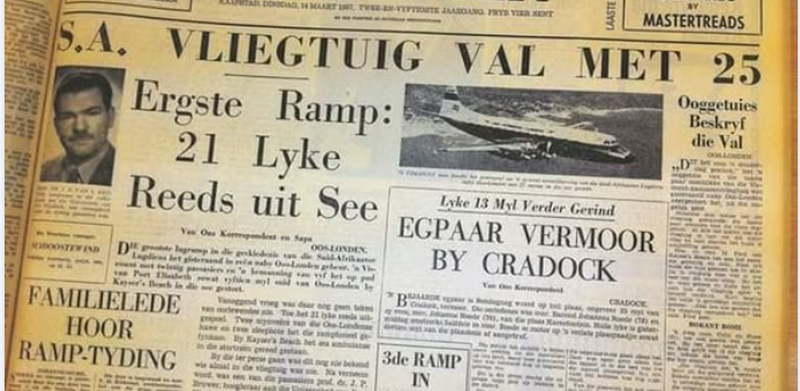
Apart from her father, said Lichter, now 70, testifying at the Khampepe Commission of Inquiry into post-Truth and Reconciliation Commission prosecution delays, on board was Professor Johannes Petrus van Schalkwyk Bruwer, a 52-year-old academic and acting chair of the secretive nationalist organisation the Afrikaner Broederbond.“The man who was wanting to change the history of this country was wiped out” [in the crash] and the history of South Africa “would have been very different if he had been successful”, she told the commission on Friday, 4 September.Lichter, representing the families of the crash victims, told the panel that she wanted to share their story of a state “cover-up” as well as investigations that had been influenced or halted. The Hendrik Verwoerd bust in Orania. (Photo: Marianne Thamm) Disillusioned Verwoerd adviserBarrydale-born Bruwer was friend, speechwriter and adviser on African affairs to former prime minister Hendrik Verwoerd. The academic had been working on a “five-year plan” for the country and had faced up to the reality of the inevitable failure of white, minority, Afrikaner nationalist rule. Years later, his son, Johan Bruwer, a subeditor with City Press, said his father had been a “deeply disillusioned” man when he boarded the Vickers Viscount Rietbok that afternoon en route to Johannesburg.Lichter told the commission that on the night of the crash the Bruwer family had been summoned to East London to identify Bruwer’s remains. His son had driven through the night only to be turned away at the mortuary with the claim that there had been “a mistake”. But a comment by officials saying “don’t worry, your father is not terribly injured or disfigured” had puzzled him, Lichter told the inquiry,Buwer’s wife, Cora, was given a payout the equivalent of R675,000 and had been threatened that she would lose her entitlement to pension or financial support if she insisted on investigating the crash. Lichter said that Bruwer’s children had grown up “carrying a heavy, traumatic sense of guilt”, believing that their father’s political work was the direct cause of the plane crash that killed so many other innocent people.Audrey Rosenthal: (Photo: Martin Legassick)Second targetWhile Bruwer might have been a target, so too was another passenger, Audrey Rosenthal, a US Citizen. Before boarding the plane, Rosenthal had criss-crossed South Africa for five weeks, gathering information for the banned Defence and Aid Fund for political prisoners and their families.Rosenthal had been recruited by her partner, Scottish-born South African Martin Legassick, a professor of history at the University of the Western Cape. After the crash, Lichter told the panel that the state’s “only thing of concern” was to find a briefcase Rosenthal had carried on board, while “finding the bodies was of no concern”.In 1998, the Mail & Guardian revealed that security policeman Donald Card, who later became mayor of East London, had claimed that his superiors were “obsessed” with the “American woman with the briefcase”.Missing bodiesLichter, a resident of Melbourne, Australia, told the commission that on the night of the crash on Monday, 13 March 1967, while families were huddled at Jan Smuts Airport (now OR Tambo International) awaiting updates, officials received a memo at 10pm confirming that the plane and 21 bodies had been located.Earlier in the day the multistop flight had taken off from Port Elizabeth at 16h58 in misty, overcast conditions. The plane lost altitude approaching East London and plunged into the ocean, killing all 25 people on board.State confirmation of these details, she added, was not shared with the families anxiously crammed into a waiting room that night and it ultimately took days for everyone to be officially notified that there were “no survivors”.Lichter said that later the official line was that the plane had not been found and that no bodies had been recovered. Because her father’s remains were never found the family have placed a memorial plaque on her grandmother’s grave in his memory.Evidence begins to surfaceIn 1998, Emlyn Brown, a filmmaker and underwater marine services expert, had become involved with the families of those who perished, and who had over the years amassed a significant amount of information about the Rietbok crash.He partnered with the families to make a presentation to the Truth and Reconciliation Commission, seeking a reopening of the investigation into the crash and the finding by Judge Cecil Margo that “pilot error” had been the cause.In March 2019, three articles were published in the Daily Dispatch detailing the cover-up. Shortly after, on 1 April, the families received an affidavit sent by lawyer Peter Hutson on behalf of a diver who had served on the naval minesweeper, the SAS Johannesburg.Divers that night, the commission heard, had successfully located the downed plane and recorded underwater video footage of the wreckage. While inside the vessel’s video room, the diver had personally witnessed the footage of the plane, which clearly showed passengers still strapped to their seats. After viewing this footage, the diving team had received a “severe dressing down” from superiors and were escorted to “an island” by an unnamed member of the Security Branch under strict security to ensure they would not speak about what they had seen.The affidavit also confirmed that Malcolm Vivier, a fellow diver on board the SAS Johannesburg, had previously tried to give evidence to the families’ association in 1998 but disappeared shortly after speaking out.2020 evidenceIn 2020, Eric Moss, another witness, came forward. Moss had been an able seaman stationed on the SAS Johannesburg and had become terrified of dying from Covid-19 and taking the truth of what he had witnessed with him.Moss provided additional corroborating details confirming that two naval minesweepers had been actively conducting search-and-rescue exercises for two weeks before the night of the crash. He said that because these were already trained and prepared – the minesweepers were deployed to search the crash site immediately on the night of the incident, locating the wreckage.Lichter said that despite the gravity of these 2019 and 2020 disclosures, the families’ attempts to submit this evidence to state bodies and heritage associations had been met with “silence and disdain”.A plea for truthIt has been 60 years since Lichter lost her father. She told the commission that her hope was for the Rietbok crash to be recognised as an apartheid-era crime and for the case to be referred to a dedicated prosecutor at the National Prosecuting Authority.While money could never fully compensate for the lives lost, she said, financial compensation for the victims’ families was needed and would be deeply appreciated, since many were left without their primary breadwinners and were severely traumatised. Lichter concluded her testimony with an emotional appeal, stating that after all this time the families asked “for nothing more than what we should have had from the beginning: the truth, full disclosure, and acknowledgment of the state’s failures”. She noted that “if reconciliation is to have meaning, it must be founded upon truth”. DM
Sabotage and Cover-up: Inquiry hears 1967 plane crash ‘wiped out’ man who could’ve altered SA history
Full Article
Original Source
Read the full article at Dailymaverick →KhanList aggregates and links to publicly available news content. We do not host full articles from third-party sources. Always verify important information with original sources.