
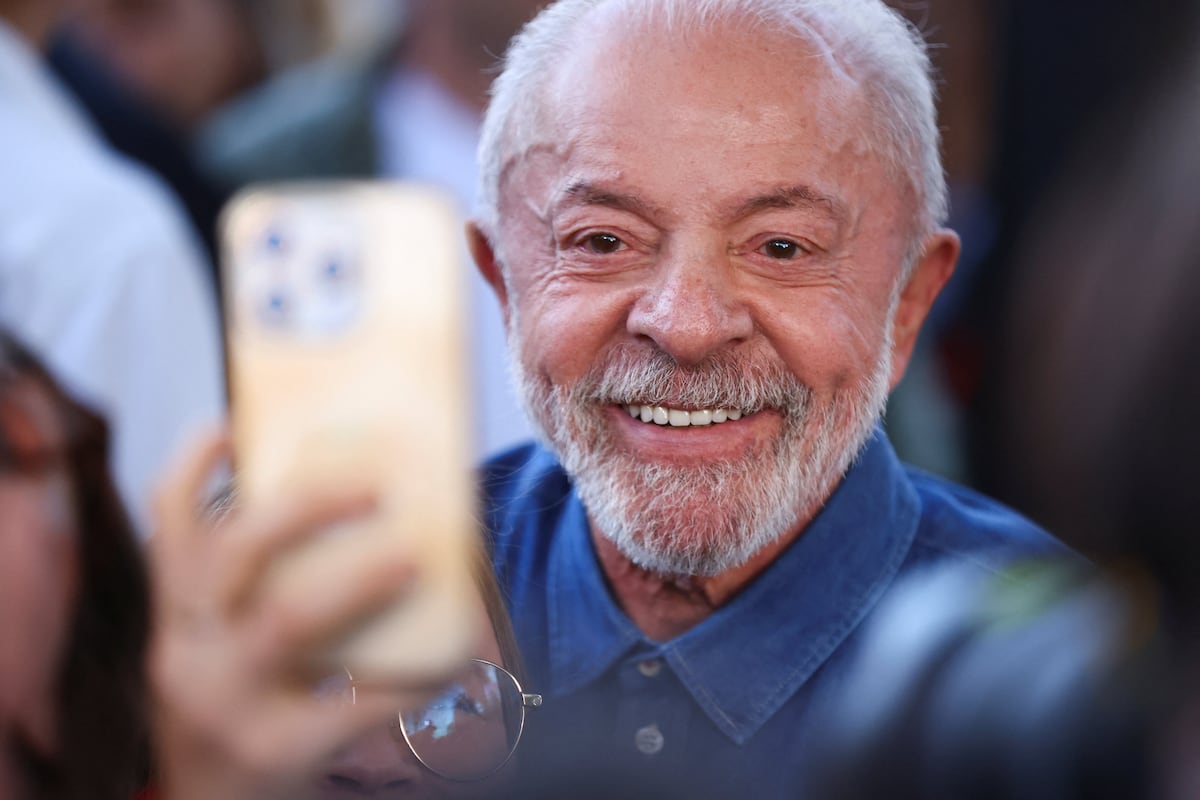
“I’m fed up with people going on about it. [My wife] Janja wakes up every day saying, ‘Come on, take a selfie.’” About to turn 81, Luiz Inácio Lula da Silva had never owned a cellphone and couldn’t quite understand the generation that lives with its finger glued to the screen. But his presidential election rival, Flávio Bolsonaro, had been speaking to Brazil with his phone in his hand for months and had just defeated him in the first round of the ballot. The incumbent president saw the writing on the wall, and just three days later, he took a symbolic yet decisive step toward his eventual victory. “I don’t like it. But today I decided to do it,” he announced on October 7.They used Janja’s phone. “We put it in his hand and taught him how to press the little button to start recording, although we had to help him because he couldn’t do everything at once,” says Pedro Rousseff, a 26-year-old elected representative and one of the driving forces behind the social media campaign that secured a fourth term for Brazil’s president. They even explained to him that he had to look at the camera. “Come on, everyone, let’s take to the streets,” said the president. On that morning of October 7, Lula changed the way he spoke to Brazilians forever.Less than three weeks later, Lula became the first candidate in Brazilian history to lose the first round and go on to win the election, with 51.7% of the vote versus Bolsonaro’s 48.2%.Between that first selfie and the victory on October 25, there was a shake-up, a meeting with young lawmakers, a WhatsApp channel whose following grew from 53,000 to 10.5 million, historic demonstrations, a standoff with the electoral tribunal and with Meta — which the courts ordered to treat posts from both candidates equally — and hundreds of Taylor Swift and BTS fan clubs campaigning on their behalf.Everyone who experienced that campaign from the inside agrees on one thing: if Lula hadn’t lost the first round, he would never have won the second. “If we had been two points ahead instead of two points behind, this wouldn’t have happened. It was a close call,” sums up one of the key figures behind this digital strategy, who prefers to remain anonymous.Lula’s team wasn’t prepared for that blow. In the days that followed, each of Bolsonaro’s posts averaged 448,000 interactions, while Lula’s averaged just 102,000, according to the consulting firm Bites. Not even the president’s social media accounts were managed by a single team; each was run by a different team. “The only place where the left lost was on social media,” Ana Elisa Santos, 21, the country’s youngest congresswoman, would say days later.For many of the young deputies and influencers who joined the campaign, the problem was not Lula but an old guard of the Workers’ Party (PT), mostly from São Paulo, that had for years shut them out. “For a long time the left treated digital communication as an extension of institutional communication,” says Bianca Borges, president of the National Student Union (UNE), who coordinated student mobilization nationwide after the first round. “The far right understood early on that social media are not just for broadcasting information, but for building identity, belonging, and mobilization.”Janja kept insisting, but the decisive push came from Rafael Fonteles, governor of Piauí, whom Lula put in charge of communications after the first round. Fonteles, 41, had long been recording videos for his voters and tried to persuade the president through his experience. It wasn’t enough. At one of those meetings, Lula protested: “You guys make me record, but the thing is, I like being around people.”Fonteles then asked him what the biggest rally of his life had been. Lula recalled the Diretas Já rally, when in 1984 more than 1.5 million people demanded direct elections in São Paulo at the end of the dictatorship. “You have 10 million people with you right now,” Fonteles told him. And Lula fell silent. “With that number he got it,” recalls Camila Jara, elected PT deputy for Mato Grosso do Sul, who was present in the room. Jara, 31, says she was elected thanks to her social media. Lula’s first selfie has already racked up 34 million views.In the social media core, they called those videos foguetinhos: little rockets. The team wrote about five scripts a day and Lula chose which ones to record. Two days later, Lula joked publicly that he was becoming “the king of the selfie.” The reach of his posts began to skyrocket.That afternoon of October 7, three days after the first-round defeat, the president had seated in front of him a generation that was far removed from his own — young people who had just won their seats. “For the first two years, Lula would look at me and have a hard time understanding that I was a congresswoman. He thought I was a member of the party’s youth wing,” jokes Jara, who has been a congresswoman since she was 26.One by one, they told him what had gone wrong. He himself admitted that it had been the least organized campaign he had participated in since 1989. Rousseff, the grandnephew of former president Dilma, recommended that he talk about what was worrying people: food prices, gas, rent, transportation, and safety. From that conversation, he says, came the phrase “Protection for workers; prison for criminals” — a slogan that serves as a counterpoint to the right wing’s successful motto, “bandido bom é bandido morto” (a good criminal is a dead criminal).Also with them was André Janones, the 42-year-old deputy from Minas Gerais who would become the general of the president’s digital army. That same October 7, Lula recorded a video with Janones inviting people to join the WhatsApp channel the deputy had created in April, which until then had been growing slowly. In Brazil the app is on 98% of smartphones and, in the most remote areas where the signal is not strong enough for Instagram or TikTok, it is often the only thing that works.Unintentionally, the electoral tribunal gave them another boost. On October 11, at the request of Flávio Bolsonaro’s campaign, the court president, Kassio Nunes Marques, ordered the channel suspended, accusing it of spreading false content, although the court’s technical unit ended up finding none. “It gave us more fuel,” Rousseff admits. “We rode that publicity.” And, already with three million followers, Janones showed up at the campaign headquarters and announced: “The army is now the army of President Lula’s campaign.” From then on, Lula would launch a little rocket in the morning and the channel would make the story explode for the rest of the day. Orders like not responding to attacks so as not to amplify them, watching his videos to the end, and all commenting and sharing at once tamed an algorithm that proved hostile to the left throughout the campaign.It was also Janones’ idea to reclaim the national team jersey, a symbol the right had appropriated, and he admitted to The New York Times that he resorted to half-truths. “The right lies shamelessly. It hits below the belt. Ideally you would hit above. I hit right on the line,” he said. He also said the belligerent tone made him uncomfortable, but that these were times of war. After the final debate, Janones led a 24-hour livestream until the eve of the vote that surpassed 21 million views.As Lula’s virtual army grew, the streets moved too. The day after the first round, students at the Federal Fluminense University were already calling assemblies. “Likes are not votes and followers are not activists,” Borges says. “There is no algorithm capable of replacing an organized society.” About 500 fan clubs for Taylor Swift, BTS, and Harry Styles put their accounts at the service of the campaign.Abstention fell and nearly three million more people voted than in the first round. But Jara issues a warning to her own party: “Lula was elected, but the government remains disapproved of by most of the population. It’s a clear message to the central leadership and to those around them.” Borges even points to the winning model itself: “Our response can’t be just learning to compete better with algorithms. We need to train not only digital armies, but a new generation of political protagonists.”On October 21, during a walk through Belo Horizonte, Lula picked up a phone and took a photo of himself amid the crowd. It was the image that Folha de S.Paulo, the country’s leading newspaper, had requested from both candidates for its election-day front page. By then, the selfie had become a symbol of the campaign, and there was no longer any need for someone to hold the phone for him. In the final days of campaigning, Lula wanted to share updates himself; he asked to see how the mobilization was going and wouldn’t leave Janones alone. Fonteles gave him two cellphones so he could choose one. And the president, who had never had a phone before, ended up keeping both.Sign up for our weekly newsletter to get more English-language news coverage from EL PAÍS USA Edition
The day Lula took his first 'selfie'
Full Article
Original Source
Read the full article at English →KhanList aggregates and links to publicly available news content. We do not host full articles from third-party sources. Always verify important information with original sources.