
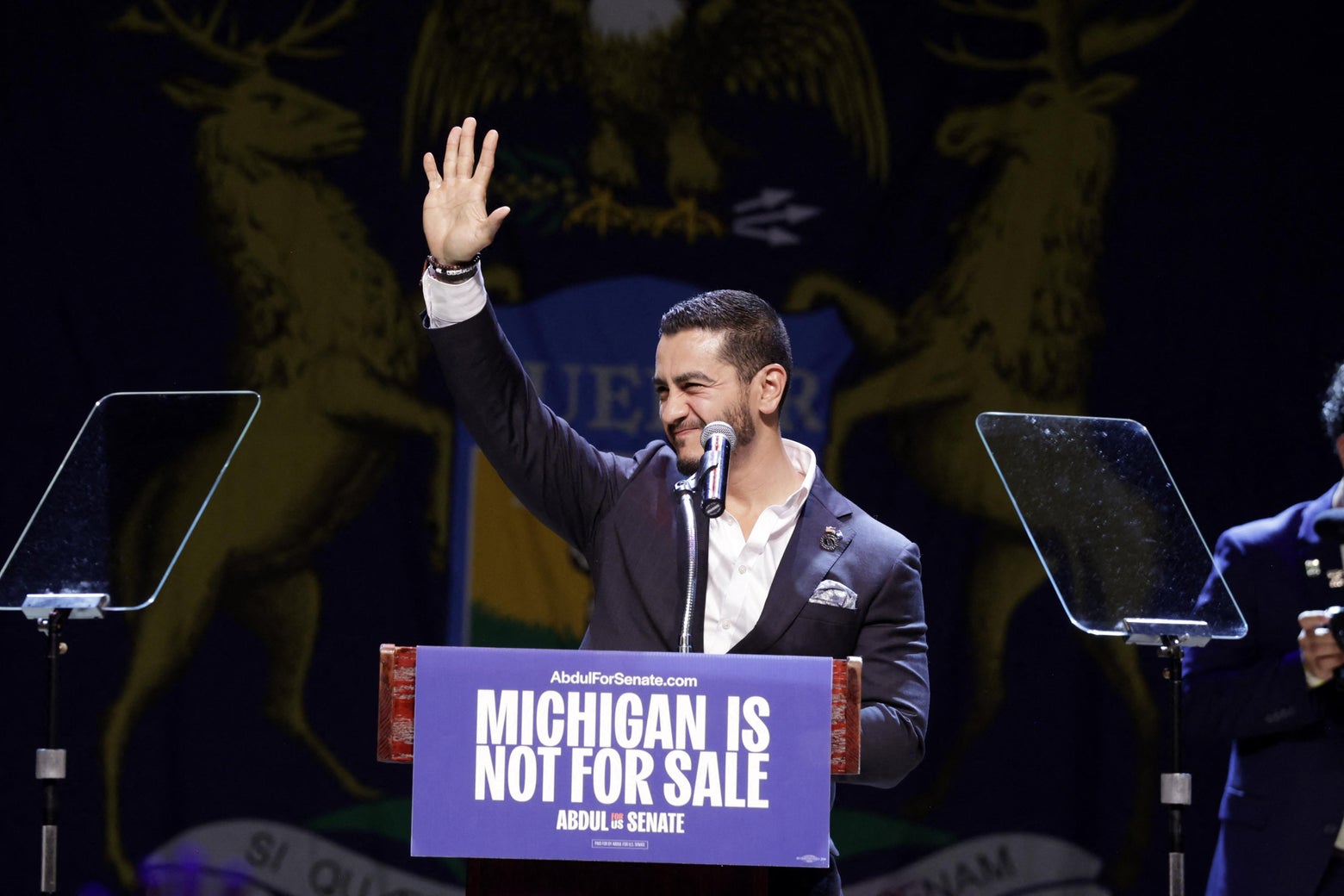
Politics For Progressives, a Massive Win in Michigan Is Only the Beginning As Abdul El-Sayed prevails in the Michigan Senate primary, it sends the Democratic Party a message for the midterms—and for 2028. Jeff Kowalsky/Getty Images Sign up for the Slatest to get the most insightful analysis, criticism, and advice out there, delivered to your inbox daily. Abdul El-Sayed, a public health official, narrowly defeated four-term Rep. Haley Stevens in the Michigan Democratic Senate primary. The vote proved too close to call on Tuesday evening, but by Wednesday morning, El-Sayed had claimed the win, and Stevens had phoned him to concede. The race was called by about 10 a.m. It’s a watershed moment in Democratic politics. No other recent instance of a left-wing insurgent defeating the Democratic establishment candidate in a swing-state Senate primary comes to mind. Stevens and her camp threw everything they had into the race. She enjoyed the support of both the Washington and Michigan Democratic establishments. Super PACs spent tens of millions of dollars, dwarfing the money spent on El-Sayed’s behalf, attempting to get Stevens across the finish line. But El-Sayed ably weaponized these resources against Stevens, making her financial superiority the core of his argument against her. And yet the victory comes with more of a whimper, given expectations heading into the night. Despite public and private polling showing double-digit leads for El-Sayed heading into the night, he defeated Stevens by just 1 percentage point. Stevens put up strong numbers in rural parts of the state to supplement her leads in metro Detroit, though that wasn’t quite enough to offset the margins El-Sayed posted in Grand Rapids and Ann Arbor. The closeness of the race only underscores one of El-Sayed’s challenges going ahead: reuniting a fractured party after a bitter primary campaign. This was not a resounding verdict. The most watched Senate primary in the country now becomes the most watched Senate election in the country, as El-Sayed will face former GOP Rep. Mike Rogers in November. The matchup gives the progressive movement that Sen. Bernie Sanders ignited 10 years ago a chance to try its case: that left-wing populism is just as, if not more, “electable” in a marquee toss-up election than the cautious moderation offered by the Democratic establishment. The stakes are high not just for the people of Michigan, or for the candidate who wins control of the Senate in the midterms. What happens in this state could color the Democratic presidential primary in 2028 too. The Michigan primary was a three-way race for most of its duration. State Sen. Mallory McMorrow, a rising star in the party with a history of viral speeches, positioned herself as a middle-ground option between Stevens’ institutional candidacy and El-Sayed’s fiery progressivism. It’s a strategy that often works better on paper than in reality. Finding the perfect position appeasing those on either side of an issue is exhausting work and prone to error. Eventually, Stevens consolidated establishment and centrist support, while El-Sayed consolidated progressives. McMorrow was squeezed out and quit the race in early July. That created a true left–vs.–center battle in the final month of the race, as Stevens worked to close El-Sayed’s polling lead. Stevens’ supportive super PACs—most notably the United Democracy Project, a group backed by the American Israel Public Affairs Committee—opened the spigots with both pro-Stevens and anti-El-Sayed television ads. El-Sayed, whose campaign wasn’t poor but couldn’t keep up with Stevens’, countered that the candidate was bought and paid for. The contest turned deeply nasty in the closing weeks. El-Sayed at one point had to direct his supporters not to mock Stevens in gross personal terms online. But El-Sayed, who does not lack confidence, didn’t always keep his tongue in check. He described Stevens as “a suit with a large AIPAC bank account” who can’t “string together two coherent sentences.” He called her the “least capable candidate in America.” Stevens wasn’t as personally hostile toward El-Sayed—his (attempted) destruction was largely outsourced to super PACs—but that last comment set her off. “Everyone in America understands you want to blame all of your problems on Jewish Americans,” Stevens posted in response to El-Sayed’s provocation. That post was one of many Stevens tells in the campaign’s final weeks demonstrating that she was the one trying to play catch-up. Neither Michigan Sen. Gary Peters nor Gov. Gretchen Whitmer—the latter Senate Minority Leader Chuck Schumer’s first attempted recruit for the Senate race—would have endorsed in the race unless they felt they had to. Stevens’ campaign, meanwhile, went all in on portraying El-Sayed as unelectable. El-Sayed, in the final week of the campaign, began to turn his attention to Mike Rogers. El-Sayed is eager to face Rogers, predicting, with characteristic moxie, that in the future, if “you say ‘Mike Rogers,’ it’ll be like: ‘Remember when Abdul just completely demolished that man’s political future?’ ” Well, it’s important to maintain a positive attitude. But Rogers and his allies will be taking on El-Sayed with a nine-figure assault, addressed to a more moderate electorate and without concern for maintaining a baseline level of cordiality. Much of the Democratic Party’s future depends on whether El-Sayed’s impressive speaking ability and quickness on his feet allow him to withstand the Rogers team’s onslaught. If a blue wave materializes in November but a Michigan Senate seat flips red—and helps the Senate stay Republican—the Democratic establishment might find it much easier to get its preferred candidates nominated the next time. But if El-Sayed can defeat Rogers, the appetite for new kinds of candidates will only spread further. We’re not just talking about Senate races either. El-Sayed’s ability to defeat the “unelectable” tag under such a bright spotlight could substantially affect whom Democrats nominate for president in 2028. Progressive leaders, eager to put one of their own atop the ticket after the Biden debacle and Harris loss in 2024, don’t just know this—they’re counting on it. In both 2016 and 2020, “electability” was a fatal blow to Sanders’ presidential campaigns, and any successor trying to fill his “lane” in 2028 would have to contend with the same issue. What an asset it would be for that candidate to be able to argue, They said the same thing in the biggest Senate race of 2026, and he won. And what a liability it would be if that candidate couldn’t. Get the best of news and politics Sign up for Slate's evening newsletter. Democrats Elections Michigan 2026 Midterms 2028 Campaign
The Country’s Most Watched Senate Primary Just Became the Country’s Most Watched Senate Race
Full Article
Original Source
Read the full article at Slate →KhanList aggregates and links to publicly available news content. We do not host full articles from third-party sources. Always verify important information with original sources.