
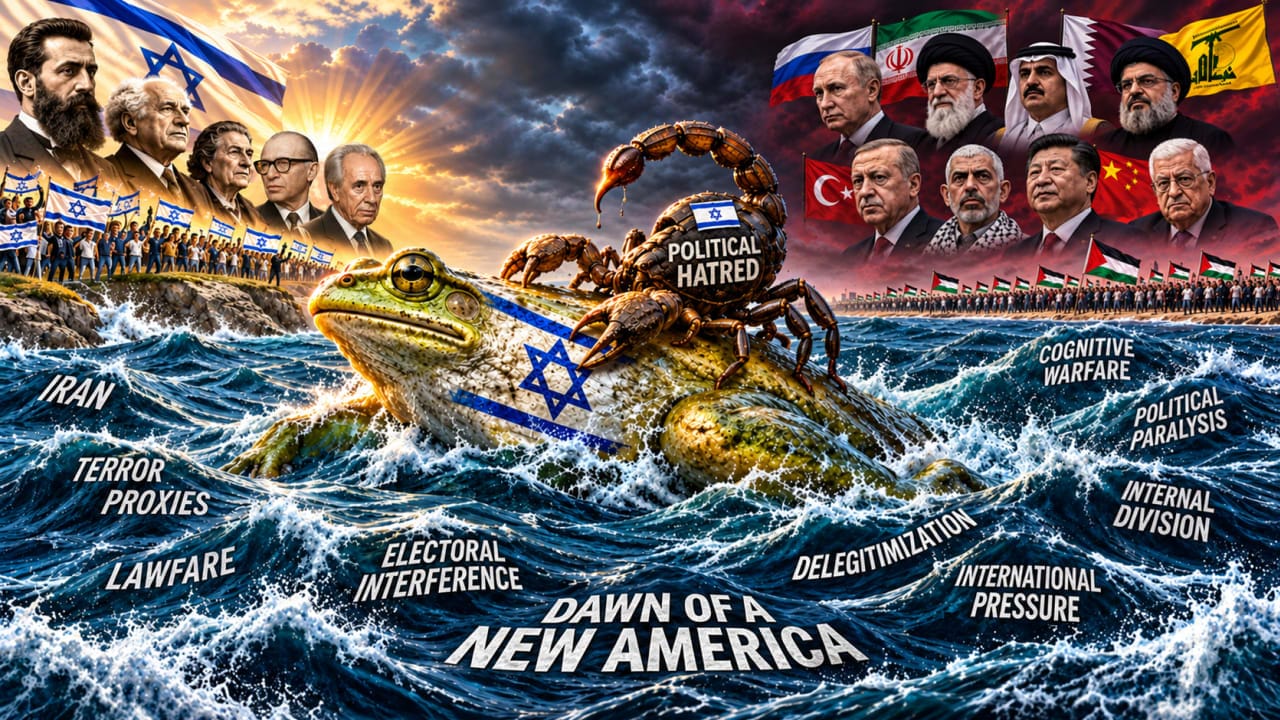
In the famous fable of the frog and the scorpion, the dying frog asks why the scorpion stung him, knowing they would both drown. The scorpion apologetically replies: “I’m sorry, but it’s in my nature.”Israel may have suffered a strategic defeat without a missile being fired, a border breached, or an enemy soldier crossing into our territory. Yet unlike previous national crises, we are becoming more divided instead of uniting against a common threat.The battlefield is our democracy. The weapons are fear, uncertainty, and doubt. The casualties may be our national cohesion, international credibility, and ultimately, our freedom to defend ourselves.Israel’s change bloc appears increasingly prepared to overlook the potentially existential consequences of suspected interference in our elections. Have we forgotten how our internal divisions before October 7 exposed vulnerabilities that our enemies exploited?Five 'change bloc' leaders meet in Yair Lapid's Tel Aviv home. (credit: Lihi Lapid)For some, removing Prime Minister Benjamin Netanyahu has become an overriding objective, regardless of the strategic price. Political hatred threatens to displace our collective responsibility for Israel’s survival.I am not advocating for Netanyahu. I am appealing for Israel’s future and for an end to the politics of hatred on all sides.For years, I have argued that Israel’s Eighth Front – cognitive warfare, delegitimization, lawfare, and the manipulation of public opinion – must be recognized as a national security priority, not relegated to the secondary status of hasbara (public diplomacy).The October 27 elections and what followed may demonstrate how costly that failure has become.We are asking the wrong questionThe debate surrounding suspected foreign interference in Israel’s elections has largely been reduced to a mathematical exercise: Did interference materially change the final allocation of Knesset seats and therefore demand a new election?That is dangerously shortsighted.The more consequential question is whether the controversy has undermined Israelis’ confidence in their democracy, intensified future internal hatred, and weakened our ability to confront enemies committed to our destruction.Psychological warfare has a name for this: FUD. Fear, uncertainty, and doubt.An adversary need not change an election’s outcome to achieve a strategic victory. Creating sufficient distrust in the electoral process, the institutions investigating it, and the government emerging from it can be devastating.Just do the mathLikud emerged as Israel’s largest party with 27 seats. Netanyahu’s right-wing bloc secured 53 seats, compared with 48 for the opposition parties generally aligned with Yashar head Gadi Eisenkot. Arab parties secured 19 seats.Those 19 seats could become decisive in determining who governs Israel, directly or through parliamentary support.The reports of trips to Qatar by leading Arab party leadership and the dramatic rise of Arab Israeli participation in the elections have raised many unanswered questions.Every Israeli citizen’s lawful vote carries equal democratic legitimacy. That is not the issue.The issue is whether foreign financing, illicit inducements, or other unlawful activities compromised the electoral process, and whether investigators have received sufficient authority, resources, and time.Fifty-three seats might not establish that half the electorate voted for Netanyahu. But they represent an enormous constituency whose confidence cannot simply be dismissed.When a substantial number of citizens suspect their institutions are failing to investigate credible evidence, the damage extends far beyond disputed ballots.Where there is smoke, investigate the fireReports of cash-filled envelopes, suspected vote-buying, and possible foreign financing demand serious examination. The Shin Bet (Israel Security Agency) has raised concerns about foreign influence operations.Justice Noam Sohlberg has called for a thorough investigation of serious suspicions involving foreign funding.These are not grounds to guarantee that the election was stolen. They are grounds to insist that certification does not resolve the broader national security threat.The confrontation involving Shin Bet director David Zini, Attorney-General Gali Baharav-Miara, and Sohlberg raises an urgent question: Why has Israel not established an investigative framework capable of following every credible lead while maintaining judicial oversight?In whose interest would it be for this investigation to be challenged or curtailed?If lawful investigative capabilities were available but not employed, the public deserves an explanation.Certifying an election and investigating hostile interference are separate responsibilities. One cannot substitute for the other.To minimize this controversy because nobody has demonstrated that five or 10 seats changed is to misunderstand cognitive warfare.Meanwhile, Washington has changedDemocrats have captured both chambers of Congress, fundamentally altering Israel’s political environment in Washington.Precisely when Israel needs bipartisan American understanding, our election controversy has become another confrontation over Netanyahu’s future.What an extraordinary missed opportunity.Israel could have explained to American lawmakers, particularly those familiar with Russian and/or Chinese election interference, that foreign penetration of democratic institutions is a shared threat.Instead, the international discussion risks becoming another argument over Netanyahu’s political survival.Congressional scrutiny of military assistance, arms transfers, settlements, and Palestinian statehood will now dramatically intensify. Israel could face renewed pressure to accept security compromises that a majority of Israelis consider intolerable after October 7.The possibility of another confrontation with Iran and its proxies makes this especially dangerous.Israel has demonstrated extraordinary capabilities on the kinetic battlefield. Yet military superiority offers limited protection when diplomatic isolation constrains national decision-making.An adversary that weakens our international legitimacy can diminish our strategic freedom without defeating our army.The scorpion’s natureReturn to the fable.The scorpion asks the frog to carry him across a river. The frog refuses, fearing the scorpion will sting him.The scorpion reasons that doing so would drown them both. Persuaded by this perfectly logical argument, the frog agrees.Halfway across, the scorpion stings him.As they begin sinking, the frog asks why.“It’s in my nature,” replies the scorpion.Israel’s political leaders should contemplate that answer carefully.Our society has reached a point where defeating Netanyahu, or defeating his opponents, can appear more important than preserving the national and international conditions necessary for either side to govern.Political hatred can become so ingrained that intelligent people pursue outcomes destructive to their own long-term interests.Consider how illogical it appears to be rejecting emergency political cooperation while Israel faces Iranian escalation, a changing Washington, and a crisis of democratic confidence.What if political victory itself produces strategic defeat?This is not an argument that everyone must embrace Netanyahu, Eisenkot, or Yair Lapid. Nor must anyone abandon political principles.It requires recognizing a national survival threshold: the minimum interoperability necessary to prevent our enemies from exploiting our divisions.Every political leader should answer one question: What short-term political advantage are you prepared to sacrifice today so Israel remains secure tomorrow?Before October 7, our internal divisions were visible to enemies who could interpret them as strategic weakness. We cannot afford to recreate those conditions.Our enemies need not invent our disagreements. They need only amplify them.The response must be immediate: a credible, adequately empowered, independently supervised investigation; transparent communication with Israel; and coordinated international engagement explaining why democratic resilience is inseparable from national security.Netanyahu and the opposition must stop treating the Eighth Front as somebody else’s responsibility.The danger is not simply losing another diplomatic argument. It is that the world could increasingly constrain our ability to defend ourselves while we remain consumed by political warfare at home.The scorpion’s sting does not distinguish between Right and Left.If Israel continues treating the Eighth Front as a public relations problem, we may discover too late that our enemies have already won an existential war we never properly recognized we were fighting.The writer is a global strategist and a strategic adviser at the Jerusalem Center for Security and Foreign Affairs. Follow him on X: @jeffkahn
The consequences of the nature of hate - opinion
Full Article
Original Source
Read the full article at Jpost →KhanList aggregates and links to publicly available news content. We do not host full articles from third-party sources. Always verify important information with original sources.