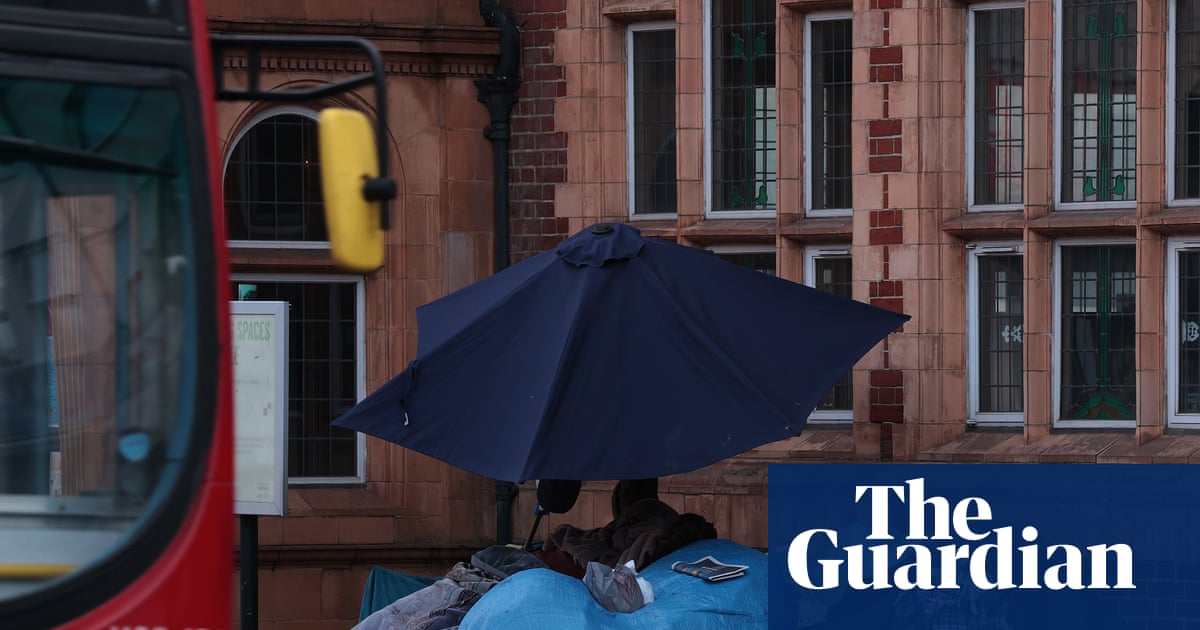
“You’ve just got to bear it. It’s like being in a hot country. It drains you,” said Tom*, a man in his 60s who has been homeless for a number of years. “I haven’t seen weather like this for as long as I’ve been outside.“I keep to my routines, but you need to find somewhere to sit down and rest. Either some cardboard outside or you find somewhere they’ll let you sit and sleep a bit inside,” he added.As the UK sweltered through its third heatwave of the year, the Guardian joined outreach workers as they tried to support some of the capital’s most vulnerable people. In his first speech as prime minister last week, Andy Burnham vowed to end rough sleeping in England “at the earliest opportunity”.“The city is not built for heat,” said Josie Ashdown, a lead manager at the homelessness charity Thames Reach. “You can feel that the concrete makes it hotter here than probably anywhere else in the country at points, and there’s hardly any tree cover.”As London endures repeated heatwaves fuelled by the climate crisis, outreach teams are offering extra support to those most at risk – handing out water, carrying out welfare checks and directing people to cool spaces. Scientists have estimated that the May and June heatwaves in England and Wales killed 2,700 people.“Outreach teams are working around the clock,” said Elle Slater, a service development manager at the homelessness charity St Mungo’s.Many of the tents beneath an underpass in London were empty when the Guardian visited. Their occupants had probably left in search of water, work or somewhere cooler, Ashdown said. But for the record numbers of people like Tom who are sleeping rough, escaping the heat is rarely straightforward.A homeless person sleeping in central London. Rough sleepers have spoken of the stigma of being visibly homeless. Photograph: Yui Mok/PADr Jennie Leggat, a former policy fellow at the University of Cambridge’s Centre for Science and Policy, said people sleeping rough were far more vulnerable to extreme heat than the general population. While their exposure to the elements was clear, she said the barriers to escaping the heat were often overlooked.“If you’re relying on begging to earn money, you don’t have much choice to leave,” said Leggat. “You have to sit outside, often in the sun and usually in hot urban environments.”Many long-term rough sleepers have chronic health conditions, including mobility and heart problems, which heighten their vulnerability to heat. Essential medication, such as insulin, is also difficult to store safely in hot weather.Slater said teams were carrying out increased welfare checks on people with existing conditions.Tom has a number of health problems and struggles to get around. The heat has only made it harder for him. “The bus is like a sauna even compared to outside,” he said. “I have to keep my legs in wraps due to the swelling from moving around and my age, but I’ve had to switch to stockings in this weather.”Often people have to carry all their belongings with them, including winter clothing they cannot safely store. Anneke Ziemen, a service manager for the Thames Reach rapid response team, recalled one man who was still dressed for cold weather during the heatwaves. “He said: ‘When winter comes, I need my clothes. I can’t have anyone steal them.’ It makes sense, but it’s also going to be 34 degrees and you are literally cooking yourself.”Ashdown said: “There have been a couple of people this year that we’ve got our eye on, in terms of whether they have the capacity to make decisions around the heat, because it makes people so much more vulnerable.”Andy Burnham promised to end rough sleeping in his first speech as PM. Photograph: Isabel Infantes/ReutersLast summer, Thames Reach had to arrange a Mental Health Act assessment for a man lying in direct sunlight under heavy layers. The team were concerned he did not understand the danger he was in due to the heat. “That’s happening a lot more than it used to,” added Ashdown.Many people encountered by outreach workers are frustrated by the lack of shelter during extreme heat. “You’re supposed to get people off the streets in weather like this,” one person said. “I can’t bear it.”In June, the mayor of London, Sadiq Khan, announced the Heat Ready London plan, which seeks to protect the capital from extreme heat. It includes expanding access to publicly available cooling spaces and free drinking water across the city.While councils have an established severe weather emergency protocol (SWEP) for cold conditions, the response to heat is less consistent. There is no single London-wide temperature trigger or mandatory level of support, leaving boroughs and outreach teams to interpret Greater London authority guidance according to local needs and resources.A mayor of London spokesperson said city hall and London councils had issued joint guidance to help boroughs and frontline services to support rough sleepers. “This is a collective effort involving councils, community organisations, health services and outreach providers,” the spokesperson said. “Our priority is making sure support reaches those who are most at risk.”A rough sleeper in south London. Many vulnerable people are trapped in hot urban environments in heatwaves. Photograph: Martin Godwin/The GuardianHowever, provision across boroughs remains uneven. One charity the Guardian spoke to described heat SWEP as “a bit of a postcode lottery”, with support such as access to temporary accommodation sometimes differing across boroughs.Even where help exists, those most vulnerable may struggle to access it.“I haven’t heard about the ‘cool places’,” said Tom. “I don’t go to places like that, as there can be issues with other people.”Leggat said stigma sometimes prevented access. “People who sleep rough may not be welcome in public spaces that could offer respite from the heat, whether that be due to having a pet in tow, having large bags that can’t be stored, or simply looking unkempt due to a lack of reliable access to showers and clean clothing.”“We need to consider the impact of climate change on homelessness,” said Francesca Albanese, the executive director of policy and social change at the homelessness charity Crisis, which estimates there are as many as 15,000 people rough sleeping in London over a year. “There is more severe weather in both directions, and we need to be equipped for that.”“Having mandatory SWEP provision across the capital and the rest of the country is the minimum,” she said, adding that emergency accommodation often lasts only a few nights before people return to the streets. “That is not sustained support.”Albanese called for more affordable homes in the long term, as well as better access to private renting and greater investment in Housing First. “Housing First is an internationally evidenced solution to ending homelessness,” she said. “We would be helping people with the most complex needs by giving them the support they need early on and preventively by placing them in a home with the right support.”Responding to Burnham’s promise, Crisis’s chief executive, Matt Downie, described the move as “a significant shift away from a series of expensive temporary fixes and towards a Housing First approach to homelessness”.In the meantime, the advice to the public – particularly during heatwaves – is to remain vigilant and use StreetLink to make a referral to a local charity if they see someone who may need help.“The problem is a systemic one,” said Zieman. “We see a spike in referrals every severe weather period, whether it’s 0 degrees or 35. But rough sleeping is not just a problem during severe weather. It’s year-round.”For Tom and many others, that reality includes the constant stigma of being visibly homeless. “People can tell or sense when you’re homeless. You hear people whispering about you, saying you’re homeless.”Yet he also experienced moments of kindness during the heatwaves. “I carry a big case around and people have been kinder in the hot weather, helping me get my luggage on and off the bus.”* Name has been changed
‘The city isn’t built for heat’: how extreme weather puts London’s rough sleepers at risk
Full Article
Original Source
Read the full article at Theguardian →KhanList aggregates and links to publicly available news content. We do not host full articles from third-party sources. Always verify important information with original sources.