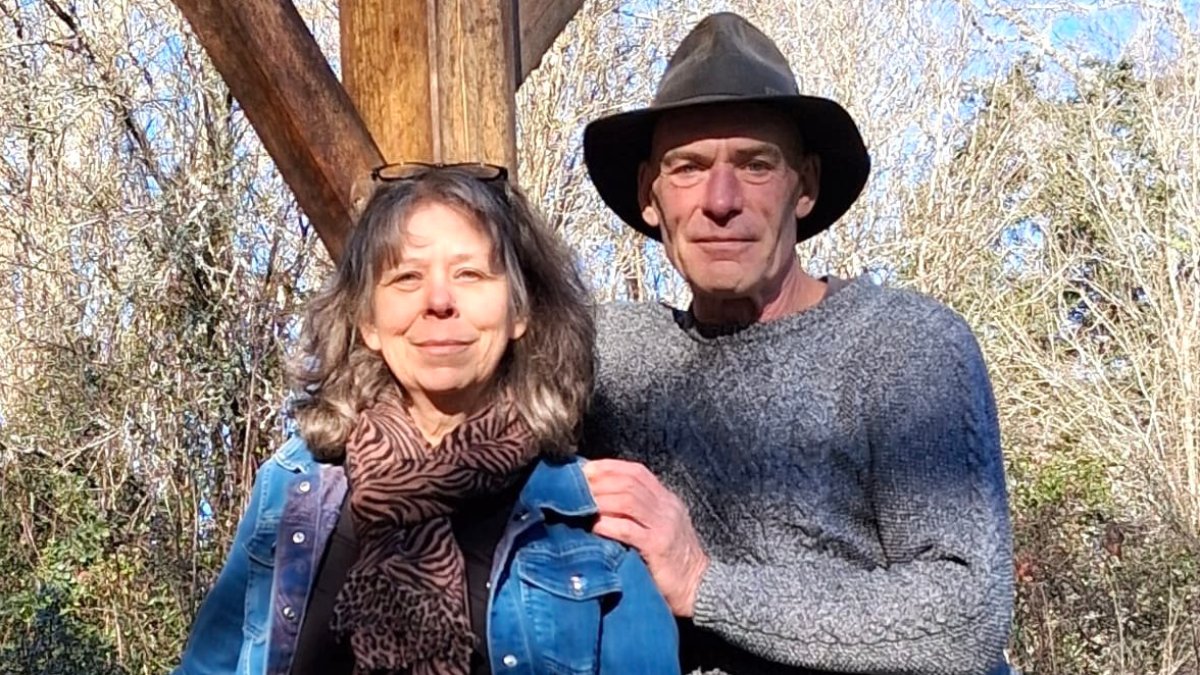
Around half a million people leave the UK to live abroad each year. A survey by the British Council showed 72 per cent of 18- to 30-year-olds would consider living and working overseas, with cold weather, the high cost of living, extortionate childcare, a lack of work-life balance and even poor romantic prospects among their motivations for leaving the country. The i Paper’s Expat Files follows Britons who have taken the leap and settled elsewhere, detailing the ups and downs of their journeys. As wildfires ravaged Bordeaux, on Sunday, clouds of smoke reached former chef Diane Kirkwood, 62, her carpenter husband Bob, 60, and their home 200km north-east of the blazing city, in a woody area in Dordogne. Originally from Chelmsford, the couple moved here 25 years ago and now run an off-grid forest retreat near the village of Piégut-Pluviers, renting wooden cabins to holidayers. Depending on how the wildfire situation evolves, they might consider changing the way their business runs to avoid the heat, but shutting in high peak summer would weigh on their finances. I woke up Sunday morning and the sun was eerily dark, like an eclipse. The sky was misty and hazy, it was totally foggy and it smelt of wood smoke. I was scared – that smell of burning wood would make anyone panic. Then I got a notification on my phone from the fire department saying not to worry, that there were no major fires currently in Dordogne. It was smoke drifting all the way up from Bordeaux. It smelt as if standing near a bonfire or a barbecue, though it wasn’t any hotter than usual, as the sun was slightly obscured. Shorts We are lucky to not be in the Bordeaux area, but I’m heartbroken for the people and animals affected over there. It has been one of the hottest years since we moved here. In back of my mind, I wonder if we will have to rethink our business – changing what time of year we start renting our cabins, perhaps closing for high peak summer months. We’ll have to see how it goes this year. Most of our income comes when people are on holiday in July and August, so it would really affect our earnings. We have apps we follow that monitor the forest fires in our location. We haven’t had anything too bad here so far, just a few little fires, and the long-range forecast said it’s going to be cooling down at the end of August. But you never know. We first came over in 2001, and bought our first house here on a bit of a whim. We were on holiday in this region and fell in love with the wooded valleys, wildflower meadows and lakes. We did the very British thing of peering into estate agents’ windows in amazement at the prices. We initially bought the place as a doer-upper, intending it to be a holiday home before eventually deciding to move here full-time. The house cost about £18,000. It was an old stone fermette (farmhouse) with a large, attached barn containing former pigsties, plus half a hectare of very overgrown pasture in a small hamlet near Busserolles. In the UK, a similar property would probably have cost around £500,000. One of the cabins Diane and Bob rent out in Dordogne We lived there happily for many years but we always dreamed of building our own home, which we later did. We didn’t dislike the UK, but we could never have afforded a country house there with land. Our previous lives were stressful and hectic – I was a chef, while my husband was a self-employed joiner and furniture maker. Before moving, we sold our home and paid off the mortgage. It wasn’t easy settling down in France, we had to start from scratch. It was challenging, but we’ve always liked adventures. Over time, we’ve bought three sections of woodland, each with its own private lake and a small cabin, to rent out. The cheapest cost €14,000 (£12,000) and the most expensive €32,000 (£27,400). All the cabins and our new house are at different locations but all about 5km to the nearest town, which is Piégut-Pluviers. And all within the regional park of Perigord-Limousin. We’re not retired. We work, maintaining and running the cabins, the land and the sawmill we have, which is for sawing up trees into useable timber like planks and beams for construction or furniture, mostly used by us. Our current home, where we’ve been since 2024, sits on half a hectare of land. It’s a wooded plot on the edge of a little hamlet of nine houses. We built it ourselves, from the foundations to the chimney. It’s an oak-framed house and, thanks to the sawmill, we processed all the timber we needed from our own or local trees. The couple built their oak-framed house themselves, from the foundations to the chimney, with timber from local trees We love living here. It’s mostly a rural area with forests but there are also towns and villages in-between. Our home and the cabins are surrounded by nature. There are a lot of trees around but luckily, the forests are different here to down there around Bordeaux, which are all pine trees – over here, we have very mixed wood which doesn’t burn so readily. Our cabins do suffer in these new soaring temperatures, though. We can’t really make it any colder. We don’t have any AC, as we don’t have much electricity – we have solar panels that only provide a very small amount of it, just for charging a phone, for example. We don’t have enough power to run machinery. There’s a lot of shade around the cabins where guests can find shelter during the day from the heat. There have been fires nearby in the past. Perhaps once before – last year – so it’s not unprecedented, but it was not as bad as the recent ones. Sunday’s certainly was the worst fire I’ve ever seen. We don’t regret moving here, or choosing to base our business in a forest. At the moment, we’re trying not to worry and think about worst-case scenarios. We are lucky, for now, but I can’t stop thinking about the poor victims of the fires, many of whom are now homeless. It’s awful.
The Bordeaux fires blotted out the sun – but I’ve no regrets about moving to France
Full Article
Original Source
Read the full article at Inews →KhanList aggregates and links to publicly available news content. We do not host full articles from third-party sources. Always verify important information with original sources.