
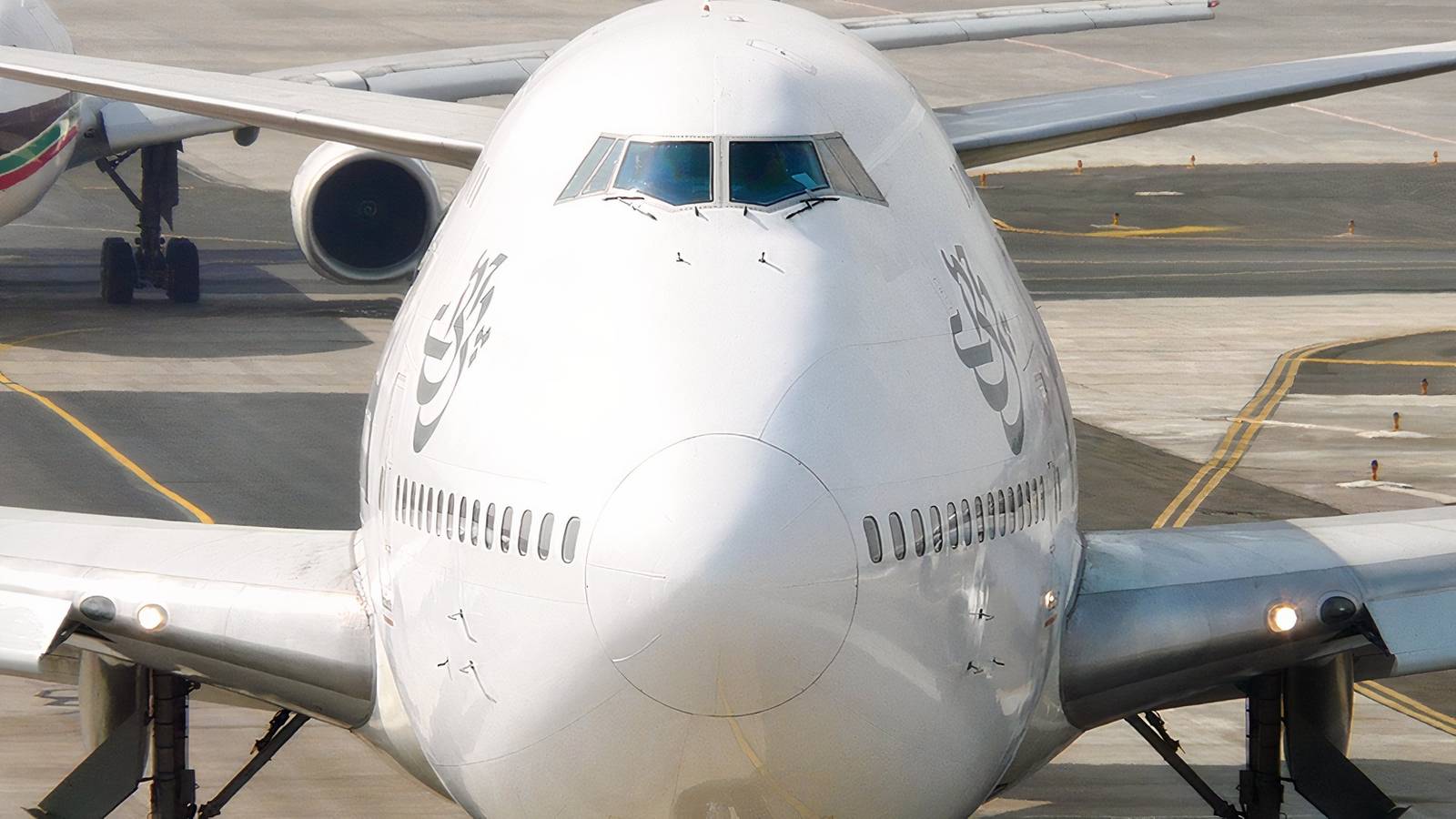
Published Nov 15, 2026, 8:00 PM EST Passionate about promoting aviation, the beauty of flight and the science behind it, Antonio is an avid reader of aviation magazines and books, and he loves visiting airshows all over the world, taking photos and writing about airplanes and helicopters as well. He is currently based in Palermo, Sicily. Imagine the most glamorous room ever built into an airliner: a spiral staircase curling up from first class, swivel armchairs, a bar, and one of the most coveted seats in the sky. Now think about Boeing’s engineers in 1965 refusing to plan a single passenger seat up there. The Boeing 747’s famous hump, the silhouette that came to define the jumbo jet, was not originally designed as a luxury perch. It was the consequence of a much more practical problem: how to build a passenger aircraft that could later carry freight through its nose. That decision would eventually create one of the most recognizable spaces in aviation history. The story runs through Boeing chief engineer Joe Sutter, Pan Am chairman Juan Trippe, a supersonic future that never arrived, and a hinged nose capable of swallowing cargo that still presents a problem for newer freighters. Follow those decisions in order, and the hump stops looking like an odd piece of styling. It becomes the visible result of Boeing preparing for a future that turned out very differently from the one it expected. Boeing Designed The 747 For A Future Dominated By Supersonic Travel Credit: Thiago B Trevisan | Shutterstock When Sutter’s team began shaping the 747 in 1965, Boeing was also pursuing a supersonic transport. According to Make Tech Easier, the company was preparing for a future in which high-paying long-haul passengers might move to faster aircraft. So, the new giant needed a second career, even though Pan Am had just committed to making it one of the world's biggest passenger aircraft. Pan Am chairman Juan Trippe shared that expectation. According to Smithsonian’s Air & Space Magazine, Trippe believed large subsonic jets would eventually become freighters once supersonic aircraft took over the most valuable passenger routes. Boeing was designing for one of its most important customers, so the fuselage was sized around two 8-foot-by-8-foot (2.4-by-2.4-meter) shipping containers side by side. The company’s own 2707 supersonic transport was eventually canceled in 1971 after design, environmental, and sonic-boom concerns. The hedge made sense at the time. The future was wrong. That created a very practical problem. A freighter could not rely on the same doors as a passenger aircraft if Boeing wanted it to carry large pieces of cargo. The nose was the obvious place for a loading door, but the cockpit occupied exactly that space. The solution was to move the pilots upstairs. The Raised 747 Cockpit Created Its Defining Cargo Advantage Credit: Ivan Cholakov | Shutterstock A conventional airliner puts its pilots in the nose, which is exactly the space a front-loading cargo door needs. Boeing solved the problem by lifting the flight deck above the main deck, leaving the nose free to swing upward on dedicated freighter versions. The hump was not an aerodynamic flourish. Smithsonian’s Air & Space Magazine traces it to the front-loading requirement, while Make Tech Easier notes that the upper deck resulted from moving the cockpit rather than an attempt to create a distinctive passenger cabin. The earliest passenger 747s did not even have noses that opened. The important point was architectural: Boeing had created an aircraft that could be converted into a highly capable freighter without moving the flight deck again. Lufthansa demonstrated how useful that arrangement could be when it began 747-200F freighter service in April 1972. The cargo advantage was substantial. As Make Tech Easier summarizes Boeing’s airport-planning data for the 747-400 Freighter, the nose door swings upward, allowing pallets or containers up to 40 feet (12.2 meters) long to be moved directly into the aircraft on motor-driven rollers. Factory-built freighters retain both a nose door and a side cargo door, while converted passenger 747s typically receive only a side door because adding a nose door requires major structural redesign. Moving the cockpit upstairs also left a pocket of fuselage behind it. Boeing had to decide what to do with that space, and the answer was much less glamorous than the 747 upper deck would eventually become. Boeing Originally Reserved The 747 Hump For Crew And Engineering Needs Credit: EQRoy|Shutterstock The space behind the raised cockpit was never an obvious luxury cabin waiting for airlines to discover. Trippe had originally wanted a full double-decker aircraft, but the Smithsonian’s Air & Space Magazine noted that Boeing studied a dual-deck design as early as 1965 and rejected it because the additional structure would have made the aircraft too heavy. What remained was a much smaller upper deck, created primarily by the decision to move the flight deck. Its first intended use was remarkably practical. According to Northwestern University’s 747 anniversary project, Boeing initially conceived the space as a rest area for flight crews, a sensible arrangement for an aircraft expected to spend many hours crossing oceans. Even the shape evolved from engineering, not luxury. Smithsonian’s Air & Space Magazine reported that the original hump began as a simple hemisphere, but it generated too much drag, so Boeing stretched the rear section into the teardrop profile that became instantly recognizable. The passenger lounge came later, and airlines transformed the space. Pan Am saw an opportunity to turn an otherwise utilitarian upper deck into something passengers would remember, beginning with the staircase that made the hump feel like a separate room rather than another section of the cabin. Within a few years, other airlines were experimenting with their own versions. The most unlikely part of the 747’s story was about to become its most famous. Airlines Turned The 747 Hump Into A Luxury Lounge Credit: Qantas Airlines quickly found a very different use for the space. In the early 1970s, Pan Am, TWA, and other carriers turned the upper deck into cocktail bars, restaurants, and social clubs, generally reserved for first-class passengers. Travelers climbed the narrow staircase into a cabin of swivel armchairs, hors d’oeuvres, premium drinks, and an atmosphere deliberately designed to feel more like an exclusive club that made you forget you were onboard an aircraft. The Pan Am Historical Foundation described the first widebody era as a return to cruise-ship-style travel, complete with a flying restaurant, bar, and lounge. The upper deck gave airlines something rare: a physical space they could use to make their branded part of the journey. The 747 was already enormous, but the staircase made passengers feel it contained a destination of its own. Other carriers pushed the idea in different directions. As reported by Executive Traveller, Pan Am promoted its upper deck as a restaurant in the sky, while United Airlines used the space as a cocktail lounge. Qantas named its version the Captain Cook Lounge, and Make Tech Easier notes that American Airlines even installed a piano bar. For a brief period, the hump had become one of the most glamorous spaces in commercial aviation. But that luxury came with a problem that had nothing to do with passenger experience. The upper deck occupied valuable space and weight that could instead be used to carry fare-paying passengers, and the economics of the 1970s were about to make that distinction impossible to ignore. The 1970s Fuel Crisis Ended The 747 Lounge Era Credit: Qantas The economics of the 747 changed faster than its reputation. The 1973 fuel crisis reportedly ended the lounge era, with virtually every 747 operator replacing the social spaces with passenger seats. British Airways even referred to the area as a “first-class lunge,” a typo that the magazine found oddly appropriate given how quickly the original lounge concept was disappearing. The irony was that the same upper deck that had once looked like wasted space could become extremely useful once airlines were willing to fill it with passengers. Boeing discovered just how much potential remained when it shortened the fuselage by 47 feet (14.3 meters) for the long-range 747SP. Engineers had to study what happened when the rear of the hump lined up with the front of the wing. There were no ill effects, opening the way for a much longer upper deck. The 747-300 subsequently arrived with an upper deck capable of seating up to 70 passengers, and later variants carried the idea forward. When the 747-8 Intercontinental entered service with Lufthansa in June 2012, it featured the longest passenger upper deck Boeing had ever built. Executive Traveller noted that the extra space allowed Lufthansa to add 10 more business-class seats upstairs, creating a cabin that still offered some of the private-jet feel associated with the original 747 lounge. The evolution was remarkable: a space created because Boeing had moved its pilots for cargo operations had become one of the most desirable places to sit on a passenger aircraft. Yet the cargo purpose behind the hump had never disappeared. The 747-8 Proved The Cargo Mission Outlasted The Luxury Era Credit: Harry Andresen | Shutterstock The later 747 variants made the upper deck more practical, but they also exposed how dramatically the market had changed. Boeing logged only 155 orders for the 747-8, with a vast majority going to the freighter service. The passenger lounge had evolved into a full cabin, but the original cargo logic had proved much more durable. That mattered because Boeing’s original assumption about supersonic travel had failed. The 747 was supposed to move into the cargo market after faster passenger aircraft took over long-haul routes. Instead, the jumbo became one of the defining passenger aircraft of the jet age, while Concorde remained a limited premium service rather than the mass-market replacement Boeing and Pan Am had anticipated. The freighter role, however, turned out to be the part of the insurance policy that really worked. On January 31, 2023, Boeing delivered the final 747, a 747-8 Freighter, to Atlas Air. It was the 1,574th jumbo built. The passenger 747 had already become a piece of aviation history. The freighter was still doing a job newer aircraft could not completely replicate.
The Boeing 747's Most Recognizable & Luxurious Feature Wasn't Originally Intended For Passengers
Full Article
Original Source
Read the full article at Simpleflying →KhanList aggregates and links to publicly available news content. We do not host full articles from third-party sources. Always verify important information with original sources.