
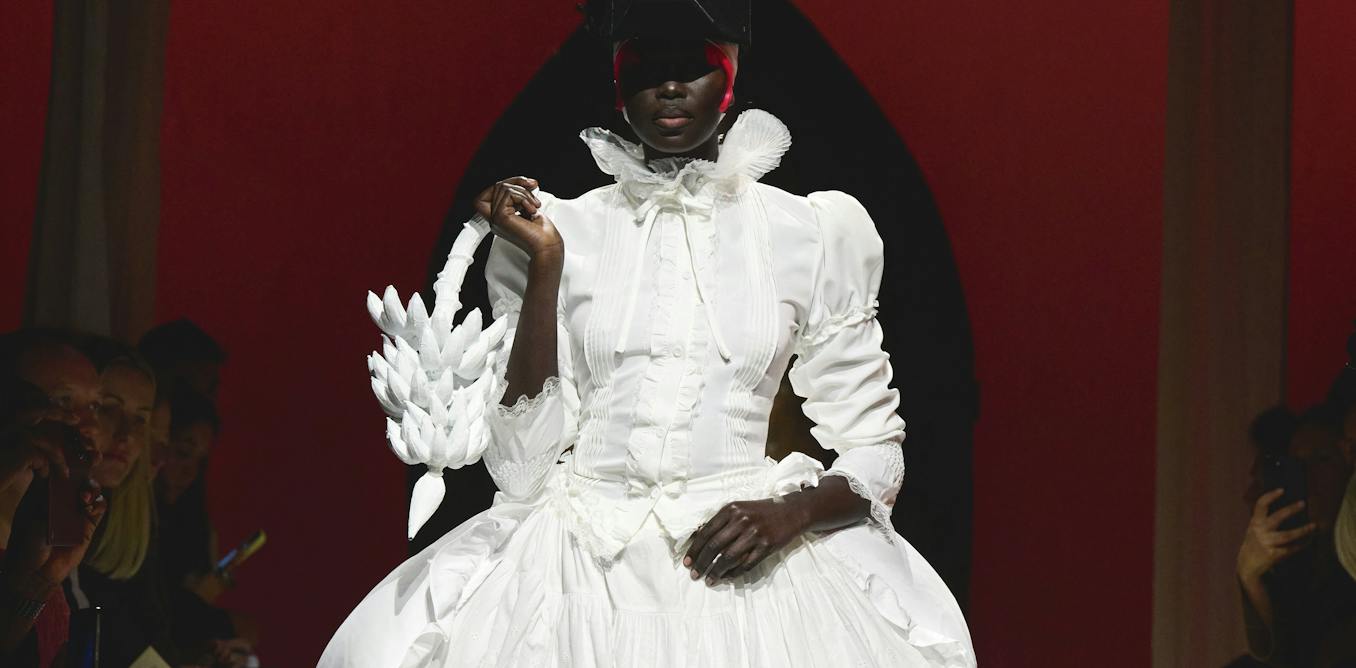
British fashion has always been shaped by creative exchange: forged inside melting pots, authored by radical style communities – and often fuelled by class and migration. Over the past decade, we’ve witnessed the distinct emergence of a new genre centred on the Black British experience. It has seen its designers drawing on their unique histories, the most prominent of which are Martine Rose, Priya Ahluwalia, Nicholas Daley, Bianca Saunders, Saul Nash and Grace Wales Bonner, with the latter appointed to lead Hermès menswear in 2025. British designer Grace Wales Bonner is head of menswear at Hermes. WIkipedia, CC BY The story is evolving. A new wave of talent is developing its own visual languages, challenging notions of Britishness and the expectation of what Black fashion design should look like. At London Fashion Week in September 2026, Francesca Lake presented Wake the Town, a spectacular exploration of Jamaican funeral traditions, nuanced dress forms and their cultural contradictions. Lake is developing an immersive design language that celebrates cultural memory and contemporary invention. The Jamaican-born, London-based designer is skilfully disrupting historical style notes to subvert ruffled lace crinolines and elaborate church headwear while purposing theatrical silhouettes into a distorted proposal of British identity. Joshua Ewusie, founder of E.W.USIE, is busy transforming everyday cultural references into luxurious and sophisticated fashion. His In Lieu of Flowers, spring/summer 2027 collection, draws on the domestic interiors of Ghanaian households, using contemporary and traditional crafts as a cultural bridge. Rising fashion star Tolu Coker is reimagining British tailoring through fusing her Nigerian heritage and her working-class upbringing in west London. Her February 2026 London Fashion Week presentation, which was attended by King Charles, took direct inspiration from the council estate where she grew up. The king’s presence was a significant moment of recognition for cultural value and Coker’s contribution to luxury fashion. Priya Ahluwalia spring/summer 2027. Priya Ahluwalia Elsewhere, debuting labels like are flourishing. NUB contemplates the convergence of heritage and metropolitan London life, while GOYAGOMA, founded by Traiceline Pratt, approaches womenswear through exploring identity, femininity and the everyday experiences of diasporic communities. Storytelling and cultural reportage have themselves become a form of luxury. But this “luxury” is no longer just about expensive fabrics or high-end logos – instead, the real desirability and prestige come from the meaningful stories, history and authentic cultural heritage woven into the clothes. At a time when immigration and national identity remain contested political questions, the work of these designers consolidates a vivid picture of modern Britain, shaped by overlapping cultures, communities and histories. Crucially, it offers a more expansive account of identity than political categories often allow. Beyond a single Black aesthetic History, experience and heritage remain central to storytelling. But designers are equally keen to debate how Black bodies should be dressed and understood. More established voices like Bianca Saunders have already reworked traditional menswear silhouettes, challenging uncomfortable and familiar ideas about gender. Saul Nash, also a choreographer and dancer, has assimilated technical sportswear with movement, helping to stage new expectations of masculinity – shaping a genderless, softer, fluid outcome. Nigerian-British designer Mowalola has been using a provocative design vocabulary to explore sexuality and popular culture with her distinctive use of leather, challenging gender expectations and respectable dress codes. Jamaican-born and Cayman Islands-raised Jawara Alleyne’s experimental garments challenge commonplace notions of Black male bodies and masculinity. Through draping, slashing, knotting and pinning, his assembled propositions offer a unique culture clash of Caribbean traditions and London’s punk histories. Like many of his contemporaries, Alleyne’s education was completed at Central Saint Martins. A 2019 graduate of University of the Arts London’s College of fashion, Abigail Ajobi uses luxury streetwear to engage with social issues, community empowerment and youth culture, intrinsically challenging the role of fashion and the runway. A generation shaping Britain’s style future Perhaps the most significant evolution is freedom to fearlessly author, build and create personal artistic worlds. Yaku Stapleton’s fantastical collections draw on family storytelling and creative character building influenced by video games. The designer imagines immersive environments which spawn playful, experimental clothing. Torishéju Dumi also transforms her tailoring through experimental construction, drawing on historical references and unconventional silhouettes. Her work reflects on her personal cultural heritage, but she does not position it as its central purpose. Ethiopian-born, London-based Feben approaches fashion through a surrealist lens, citing “form and matter” as merging contributors to distinctive textured and draped forms. Ronan McKenzie’s label, Selasi, works with the simple notion that women should “understand and listen to their own bodies” – and her cultural identity is embedded in the process. In 2023, I co-curated The Missing Thread at Somerset House in London, an exhibition that recovered overlooked contributions to British fashion. One was Joe Casely-Hayford’s, which was shaped partly through responses to political and societal changes; at the same time, he defined the first iteration of Black British identity in fashion. Today, this new generation is writing the next chapter while expanding into unexpected directions. Their work excels amid political tensions and arguments about immigration and belonging, but they are not necessarily presenting overt political statements. Being Black, or British, has never been a monolithic experience. Culture is not fixed – it is a continuously altered by its participants. It is a tapestry to be refined, deconstructed and repurposed for its own users. These trailblazing young designers bring a huge range of voices to British fashion, expanding its cultural imagination and redefining who has the authority to construct and create identity.
The Black designers redefining British fashion by drawing on their own heritage, culture and history
Full Article
Original Source
Read the full article at Theconversation →KhanList aggregates and links to publicly available news content. We do not host full articles from third-party sources. Always verify important information with original sources.