
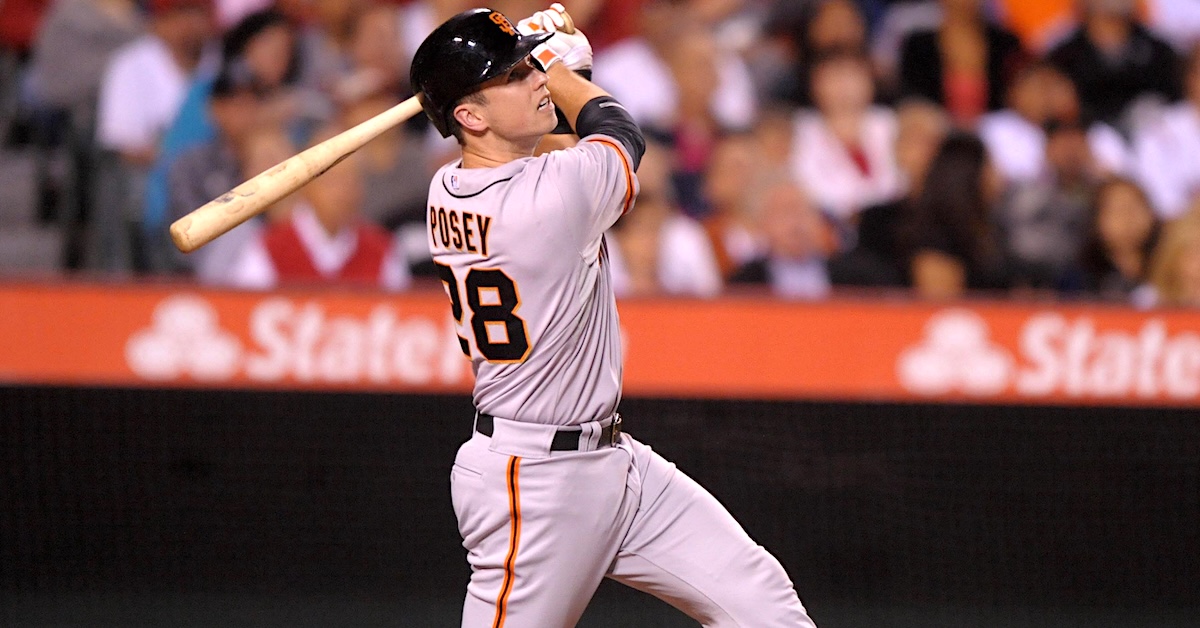
Kirby Lee/Image of Sport-USA TODAY Sports Not to take anything away from the elections of holdovers Carlos Beltrán and Andruw Jones, but last year’s BBWAA Hall of Fame ballot was a dud as far as first-year candidates were concerned. Where the 2024 and ’25 ballots each introduced a pair of newcomers who were elected in their first year of eligibility — Adrian Beltré and Joe Mauer in the former year, Ichiro Suzuki and CC Sabathia in the latter — none of the 12 first-year candidates on the ’26 ballot came close to election. What’s more, from that group only Cole Hamels even received enough votes to retain eligibility. This year’s ballot, which the Hall released on Monday, has one very strong candidate for first-year election in Buster Posey, but after that, particularly with four holdovers also elected over the past three years, the pickings are slim. Based on well-worn electoral patterns, only one returning candidate has a shot at reaching 75% this year. That’s my quick read on the new ballot, which contains 27 candidates (14 newcomers and 13 holdovers). Over the next six weeks, I’ll profile all of the candidates likely to wind up on voters’ ballots ahead of the December 31 deadline, with a handful of profiles — the “one-and-dones” — trickling into January. I’ll be examining their cases in light of my Jaffe WAR Score (JAWS) system, which I’ve used to break down Hall of Fame ballots as part of an annual tradition that’s old enough to drink. The series debuted at Baseball Prospectus (2004-12), then moved to SI.com (2013-18), which provided me an opportunity to go into greater depth on each candidate. In 2018, I brought the series to FanGraphs, where my coverage has become even more expansive. Today I’ll offer a quick look at the biggest questions attached to this year’s election cycle, but first… The Basics To be eligible for election to the Hall of Fame via the BBWAA ballot, a candidate must have played in the majors for parts of 10 years (one game is sufficient to be counted as a year in this context), have been out of the majors for five years (the minors or foreign leagues don’t count against that), and then have been nominated by two members of the BBWAA’s six-member screening committee. Since the balloting is titled with respect to induction year, not the year of release, that means that this year’s newcomers last appeared in the majors in 2021. Each new candidate has 10 years of eligibility on the ballot, a reduction from the 15-year period that was in effect for several decades. The last candidate grandfathered into getting the full 15 years was Lee Smith, whose eligibility expired in 2017, while the last to have his eligibility window truncated mid-candidacy was Jeff Kent, who fell off after the 2023 cycle. To be elected, a candidate must receive at least 75% of the ballots cast, and in this case, they don’t round up; 74.9% won’t cut it. Likewise, candidates who don’t receive at least 5% fall off the ballot and can then only be considered for election by the Contemporary Baseball Era Committee — but not until what would have been their 10-year run of eligibility expires. The voters, each of whom has been an active BBWAA member for at least 10 years and is no more than 10 years removed from active coverage, can select as many as 10 candidates on their ballots, a number that became a point of contention over a decade ago given the high volume of qualified candidates. In 2015, the Hall tabled a BBWAA proposal to expand the ballot to 12 slots (I was on the committee that recommended the change). Last year was the 11th since the Hall purged the rolls of voters more than 10 years removed from coverage, and the first in which MLB.com writers and editors became eligible thanks to the BBWAA’s 2015 decision to admit them. The total of 425 ballots cast — including the first ones of colleagues Dan Szymborski and Jeff Zimmerman — was the highest since 2019, up from 394 in ’25 and 385 in ’24; that latter total was the fewest of any cycle since 1983. Ballots must be postmarked by December 31 (yes, the BBWAA still does this by mail). Voters may reveal their ballots prior to the announcement, as 58% did last year. You can track the reported ballots using the Ballot Tracker, and if you’re looking to follow along with the Tracker as ballots are revealed, you can follow Ryan Thibodaux and his diligent and insightful crew on Bluesky. Voters can also check a box on the ballot to authorize the publication of their choices on the BBWAA’s website two weeks after the election results are revealed. Between BBWAA.com and the Tracker, 85.9% of voters revealed their ballots in 2026, the highest share ever. I’ll be revealing my own ballot here at FanGraphs a few days before the deadline, taking readers through my thought process as I explain which boxes I’ll be checking. This will be my seventh year as a voter — holy cow! — and no, the novelty hasn’t worn off. For those who want to play along at home, registered FanGraphs users will be able to participate in our crowdsource ballot, which we will post soon. The election results will be announced live on MLB Network at 6 p.m. ET on January 19. Any players elected will join any honorees elected via the Contemporary Baseball Managers/Umpires/Executives ballot, whose results will be announced on December 6, for the Induction Ceremony scheduled for July 25, 2027 on the grounds of the Clark Sports Center in Cooperstown, New York. Are you going to tell us who’s actually on the ballot? Hold your baserunners, I’m getting to it. The 14 newcomers are noted in italics: The ballot: Bobby Abreu, Jake Arrieta, Jay Bruce, Mark Buehrle, Asdrúbal Cabrera, Starlin Castro, Wade Davis, Brett Gardner, Cole Hamels, Félix Hernández, Torii Hunter, Jon Lester, Andrew Miller, Dustin Pedroia, Andy Pettitte, Buster Posey, Alex Rodriguez, Francisco Rodríguez, Jimmy Rollins, Pablo Sandoval, Ervin Santana, Kyle Seager, Joakim Soria, Chase Utley, Omar Vizquel, David Wright, and Ryan Zimmerman. Who are the best newcomers? By far the best is Posey. His sudden retirement at age 34, after his strongest offensive performance in at least half a decade, left him with just 1,500 career hits, but his seven All-Star appearances, three championships, MVP, Rookie of the Year, and Gold Glove awards, and 129 OPS+ make for a full enough résumé for Cooperstown. The only thing missing from his career was the unpleasant breakdown phase, the years of declining with the bat while Father Time caught up to him. By traditional JAWS, he ranks 14th at the position with 40.8 points, 3.5 below the standard, but his peak total of 36.5 WAR — his best seven seasons — ranks 10th, 1.6 WAR above the standard, and that’s without considering the impact of his elite pitch framing, data that I strongly believe voters shouldn’t ignore. Posey ranks seventh in our framing metric (based on data for the 2008–26 period) with 128.8 runs, 22.3 behind 2028 candidate Yadier Molina, who caught 44% more innings in that timeframe, and about 37 runs behind both Russell Martin and Brian McCann, who respectively caught 20% and 17% more innings in that span. He’s a close sixth in Baseball Prospectus’ framing metric, which stretches back to the dawn of the pitch-count era (1988) despite the innings counts of Martin/McCann/Molina being even higher as the starts of their careers predated his. Years ago, using BP’s numbers to cover the 1988–2007 period and ours for the 2008–26 period, I cobbled together a framing-inclusive JAWS, using fWAR (because it incorporates that data) instead of bWAR for both career and seven-year peak totals. By those numbers, Posey ranks third, behind only a pair of Hall of Famers whose careers began in the 1990s, both of whom had much longer careers: FanGraphs Framing-Inclusive JAWS for Catchers # Player Career WAR FG FRM BP Fram WAR Adj frWAR frPeak frJAWS 1 Mike Piazza 1992-2007 62.5 — 93.2 9.0 71.5 52.4 62.0 2 Ivan Rodriguez 1991-2011 68.4 2.9 -16.0 -1.6 66.7 40.1 53.4 3 Buster Posey 2009-2021 57.9 128.8 — — 57.9 47.7 52.8 4 Joe Mauer 2004-2018 53.5 27.6 43.7 4.3 57.8 42.7 50.3 5 Russell Martin 2006-2019 54.5 165.7 47.7 4.6 59.1 40.8 49.9 6 Yadier Molina 2004-2022 55.6 151.1 37.6 3.7 59.3 37.6 48.5 7 Brian McCann 2005-2019 52.2 165.6 -15.6 -1.5 50.7 37.2 44.0 8 J.T. Realmuto 2014-2026 37.2 -33.0 — — 37.2 30.7 39.0 9 Yasmani Grandal 2012-2024 40.0 152.0 — — 40.0 33.5 36.8 10 Jonathan Lucroy 2010-2021 35.2 133.2 — — 35.2 35.0 35.1 11 Jorge Posada 1995-2011 40.9 -43.9 -69.5 -6.7 34.1 29.1 31.6 FG FRM = FanGraphs framing runs for 2008 onward, now included in WAR. BP Fram = framing runs from 1988-2007 via Baseball Prospectus. WAR Adj = BP framing runs converted to FanGraphs WAR. frWAR, frPeak, frJAWS = FanGraphs WAR-based career/peak/JAWS, adjusted to include BP framing runs for pre-2008. Despite the brevity of Posey’s career, I think he has a real shot at joining Johnny Bench, Rodriguez, and Mauer as the only catchers elected by the writers on the first ballot. (Yes, it’s a ridiculously short list.) Beyond Posey, the most interesting newcomer is Lester, who went 200-117 with a 3.66 ERA (117 ERA+) and 2,488 strikeouts in his 16-year career. He was particularly impressive in the postseason; beyond a 9-7 record, he posted a 2.51 ERA in 154 innings, and went 4-1 with a 1.77 ERA in 35 2/3 World Series innings while helping the 2007 and ’13 Red Sox and ’16 Cubs win it all. Those numbers and that reputation cast Lester as a shorter-career version of Pettitte, who went 256-153 with a 3.85 ERA (117 ERA+) and 2,448 strikeouts during his 18-year career, and who received 48.5% of the vote in his eighth year of eligibility. However, the 576-inning gap between the two lefties really matters. Lester racked up just 43.4 WAR in his career to Pettitte’s 60.2; their seven-year peaks are virtually identical (just over 34 WAR for both), so Pettite has the edge in S-JAWS, 47.2 to 38.8. Hammels, Buehrle, and Pettitte are all within one point of each other in S-JAWS, and Hernández is just about three points behind Pettitte. Lester being further below Hernández than King Félix is below the other three makes it hard to consider him as part of the same cluster. I suspect he’ll likely get enough votes to retain eligibility and remain in the ongoing discussion about evolving starting pitching standards, but he’s not going to rocket toward 75%. Does anyone else stand out to you among the newcomers? In the sense that they’re players who took home some significant awards or had other accomplishments of note, yes. Arietta is a former Cy Young winner who, like Lester, played a key role in ending the Cubs’ 108-year championship drought. A Giants fan favorite, Sandoval was the MVP of the 2012 World Series and a key player on San Francisco’s team that won two years later as well. (He was also on the 2010 champs but played sparingly in the postseason.) Miller was the 2016 ALCS MVP — I just wrote about his remarkable 16-inning postseason scoreless streak a few weeks ago — and won the 2015 Mariano Rivera AL Reliever of the Year award. So is this the weakest ballot ever? I had to address this question last year as well, and the answer is that even with the arrival of Posey, yes, this one is weaker. The primary way I track ballot strength is by counting how many candidates meet or exceed the JAWS standard at their position, and how many have a JAWS of at least 50.0 (40.0 for catcher). The totals here are two for the former (A-Rod and Utley) and four for the latter (Abreu and Posey are the others), down from last year’s revised totals of three above the standard and six above 50.0. Why revised? The election of Kent (45.6 JAWS) on the 2026 Contemporary Baseball ballot was enough to nudge the JAWS standard at second base down from 57.0 to 56.6, meaning that Utley (56.9) suddenly counted within that group; the difference is negligible in a qualitative sense, but for accounting purposes, I don’t round up. Hence the second count, which I believe to be a better big-picture approximation of ballot quality. You have to go all the way back to 1988 to find the last time a ballot had two or fewer candidates who met the JAWS standard; that year, only Ron Santo did so, but he received just 25.3% of the vote while first-year candidate Willie Stargell, who didn’t even reach 50.0 JAWS (47.3), was the only one elected. The last time there were four or fewer candidates who reached the 50.0 JAWS cutoff was 2006 (Bert Blyleven, Alan Trammell, and Rich Gossage, whom I counted since he also exceeded the old standard for relievers). None of them was elected; instead, Bruce Sutter was the only one, which at least paved the way for the Goose to be honored two years later. Here’s an overview of the ballots from the past 51 cycles: Another way to measure ballot strength is by how many first-year candidates receive the 5% required to remain eligible. In that regard, last year’s ballot was the first since 2012 with just one. The only newcomer who advanced that year was Bernie Williams, who received 9.6% and lasted just one more year. The 2008 ballot also produced only one holdover in Tim Raines (24.3%), but at least he went on to be elected. For all of that, this bears repeating: Even if this isn’t a strong ballot, the candidates on it all had impressive careers, and the checkbox next to their names — and the attendant recognition that comes with their presence in this cycle — is itself an honor. I’ll be taking deep dives into all of their careers; some of my favorite profiles to write are of the one-and-done guys, and I know readers enjoy those as well. Do any holdovers have a chance to get elected this year? With last year’s elections of Beltrán in his fourth year of eligibility and Jones in his ninth, just one returning candidate received at least 50%, namely Utley (59.1% in his third year). While we’ve seen jumps to election in the vicinity of 16 points before, those have usually had some final-year urgency attached to them; Larry Walker leapt from 54.6% in 2019 to 76.6% in ’20, his 10th and final year on the ballot, and Ralph Kiner went from 58.9% in 1974 to 75.4% in ’75. Utley isn’t facing that kind of finality to his bid. There is some urgency attached to Pettitte, who gained 20.6 percentage points to rocket to 48.5% in his eighth year. Leaving aside the possible drag on his trajectory because of his admission of HGH use in the pre-testing era, he’s 14 points ahead of where Walker was after year eight, but realistically he probably needs to get into the low 60s to have a solid chance of election next year. How about those PED guys? Nothing’s changed, in that nobody suspended by Major League Baseball either for testing positive or incurring a non-analytic positive (i.e., being identified as a user via a league investigation such as Biogenesis) since testing began in 2004 has been elected. Manny Ramirez fell off the ballot after receiving 38.3% in his 10th year, while A-Rod received 40%, a gain of 2.9 points, in his fifth year. Ryan Braun fell off after receiving just 3.5% in his first year. None of the newcomers was ever suspended for PEDs, though Castro was suspended 30 games for violating the league’s domestic violence policy. He’s not the first candidate to run afoul of the policy, instituted in 2015, as Jose Reyes appeared on the 2024 ballot. Are there any down-ballot candidates worth keeping eyes on? Pettite, Hernandez (up from 20.6% to 46.1%), Buehrle (from 11.4% to 20%) and Hamels (23.8% in his debut) are riding some momentum with regards to the ongoing conversation about starting pitcher standards. Beyond them, Pedroia and Rollins could continue to benefit from Utley’s coattails. Pedroia is 20th in JAWS among second basemen, eight spots and 10.5 points below Utley in a career that was more than 1,000 plate appearances shorter, but he does have hardware (MVP and Rookie of the Year awards, plus four Gold Gloves) that Utley lacks. He also started for two World Series winners to Utley’s one. He jumped 8.8 points to 20.7% on the 2026 ballot. Rollins, Utley’s double play partner, is just 35th in JAWS, 15.2 points below the standard, but he’s got an MVP and four Gold Gloves along with counting stats that are well beyond those of his former teammate. He climbed 7.4 points to 25.4% on the 2026 ballot. Did anybody of note get left off the ballot? Inevitably, some candidates who meet the basic requirements aren’t included on the ballot, and if you’re using WAR as a guide, it can look rather arbitrary with regards to who’s on and who’s off. Todd Frazier, the 2015 Home Run Derby champion, has the highest WAR of any qualified player not included (25.8), and a couple others missed the cut between him and the position player with the lowest total, Castro (18.2), namely Josh Reddick (25.0) and Dexter Fowler (19.2). On the pitching side, Scott Kazmir (22.3) and Jordan Zimmermann (22.1) both had higher WAR totals than some position players who are on here, but they had lower marks than the lowest included starter, Arrieta (22.7). The choice of relievers appears to be more scattershot, but this is trivia, not travesty. I keep a lookout on these things because in the past, some omissions have been more alarming. While I still have three candidates to cover on the Contemporary Baseball ballot, profiles of these candidates will begin rolling out later this week, and I’ll publish a preliminary schedule when our crowdsource ballot goes live.
The Big Questions About the 2027 BBWAA Hall of Fame Ballot
Full Article
Original Source
Read the full article at Blogs →KhanList aggregates and links to publicly available news content. We do not host full articles from third-party sources. Always verify important information with original sources.