
Just about every political party has an election policy to get the panels onto rooftops across the nation.The technology will "strengthen New Zealand's energy resilience and help lower power bills" (National), "create local jobs for electricians, installers, and roofers" (Labour), and provide "abundant, affordable renewable energy" (Greens).Solar power will also lower our climate emissions.But, barring one nod from Opportunity to "a future of reduced carbon emissions", nobody is really talking about that.Similarly, the Greens say their public transport policies will - if enacted - "save everyone time and money".There's a fleeting mention of climate and emissions in a press release accompanying the announcement. Otherwise, neither are mentioned anywhere in the party's transport policy document or website summary.Greens co-leader Chlöe Swarbrick and transport spokesperson Julie-Anne Genter arrive at the party's transport policy announcement in early October.NZ Herald/SuppliedReframing climate change action as something - anything - else is not unique to just one party, or even the election campaign.Prime Minister Christopher Luxon has committed repeatedly this year to keeping New Zealand in the Paris Agreement - for the purpose of securing the country's continued access to global markets. He appears less interested in the agreement's primary purpose: to bring down global emissions through collective effort.But if politicians are still backing policies that address climate change - even as a by-product - does it matter what the motivation is?Or do we run the risk of only making changes that come with an immediate and personal financial benefit, and ignoring everything else?A global re-brandBronwyn Hayward, a professor of political science at Canterbury University, says the rush to re-brand climate action as energy resilience, in particular, is happening everywhere."Globally this is a trend, not just in New Zealand - trying to talk about these issues in other ways, using other language, has been a tactic that everybody's trying."Last month, a UK House of Commons committee recommended dropping 'net zero' from its own name, saying the term "has lost much of its significant positive association" and had turned into a distraction from the broader benefits of transitioning to clean energy."A gas price shock and the acute cost of living pressures contributed to a shift of sentiment and scapegoating of the transition rather than the fossil fuel dependence that had caused the crisis," the committee wrote.It's hard right now for even the politicians who want to talk about climate change, and have previously campaigned on it, to do so directly, Hayward says."I think bringing climate into everybody's everyday language and experience, it's a tactic that politicians have to do at the moment in such a polarised social media and political environment."National is among those pledging to offer low-cost loans for rooftop solar if elected.NATHAN MCKINNON / RNZAnd it's not a bad tactic, she says."To be honest, I've always thought we should be talking about climate [action] as not about reducing carbon, but actually about, how does it improve our lives?"That narrative gives back some agency and solutions to ordinary people, who, on the whole, still care about the climate, she says."The language of our lobby groups, the language of our politicians, and the language of social media is divisive."But when you actually talk to communities and people and we survey people, they're not as divided as they think."Taking the temperature of the roomClimate researcher and advocate David Hall, who heads up the environmental fintech organisation Toha Network, sees the new focus on energy security and resilience as simply the latest in a series of transformations that climate awareness and action has undergone over the years."I think that's a good thing, because that means the climate debate is responding to circumstances, it's responding to obstacles and barriers, and finding new ways to mobilise support."Support for climate action surged during the first term of the Ardern government.RNZ / Ana ToveyThe current preoccupation reflects the dramatic drop in costs of solar and other low-emissions tech, at the same time as dual cost-of-living and fuel crises have affected countries around the world, he says.Ongoing disruption in the Strait of Hormuz is "alerting everybody to the vulnerabilities and their exposure to imports of fossil fuels and the cost implications of that dependency".Within New Zealand, Hall says groups like Rewiring Aotearoa (which he co-founded) have provided effective advocacy in areas where New Zealand has previously lagged."The New Zealand policy conversation was far behind technological reality," he says."We were still stuck five years ago in a mentality that these technologies were unaffordable, they were ineffective, they were prone to intermittency problems."Sebastian Gehricke, director of the University of Otago's Climate and Energy Finance Group, says climate advocates have long talked about the cost and resilience co-benefits of electrification."Now that we're in the crisis, everyone wakes up, right?"Fuel prices are still rising as conflict-driven disruption continues in the Middle East.Nick MonroPolitical parties are coming around, but it's also campaign season, he says."What most of the parties will jump on, is what is the hot topic to talk about. Right now that's energy security, rather than climate change. It's cost of living, et cetera."Come for the savings, stay for the climateNo one has driven the energy resilience and cost-savings line harder than Rewiring Aotearoa's Mike Casey, who has greeted each new solar policy announcement this year with ever-more hyperbolic enthusiasm.Rewiring - which advocates for an electrified economy - has been "super intentional" in its choice to zero in on the cost benefit of solar, EVs, and getting people off household gas connections, he says."We are a small country, a lot of our emissions are biogenic methane emissions, that's complex, that can drive people apart."Rewiring Aotearoa's Mike Casey says the economic argument is winning many people - including politicians - over to low-emissions technology.Supplied / Rewiring AotearoaThe science of climate change is "unequivocal", he says, but for a long time it appeared that acting on that would only ever involve a cost - to jobs, economies, our standard of living."The climate movement up until this point has been very, very good at creating dartboards, but terrible at providing people with darts to play the game."That's allowed for inaction, and active lobbying against climate change action from fossil fuel companies and others who stand to lose out, Casey says.The solution is "flipping it into a strong economic narrative that they can't possibly fight with"."Every time a New Zealander puts solar panels on their roof and buys an electric vehicle, they tell the story of how much money they're saving. And that's so much more powerful than anything an international lobbyist can do in this space."It's made politicians of all stripes pay attention, too.Casey is just as happy to pose with Qiulae Wong in a photo on Opportunity's website as he is to provide ACT's David Seymour with a life-size cardboard cut-out of himself for a ministerial announcement.David Seymour announces ACT's plan to change solar installation regulations.RNZ / Baz Macdonald"One of the things I'm most proud of is the cross-party support that we have for a lot of these things."Each party "will wrap it up in their own narrative", he says - but to him, that doesn't matter.Nor does he mind that reducing emissions might not be someone's primary motivation for putting solar panels on their roof or buying an EV."While myself and many other people ultimately came for the climate, I think more and more New Zealanders are staying for the economics."That approach won't solve New Zealand's trickier emissions problems, he concedes.But Casey is clear: there is plenty of the easy, win-win stuff left to do, before the country even gets to the pointier end of its emissions reductions."Some things are going to require advancements in technology - that would include high process heat and biogenic methane," he says."But while we're waiting for that, let's go after the stuff that actually works. What works? Well, the electrification of the vehicle fleet certainly works and certainly saves us a lot of money. Getting gas out of homes and out of businesses certainly works and saves a lot of money. The electrification of things like our trucking fleet, the technology now exists."Long-haul electric trucks are starting to arrive in New Zealand but companies have struggled with vehicle dimension regulations and cost.Supplied / Foodstuffs North IslandGet the incentives in place, and pursue it wholeheartedly, he says."That doesn't mean the other emissions don't need to be figured out, but we probably should go after the easy stuff first."Losing the bigger pictureIf we're only incidentally tackling climate change, as a side-benefit of other policies, will the hard stuff ever get done?Hall is "sort of okay" with the energy narrative and economic self-interest for now."I'm pleased and happy to see electrification having such prominence in the election, because I think making real traction on that now is overall a good thing."After 15 years as an advocate, it makes a nice change to have climate solutions suddenly framed as a pathway to prosperity, rather than economic sacrifice, he says.National seems to be applying a similar economic rationale for staying in the Paris Agreement, he says.But he's concerned it creates an "impoverished" view of climate action; one that will only get New Zealand - and the world - so far."It's perceiving the climate challenge as one purely of economic advantage … [where] we should only be investing where there are realisable economic benefits that justify the costs of investing into climate action."Toha's David Hall says the energy resilience argument is helping electric technology gain traction - but it's not the whole climate picture.David HallGehricke says some of the doubters or opponents of climate action may see the current moment as a chance to start moving the conversation away from climate change altogether."Energy security is a very pressing issue and … for those that weren't on board with the transition anyway or had their own interests, let's say, this is a great opportunity to start reframing things and reprioritising things."Not every energy solution is also a climate solution, Gehricke says."If certain leaders are focused on energy security and then talking up the potential climate benefits as a side effect, you've got to be careful around if we give the mandate to focus only on security, we probably will end up with more coal stockpiled at Huntly."Recently, the government announced a new Gas Transition Fund to supply loans to industrial companies wanting to move to alternative fuels.Energy Minister Simeon Brown confirmed in a post-Cabinet press conference that the scheme was "fuel-agnostic" - meaning industry could use it to convert from natural gas to LPG, diesel, or coal if they wanted to.Earlier in the year, Luxon told a BusinessNZ pre-Budget event: "Energy independence must be treated as an immediate national security interest, instead of a contributing factor to a long-term climate strategy."The government says a proposed LNG import terminal is crucial to secure New Zealand's winter energy supply.Eduardo RCasey agrees with Gehricke there's a risk of leaning too heavily on the energy security argument."We still have a lot of fossil fuel industry lobbying that happens in New Zealand and a number of politicians that would rather be fuel-agnostic, which is, I think, a way of saying, 'I don't want to be strategic on this or brave on this and I just want to let happen what happens'."Hayward, too, worries that climate change risks slipping into insignificance if we're no longer directly talking about it.Countries are making progress on their emissions, but they face headwinds, she says."We are not making fast enough progress, and there are key international and domestic political actors who are speaking out and very aggressively attacking climate goals."The risk of a narrative that doesn't talk about the climate at all is that we lose sight of the big picture."Where are we on the journey to becoming a more resilient country? Are we reducing our emissions and are we protecting our people and our economy and our environment?"Bronwyn Hayward says we should encourage solutions that also save poeple money, but not forget the bigger picture.SuppliedThe transition from fossil fuels to renewable technologies is a crucial part of that big picture, Hall says."But it's not just that. There's also questions of land use. There's questions of demand and consumption and how much we consume as humans. There's wider philosophical and spiritual questions around our relationship to nature, to the planet and to ourselves."All are valid ways of looking at the problem, and some will make more sense at certain times, he says."The real danger is that any one of these narratives dominates all others."
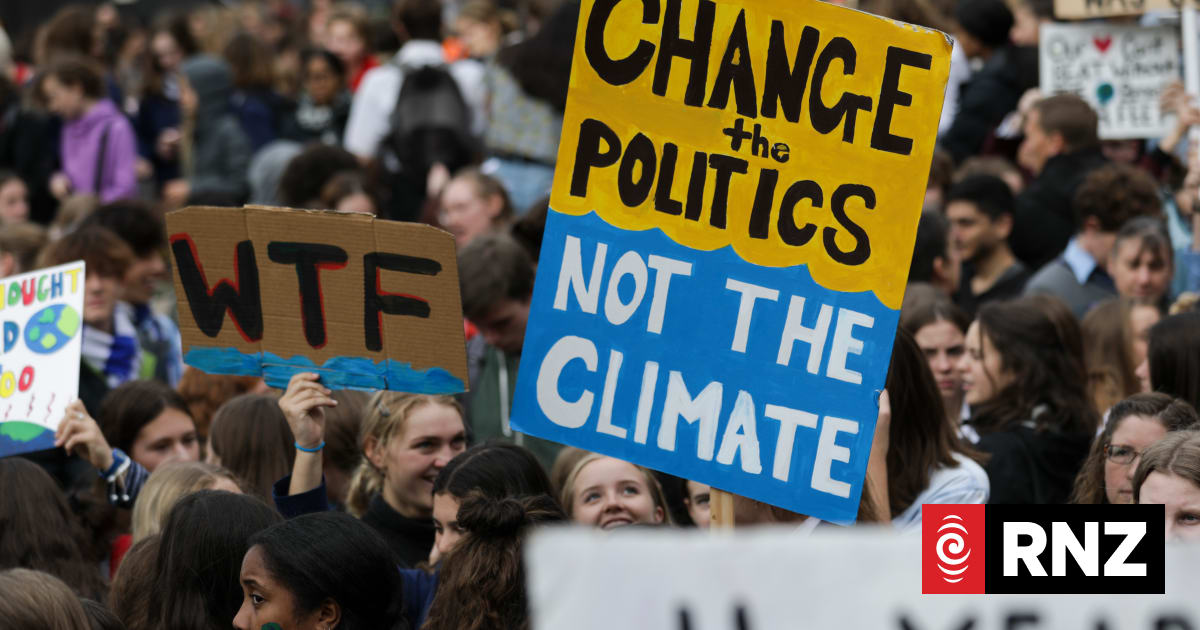
The big climate change re-brand - and whether it matters
Full Article
Original Source
Read the full article at Rnz →KhanList aggregates and links to publicly available news content. We do not host full articles from third-party sources. Always verify important information with original sources.