
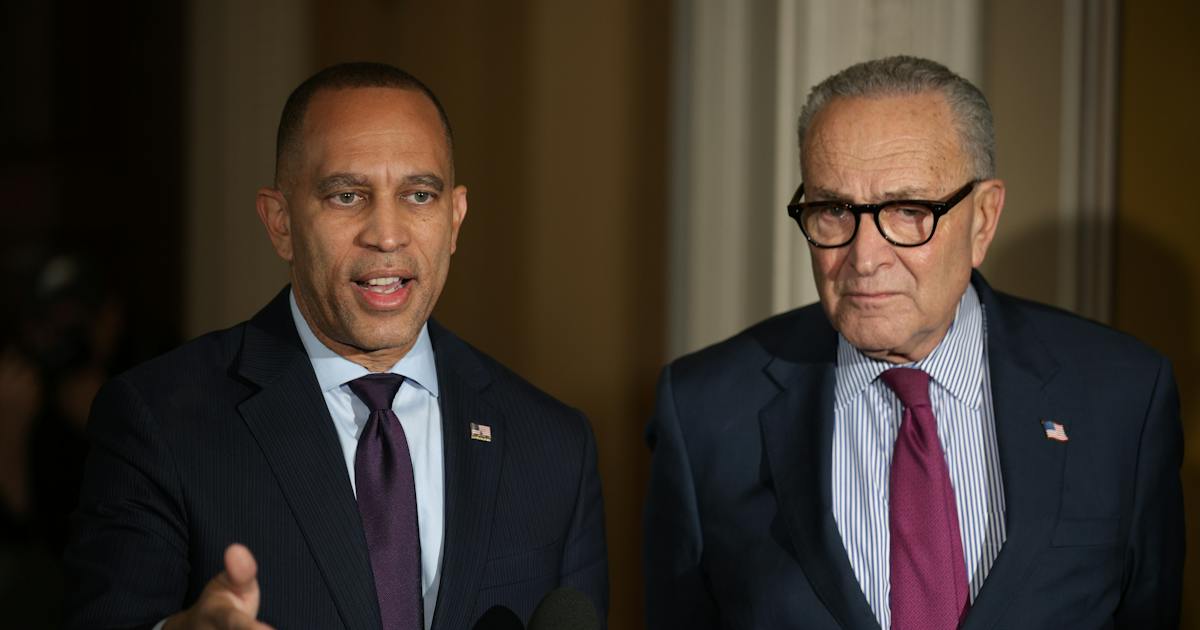
The Democratic Party just did something pretty remarkable. It expanded its congressional presence into regions of the country and states where it had been dead as a doornail for a decade or longer. They won big races in Ohio. They did the same in Iowa. They won in Kansas and Montana and South Carolina and Kentucky and Texas and Mississippi. They have a national footprint of a sort they haven’t had since the early 1990s, when, in the 102nd Congress, they controlled 56 seats in the Senate and 267 in the House.You might think they’d want leadership teams that reflect this geographic power and diversity. After all, one of the right’s favorite attack lines against Democrats is that they’re a party of big-city coastal elites with no foothold in, or feeling for, the American heartland. In this light, then, I pose a question to you: Is it a problem that the two men who are likely to lead the party in the next Congress live about one mile away from each other, in a city the rest of the country doesn’t particularly like?Chuck Schumer lives along Brooklyn’s glorious Prospect Park. Hakeem Jeffries lives just a few blocks to the north. Yes, it’s a mere coincidence. And yes, I love Brooklyn. I lived in (I think) five different apartments in the County of Kings over the 20 years I lived in New York.But my feelings about the place, or anyone else’s, aren’t the issue here. The issue is how the Democratic Party presents itself to the nation. And one way not to be caricatured as a party of New York City and San Francisco is … to have leaders who aren’t from New York City and San Francisco. Before I mount that horse, let’s consider Jeffries and Schumer and their other merits and demerits. This Wednesday, House Democrats are expected to vote to make Jeffries their leader (the official vote to make him the next speaker of the House will take place next January 3). There’s no way Democrats are going to deny the speakership to the first Black man in history in line to hold that position. No serious challenge to Jeffries has emerged, and none is likely to; he and his team have been aggressive in preemptively fighting off such challenges and making support for him appear to be as unanimous as possible.At the same time, there’s considerable grumpiness on Bluesky (natch) and in certain progressive circles about this presumed coronation. It reflects three concerns: one, that he wasn’t a more effective opposition leader in the first year of Donald Trump’s second term (things improved some in year two); two, his perceived and in some cases real coziness to corporate donors and AIPAC; three, a sense, stemming from the first two points, that he’s not the man to lead the charge on either reining in Trumpian corruption or passing aggressively populist legislation that will tell the multibillionaires and monopolists that the party’s over.I think Jeffries has taken some fair shots and some unfair ones over the years, but you can count me among those who share concern number three. On investigating Trump, it was not reassuring that the day after the big win, he defaulted to saying “the American people don’t want us to get even” and dismissing legitimate and necessary investigations into acts of obvious illegality and unconstitutionality as “retribution.” He just doesn’t sound like someone who has a zest for the fight.On economic matters, this son of two union members has never been a populist. People are watching very closely to see how big he’s willing to go. At the party’s conference last week in Denver, he did say that after reversing the Trump Medicaid cuts and restoring the Obamacare subsidies, the House would move to lower the Medicare eligibility age and extend coverage to hearing, vision, and dental coverage.Some will complain that it’s not Medicare for All, but M4A involves substantial tax increases that of necessity are going to be the topic of a lengthy debate. The above change, if the House passes it, would constitute a significant step in that direction. Of course, to mean anything, it has to pass the Senate, too—which brings us to Schumer.If the Democratic base is grudgingly willing to give Jeffries his shot, the verdict on Schumer is far less mixed. He’s five points underwater among Democrats in a recent CNN poll. Said the network’s Harry Enten: “He’s the least popular Democratic leader in the United States Senate since at least 1985.” I’ve known and watched Schumer for a long time. He has clear strengths and clear weaknesses. He’s a great nose-counter, horse-trader, and cat-herder; he knows how to get stuff passed. He did that very well during Biden’s presidency. In other words, he is, literally, a skilled majority leader. But when the party’s in the minority, that’s when his weak points come to the fore. He’s not a street fighter or a hellraiser. He’s an establishment guy. It just isn’t in his DNA to be a swashbuckling opposition leader. Leading a legislative majority and leading a legislative minority are two completely different jobs, so much so that I’ve come around to the belief that Democrats should officially make them two different jobs: elevate someone with the majority-leader skill set when they’re in the majority, then switch to someone with the minority-leader skill set when they’re in the minority.The next Congress presents a bit of puzzle, because, while the Democrats will be in the majority in the Senate, the president will still be a Republican (and not just any Republican). The Democrats will want to pass bills, of course, but opposing Trump will still be a big part of the job; arguably still the main part of the job. Enter Chris Van Hollen, who’s challenging Schumer for the leadership. It’s not clear how much of a hellraiser he is, but his trip to El Salvador to try to see Kilmar Ábrego García and his vocal opposition to Israel’s cruelly excessive post–October 7 violence in Gaza have won him the progressives’ stamp of approval. The more left-leaning groups are pushing his candidacy hard. The secret-ballot vote is scheduled for Tuesday, December 1.I’d still rate Van Hollen as a long shot. Schumer has been the majority leader for a decade now. That’s a lot of favors he’s done for a lot of senators. And senators just aren’t boat-rockers. The stodginess of the place is practically in the water. Schumer seems to have the votes right now, which is why he and his people are pushing to have the vote before December 1.It’s getting acrimonious. One ABC’s This Week Sunday, Van Hollen took aim at the argument that Schumer’s supporters have advanced since the election and that the conventional wisdom seems to have bought completely: that Schumer led the Democrats to this historic victory. As ABC’s Martha Raddatz put it to Van Hollen, quoting one Schumer-backing senator: “Why would you fire the manager who just won the World Series?”Van Hollen had an answer, and it was a good one: “Let’s be real. This was not a Washington-orchestrated election around the country. This was the American people rising up against a lawless president and demanding change. We won not just Senate seats and House seats. We won governor’s races. We won legislative races.”He’s totally right. Schumer deserves credit for recruiting winning candidates in some cases. But in other cases, he opposed winners. He opposed Abdul El-Sayed in Michigan and Peggy Flanagan in Minnesota in their primaries. In Maine, he wanted Janet Mills, who flamed out quickly and excited no one. National Democrats only moved to help Scott Colom in Mississippi very late in the game, and they did nothing for Angie Nixon in Florida and Jamie Davis in Louisiana, both of whom could have won with some help. So Schumer’s record in these midterms was actually mixed. The team won the World Series, but the manager made some questionable decisions about the pitching rotation.Even if Van Hollen doesn’t win, we can hope that his challenge to Schumer can get the latter to agree to some things that he could just ignore if he didn’t face a challenge. The most important among these is the filibuster. The House will pass all these nice things, like restoring Obamacare subsidies. But then, if the filibuster isn’t changed or eliminated, they’ll go to the Senate and die. Schumer and other filibuster defenders will blow a lot of smoke at us about how they think they can work with a chastened Republican Party and those four votes to end cloture and move to a final vote, which requires 60 votes. But it’ll be nonsense. In most cases, no Republican will want to be that 60th vote. Doing so would guarantee them a well-funded and possibly career-ending primary. So none of these lovely things will pass the Senate. And to most voters it’ll just look like the same old dysfunction.A conversation about the filibuster has at least started. Van Hollen said in Denver that he personally opposes the filibuster, and he committed at least to debating it if elected leader: “This is an issue that I think we need to talk to the caucus about.” And Schumer last week didn’t rule out eliminating the filibuster. This is a huge development, and it wouldn’t be happening if Schumer were waltzing to re-coronation.As of today, it seems like that these two neighbors who live a 15-minute walk away from each other will probably lead their caucuses. If Schumer wins, it will presumably be his last term. For Jeffries, it could be the start of a long tenure. But whatever the future holds for these two, the Democrats have to take full advantage of the astonishing geographic mandate the voters just gave them. At the very least, they need to elevate their candidates who won in red states and let America see that there are Democrats from places like Kentucky and South Carolina and that, on economics at least, they’re pretty populist. The midterms have handed them the opportunity to decimate the image of them as representing only coastal big cities. They need to seize it.
The Best Case Against Schumer and Jeffries Is Geography, Not Ideology
Full Article
Original Source
Read the full article at Newrepublic →KhanList aggregates and links to publicly available news content. We do not host full articles from third-party sources. Always verify important information with original sources.