
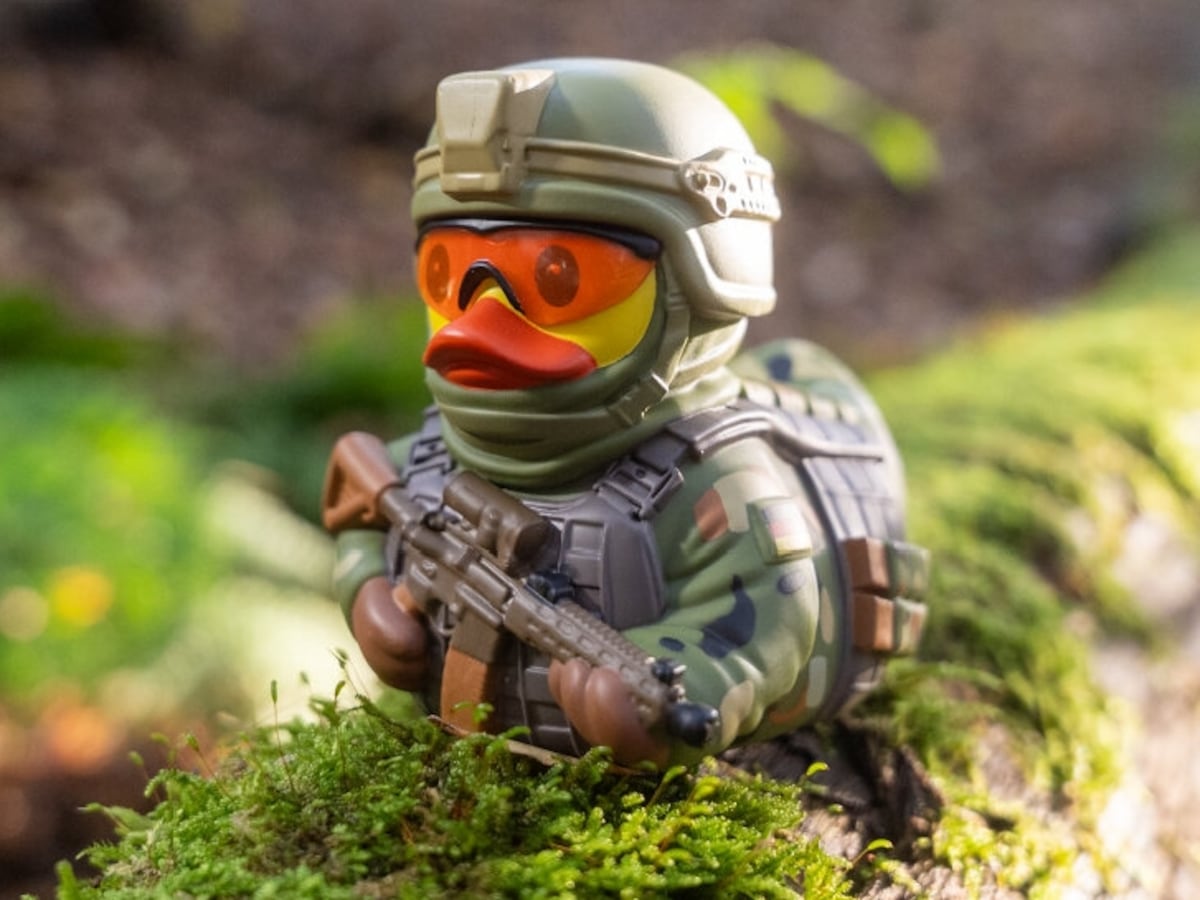
A baseball cap emblazoned with the slogan “Bundeswehr: Since 1955,” a matching jacket, flashlights, carabiners, and even children’s items such as a teddy bear wearing a camouflage hoodie bearing the army insignia and a rubber duck dressed in military uniform and carrying an assault rifle. The latter product has become both a target of criticism and an object of desire among Germans. It sold out within hours on the new online store of Germany’s armed forces, the Bundeswehr.“Unfortunately, this product is currently out of stock,” read a notice on the website on Friday. The store officially launched on Thursday to coincide with the 71st anniversary of the founding of the Bundeswehr. “You have completely overwhelmed us. Even we didn’t expect this. Our warehouses are empty, but we’re not going to leave you hanging. Our team is already working at full speed to restock.”During the first few hours, the website crashed, likely due to the high volume of traffic from curious visitors, critics and customers alike. The announcement has also sparked a heated debate on social media, with some calling it distasteful to place the Iron Cross and the word Bundeswehr on everyday consumer items, others criticizing the sale of military-themed products aimed at children, and still others viewing it as part of the army’s effort to rebrand itself as a conventional employer and attract new recruits.Goal: Building the EU’s largest armyGermany has set itself the goal of having the European Union’s largest conventional military. To achieve that, it plans to increase the number of active-duty soldiers from the current 186,200 to 260,000 by 2035. To that end, the country has been working for some time to make military service more attractive.German Defense Minister Boris Pistorius recently expressed optimism that the armed forces will be able to meet their future staffing needs without having to make the country’s new voluntary military service program mandatory.At the same time, however, the number of conscientious-objector applications in Germany has risen sharply. Between January and August 2026, the Federal Office for Family Affairs and Civil Society Functions, the agency responsible for the program, received 12,102 applications. For comparison, 3,879 applications were filed during all of 2025 and 2,249 in 2024. That increase should be viewed in the context of the voluntary military service program, which only came into force in January.For now, the online store appears to be generating enthusiasm. An announcement posted on the Bundeswehr’s Instagram account last week has already received more than 13,800 likes, and some users have begun requesting additional versions of the rubber duck, including a naval edition.“Our major public events, such as German Armed Forces Day, have been growing in popularity for years,” Pistorius said in a statement.For the defense minister, public interest in the work carried out by servicemen and servicewomen is a clear sign that the armed forces are “once again more rooted in society.” He added that many people recognize that: “Our Bundeswehr protects our security abroad and, with it, our way of living in freedom.” In his view, the new store offers an opportunity to promote the Bundeswehr brand “even in places where traditional advertising cannot reach.” According to the Bundeswehr website, the products “are not intended to be worn with, or as part of, the military uniform.” Rather, Pistorius said, they are designed “for everyone who feels connected to the military and its mission.”In its press release, the German armed forces said the goal is to make “the Bundeswehr even more visible and accessible, whether during the daily commute, on a run or in the office.”The store is operated by an outside company that won a public tender. It serves as the official concessionaire and licensee of the Bundeswehr, which does not receive any revenue from sales. Defense Ministry spokesperson Natalie Jenning reiterated that point on Friday while also responding to criticism from those who have accused the military of marketing children’s products such as the rubber duck carrying the Bundeswehr’s new G95 assault rifle.“Our target audience is obviously not children; it really is a collector’s item,” she said. “I would add that the number of visits and the debate now revolving around this rubber duck show to some extent that we hit the target in this respect. It is a collectible. Of course, it is not about bringing the German Army into children’s bedrooms or anything like that,” she added during the government’s regular press briefing, where she brought along samples of the duck.CriticismSince the advertising campaign was unveiled, criticism has continued to mount, particularly from opposition parties. “When we demanded that the German army be withdrawn from schools, we certainly did not mean for it to take its advertising into toddlers’ bathtubs. The fact that the army is now selling rubber ducks with assault rifles is an inappropriate trivialization of soldiers’ hazardous work,” Sören Pellmann, leader of Die Linke’s parliamentary group, said in a public statement. The army must not “trivialize war and armed service with lifestyle products in bright colors,” he added.This is not the first time a Bundeswehr campaign has caused controversy. In 2025, several tram drivers in Munich refused to work because the vehicles carried advertising for the armed forces. Another campaign that drew attention this year involved postcards personally addressed to young people by their first names. The cards were sent to those due to turn 18 next year and invited them to German Armed Forces Day, held on June 6. More than 600,000 young people received the postcards as part of an effort to boost recruitment.Sign up for our weekly newsletter to get more English-language news coverage from EL PAÍS USA Edition
The assault-rifle rubber duck dividing Germany: A hit and a headache for the armed forces
Full Article
Original Source
Read the full article at English →KhanList aggregates and links to publicly available news content. We do not host full articles from third-party sources. Always verify important information with original sources.