
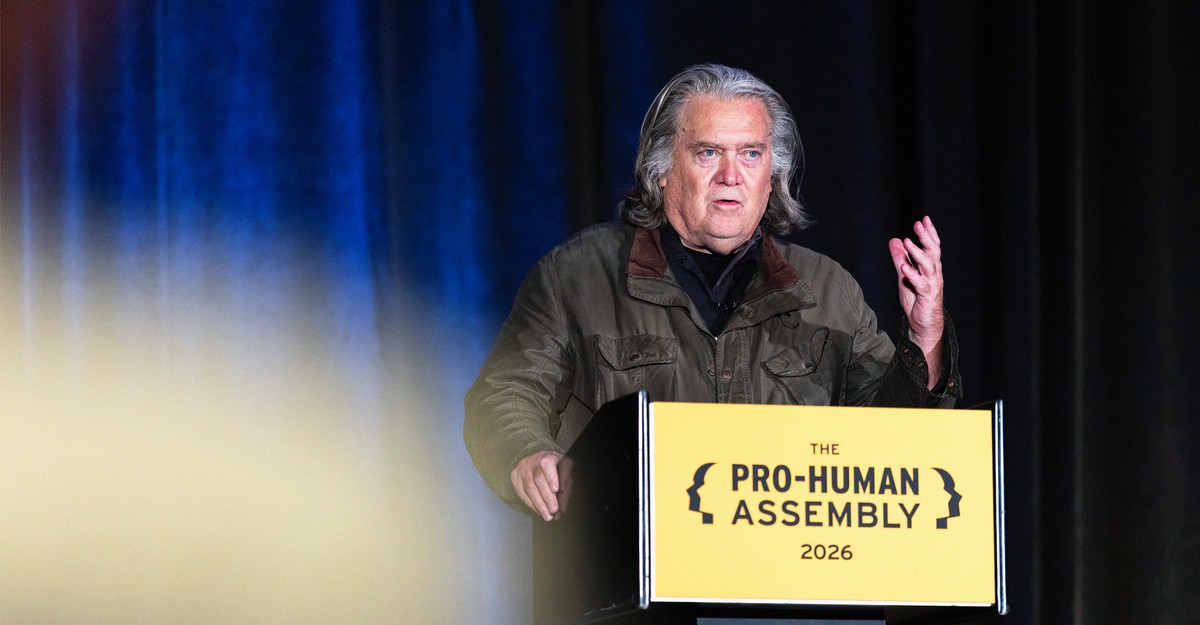
If there was any question over whether the concept of “the enemy of my enemy is my friend” is still operative in Washington’s hyperpartisan political environment, the answer may be found in the budding coalition of progressives and MAGA-friendly activists who have united in recent days to speak out against artificial intelligence. Which is how Senator Bernie Sanders and Steve Bannon found themselves speaking on the same stage today.With warnings that the technology could cause mass economic displacement and even human extinction, political figures who once wanted nothing to do with one another are suddenly joining forces, scrambling the political landscape just weeks before the midterm elections. The odd couples, who would have been hard to fathom just weeks ago, are also reshaping the legislative agenda. Republican Senators Ted Cruz and John Thune have teamed up with Democratic Senator Amy Klobuchar on an AI-safety bill; progressive Senator Richard Blumenthal joined forces with conservative Senator Josh Hawley to push a bill requiring AI companies to obtain approval from the Department of Energy before deploying new systems.Nearly a decade ago, Sanders urged then–President-Elect Trump to reverse his decision to hire Bannon, a pugilistic architect of the MAGA movement, and called him “a racist individual.” Last year, Bannon called Sanders a “pussy” for not going after Hillary Clinton hard enough in 2016. But the two were able to put all of that aside today to deliver the same message: If AI has the potential to wipe out humanity, Americans should have a say in how it operates.Read: Trump’s see-no-evil AI policy“If the lives of every man, woman, and child are going to be fundamentally changed by this technology, then the people of this country must make the decisions about AI, and not just a handful of oligarchs,” Sanders said at the all-day “Pro-Human Assembly.” Bannon sounded pretty much exactly the same. “The American citizens are not going to be supplicants to the oligarchs anymore,” the MAGA strategist said in what easily could have been a continuation of the Vermont socialist’s remarks. “We can’t do it.”Standing decidedly outside of this spirit of cross-party cooperation is Trump, who has downplayed warnings of AI’s risks and called the concerns over the rapidly advancing technology a “hoax.” Trump made a surprise appearance at an AI-friendly event yesterday by placing a phone call to Nvidia CEO Jensen Huang and making clear that he does not believe the doomsday warnings that have circulated in recent days. “The robots are not going to be taking over the world,” he told Huang, who took the call while speaking at a summit in Los Angeles and put it on speakerphone for the crowd to hear. “That’s not going to happen.”Bannon and Sanders, speaking back-to-back, essentially agreed to disagree about Trump. Sanders said that Trump’s “ignorance regarding this issue is truly embarrassing” and suggested that the president is not taking the technology’s risks seriously enough.“Obviously, he and I have a quite different opinion of the president of the United States,” Bannon told the crowd. “But we’re trying to raise above partisanship, and we have to.” That line received applause. But overriding Trump’s opposition to AI regulation in order to make meaningful policy changes could be a heavy lift. In several social-media posts yesterday, Trump dismissed those concerned about AI’s dangers as “Conspiracy Theorists, Treasonists, Traitors, and Leakers.” He suggested that AI and the data centers that power it could represent the greatest economic opportunity in American history. “Don’t kill the Golden Goose!” he wrote. Some lawmakers and activists, including Trump supporters and detractors, are now attempting to create a formal coalition to push for stronger guardrails around AI. Sanders plans to host a closed-door, bipartisan briefing on AI tomorrow in Washington.Today’s event in Washington was branded by organizers as an opportunity to create a “more human-centric path for AI development.” Speakers, including lawmakers, labor officials, and faith leaders, leaned heavily on the idea that the battle to slow AI’s advance should transcend traditional partisan or ideological divides.Read: The thrill of wanting AI to destroy the worldThe event was organized by the Future of Life Institute, a nonprofit that was primarily funded by a donation of more than $650 million in 2021 from Vitalik Buterin, a wealthy cryptocurrency entrepreneur. (The donation was delivered in crypto.) Politico reported in 2024 that the small organization’s hefty war chest put it in the same league as organizational behemoths such as the American Civil Liberties Union Foundation and the Brookings Institution.Today’s event featured free merch that included Carhartt shirts, yellow hoodies, and camouflage hats featuring mottos such as Keep the future human and Pro-Human. A video booth, fully decked out with stage lighting and a single chair, offered attendees the chance to answer the prompt When did you feel most human? Not, apparently, on video: When I walked by it a few times, it was not being used.A parody news report on nearby television screens played a staged interview with “Dan X,” who appeared to be a stand-in for an AI executive. The CEO of a fictional company called Replacement.AI was described by the faux journalist as “a walking paradox” who “loves people but isn’t crazy about humans.” Wearing a Patagonia vest and a smart watch, the Millenial-coded CEO ended the interview by offering this advice: “Live every day as if it is your last, because one day soon, very soon, it might be.”Stuart Russell, a computer-science professor and the president of the International Association for Safe & Ethical AI, told the crowd that his private discussions with AI-company officials included even more dire predictions about the technology's dangers than what they have discussed publicly. But organizers seemed eager to push the event beyond dystopian warnings and move toward solutions."There is no better testimony to how united we are than the mind-blowing ideological diversity that you’re going to see onstage today," Max Tegmark, a co-founder and the chair of the Future of Life Institute, said at the assembly’s opening. In addition to lawmakers, the event featured clergy who spoke about AI’s impact on faith, parents whose teenage children had committed suicide after engaging with chatbots, and economists concerned about the mass displacement of the workforce. Attendees attempting to navigate the event website had to first agree to “Standards of Conduct” requiring participants to “practice active listening” and refrain from personal attacks.Representative Chip Roy of Texas, who is retiring from Congress, was the only elected Republican to appear onstage. He told me that organizers had encouraged him to avoid politics in his remarks but that he predicted that political differences will inevitably intrude as the debate over what to do about AI continues. “I doubt Bernie’s solutions are going to be my solution,” he said.Still, there were signs that figures on both sides of the aisle seemed ready to at least have an honest conversation. “I don’t think you could find any two harder partisans than Bernie Sanders on the left and Steve Bannon on the right,” Bannnon said during his remarks. “This is a hinge in history. We have to handle this correctly. To handle it correctly, number one, we can never trust what an oligarch says.”Sanders was by then out of sight, but on that much, he surely agreed.
The Bannon-Bernie Bromance Over AI and Oligarchs
Full Article
Original Source
Read the full article at Theatlantic →KhanList aggregates and links to publicly available news content. We do not host full articles from third-party sources. Always verify important information with original sources.