
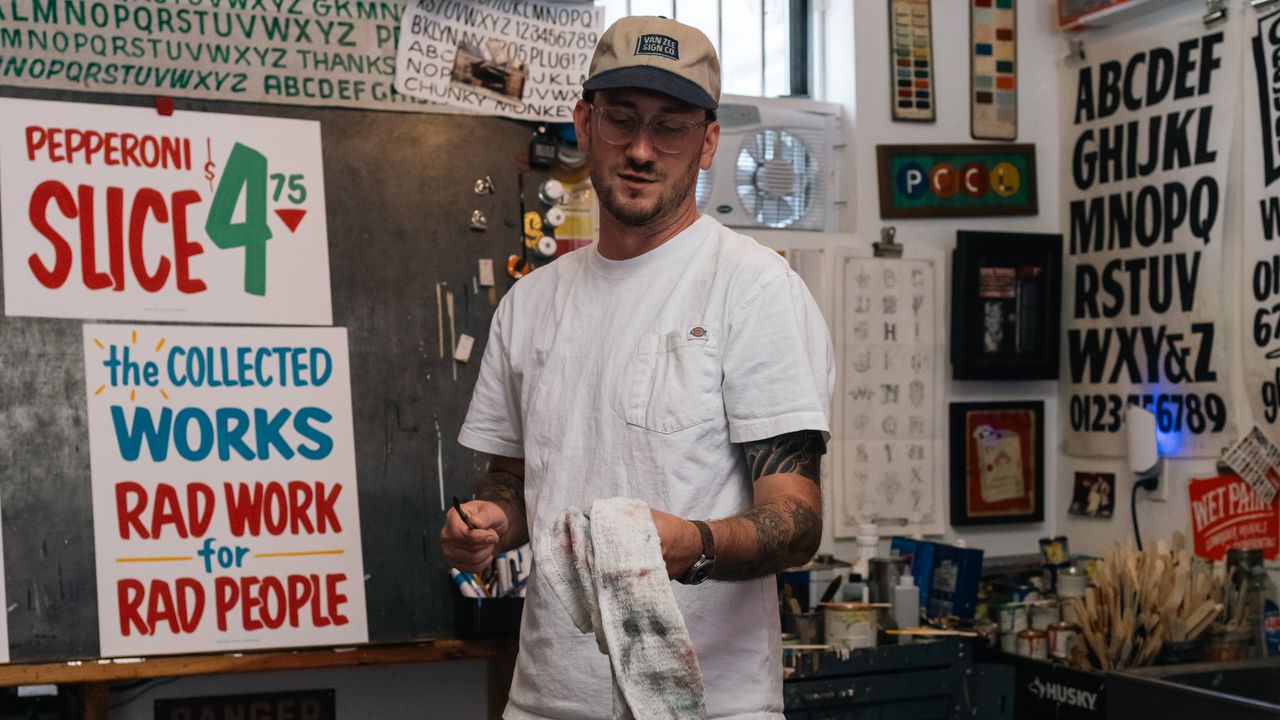
In Person of Interest we talk to the people catching our eye right now about their projects past and present. Next up, we chat with Brooklyn-based sign painter Will Van Zee about the art of hand-painted restaurant signs, how Instagram has helped revive interest in the craft, and why handmade design still matters in the age of AI.If you've walked past Elbow Bread, S&P Lunch, Levain Bakery, or dozens of other New York restaurants, you've probably seen Will Van Zee's work. Through his Brooklyn-based studio, Van Zee Sign Co., the artist creates hand-painted and gilded signs that have become a fixture of the city's restaurant landscape. While the online discourse around AI-generated food imagery heats up, Van Zee’s most effective tools remain decidedly old-fashioned.His thriving business is built on centuries-old techniques, yet many of his clients discover him through Instagram, where videos of his work regularly attract millions of views. Van Zee’s specialty is gilded signage for restaurants, bakeries, and shops. Watch his hypnotic Instagram Reels, and you’ll be transfixed by his meticulous brushwork, application of delicate gold leaf, and detailed flourishes. Through Van Zee’s posts, I discover bakeries, restaurants, and shops that immediately earn a spot on my growing list of places to visit. In this age of AI slop, I reason that if a business is thoughtful enough to invest in custom signage, it is probably just as thoughtful about everything else it did.We spoke with Van Zee about why handmade signs still matter, how social media has helped revive interest in the craft of sign-making, and what he's learned from his unique vantage point as an artist helping define a restaurant's identity.Photograph by Costa DamaskosHow did you get into sign painting?I moved to New York in 2008 to study product design. Within about a year of graduating, I started sign-painting professionally but my introduction to this work started much earlier. Growing up, I worked as a house painter. My dad would find jobs for me painting fences, trim, and siding around the neighborhood. It was hard work, but it helped me develop brush control at a young age.I also fell in love with the restaurant industry. Around age 16, I started as a dishwasher and porter, then became a prep cook and eventually worked closely with the chef and owner. There's something special about being part of a team, getting through a busy service, and feeling exhausted but proud at the end of the night.Part of building this business was creating a career that allowed me to spend more time around restaurants and the people who run them. New York is a city where people come to eat, and it's exciting to play a small role in helping restaurant owners realize their dreams.What do you enjoy most about being part of restaurant projects?I've been in this industry for about 13 or 14 years, so it's common to run into people I've worked with before. A contractor, chef, owner, or designer on a new project is often someone connected to a previous one. My business relies heavily on word of mouth, so those relationships are incredibly important.Photograph by Nash Studio One of my favorite parts of the job is attending friends-and-family nights. Most of the time, I see restaurants while they're still under construction, so those events are often my first chance to experience the finished space, try the food, and see everything come together. It's rewarding to celebrate alongside everyone who helped bring the restaurant to life and see the project finally open its doors.How would you describe your design style?I try to recreate and preserve the visual character of the city. I spend a lot of time looking at historic photographs and documentation, and as a sign painter, I feel a responsibility to help maintain the visual language that makes New York feel like New York. At the same time, every project is a partnership. The goal is to create something I'm proud of while also making sure it properly represents the business.I encourage clients to look at historic photos of their building and neighborhood. New York has incredible archives that show what these places looked like decades prior, and those images often provide inspiration for signage today. Sometimes the best solution is simply adapting something that already worked fifty years ago and giving it new life.Plus the rise of Loonen water, and Keith Lee steps in during a crisisHow do you position your work in the age of AI-generated design and inexpensive digital graphics?What makes sign painting special is that it's deeply human. Almost everything I do is made by hand, and that creates a natural connection to restaurants, where chefs are also making things by hand everyday. Hand-painted signs have soul. They're not perfect, and that's exactly what makes them special. The same is true of a great meal. You can tell that a real person made it.Many of my clients want to communicate that they value things made by people. Even if it costs more or takes longer, a hand-painted sign demonstrates care and craftsmanship. That's especially important in fine dining, where every detail matters. Hiring real artisans signals that level of attention to customersHow did you get started on social media? Did you ever expect your audience to grow the way it has?I was actually pretty resistant to social media when I started. I didn't even have a personal Instagram account. My wife encouraged me to invest energy into documenting and sharing my work, and it's become part of my process. It's made me a better documentarian.What's exciting is that sign-painting isn't something most people think about every day, even though signs shape how we experience cities and businesses. Getting to share the process has been really rewarding. Social media has been great for my business, but more importantly, it's helped people appreciate the craft.What have been some of your favorite restaurant projects?Some of the restaurant clients that stand out include Rezdôra, Sailor, and Levain Bakery, S&P Lunch, and Baby Blues Luncheonette, for which I designed the logo. Sailor was especially meaningful because it's in my neighborhood. I had eaten at the previous restaurant in that space many times, so being involved in its next chapter felt personal.The projects I'm proudest of are often the ones that stand the test of time. New York restaurants come and go, so when a place is still thriving a decade later, that feels significant. Rezdôra is a great example. The signage itself isn't especially elaborate, but people love that restaurant. Knowing I played a small role in shaping its identity and helping establish a place that has become so beloved is incredibly rewarding.
The Artist Behind New York City’s Most Iconic Restaurant Signs
Full Article
Original Source
Read the full article at Bonappetit →KhanList aggregates and links to publicly available news content. We do not host full articles from third-party sources. Always verify important information with original sources.