is a professor at George Washington University. He writes "The Future, Now and Then" newsletter on Beehiiv. His next book, Vaporware, Inc: How Silicon Valley Sells the Future to Control the Present, is forthcoming in January 2027. Welcome to Power Players, The i Paper’s opinion series in which our writers and experts take an in-depth look at the key figures in American politics as the US reshapes itself and the world. • The ‘swamp creature’ eclipsing JD Vance in the race to succeed Trump• The ‘pro-white nationalist’ whose power over Trump grows every day• Trump’s military cheerleader who is learning about war the hard way• The high-flying lawyer who turned tradwife for JD Vance• The right-wing judge who put Trump above the law• The female firebrand ready to reshape Trump’s America• Tucker Carlson: the hardline Maga kingmaker who turned on Trump• The anti-woke bulldog driving Trump’s fight against progress Here is a handy rule of thumb: anytime you read about a ridiculous new idea at the intersection of technology, culture, and politics, you can assume that Peter Thiel is somehow involved. The more outlandish the idea, the more likely that it is Thiel-funded. That Peter Thiel is simultaneously one of the most influential figures in US politics today should tell you something about the state of my home country. These are absurd times we are living through. The highlights of Thiel’s Silicon Valley career are as follows. He co-founded Confinity, the company that became PayPal in 1998, famously quarrelling with and replacing Elon Musk as the company’s CEO in 2000. He also co-founded the digital surveillance company Palantir in 2003. In 2004, he gave Mark Zuckerberg $500,000 (£272,800) in exchange for 10.2 per cent of young Zuckerberg’s company, Facebook. Thiel was Facebook’s first outside investor, and an early mentor to Zuckerberg. Thiel’s fans treat this as evidence of his unique brilliance. The critics point out that a fair bit of luck was involved. (Someone was bound to be Facebook’s first outside investor.) Thiel’s public profile has far less to do with how he made his money than with how he spends it, and the networks of influence he has built along the way. Thiel has a habit of rewarding his friends and demolishing his enemies. No single individual has done more to bend Silicon Valley toward Trumpism. Figures like Elon Musk, Jeff Bezos and Marc Andreessen are all relative newcomers to the Trump coalition. They kept their distance during the first Trump administration, and then developed Maga swagger in late 2024. Thiel, by contrast, was one of Trump’s earliest 2016 promoters. He is also the longtime mentor to Vice President JD Vance. Thiel helped Vance raise nearly $100m (£75m) from a number of prominent investors for Narya Capital, Vance’s investment fund. He bankrolled Vance’s Senate campaign to the tune of $15m (£11m), via the super PAC supporting his run. Long before he showed any interest in technology, Thiel was an avid libertarian iconoclast. His political awakening dates back to his undergraduate days at Stanford University. In 1987, Thiel cofounded a conservative campus newspaper, The Stanford Review, and served as its first editor-in-chief. The Review positioned conservatism as countercultural, publishing diatribes against the liberal campus political climate. It was, and remains, a pugilistic outlet. This, mind you, was at the height of the Reagan era. College campuses might have leaned left, but political conservatism reigned nationwide. In 1995, he and David Sacks (another Stanford Review alum) co-authored their first book, The Diversity Myth: Multiculturalism and the Politics of Intolerance at Stanford. The book took aim at political correctness, the 90s-era precursor to “wokeness”. It was dismissed as cartoonish demagoguery, and had little public impact. But it did cement a lasting relationship. Thiel would later hire Sacks as PayPal’s COO. As Thiel’s stature grew, so too did Sacks’s. David Sacks gave a primetime speech at the 2024 Republican National Convention, and went on to serve as Trump’s AI and crypto tsar. This has been something of a pattern with Thiel: The Stanford Review functioned as a recruitment pipeline of sorts, shuttling Stanford University’s most outspoken conservative students into Thiel-adjacent careers in tech and venture capital. In 2011, Thiel also launched the Thiel Fellowship, an initiative that encourages young entrepreneurs to skip or drop out of college in exchange for $250,000 (£188,000) from Thiel himself. The track record of the Thiel fellows programme has been mixed, but it has become yet another avenue for building Thiel’s cadre of brash young libertarians. It was once the case that to succeed in Silicon Valley, you needed to have a youthful affinity for soldering irons or computer code. Thanks to Thiel, the neophyte startup founder is better off reading Ayn Rand and Milton Friedman. Much of Thiel’s public profile has been shaped by the vendettas he has pursued. In 2007, Gawker’s Valleywag blog published an article title headlined “Peter Thiel is totally gay, people”. This was, at the time, something of an open secret. Thiel had never discussed his sexual orientation publicly, but it was also well-known among his peers and business associates. Thiel took offence at the article, and hatched a plan to even the score. Over the course of the following nine years, Thiel secretly funded multiple lawsuits against the Gawker media network. He did not sue Gawker on his own behalf – he sought out other plaintiffs and offered to pay their legal fees. One such lawsuit, by professional wrestler Terry Bollea (better known by his stage name, Hulk Hogan), bore fruit and bankrupted the company. It was only after Gawker lay in ruins that Thiel took a victory lap, revealing that he had funded the entire effort, stating it was “less about revenge and more about specific deterrence”. Many of Thiel’s peers have a long-time dislike of critical media coverage. But Thiel alone blazed a new trail, deploying his personal fortune to ruin his journalistic critics. In the decade since, his fellow tech billionaires have become increasingly aggressive in their approach to media outlets they dislike. This is one part of Thiel’s political legacy. Thiel has also been an outspoken critic of democracy itself. In a 2009 essay, “The Education of a Libertarian”, Thiel states that “the vast increase in welfare beneficiaries and the extension of the franchise to women – two constituencies that are notoriously tough for libertarians – have rendered the notion of ‘capitalist democracy’ into an oxymoron”. It came as little surprise, then, when Thiel embraced Donald Trump as his preferred avatar of governance by and for the capitalist class. Thiel authored a second book, Zero to One: Notes on Startups, or How to Build the Future. It was co-authored with Blake Masters, whose failed Senate candidacy Thiel also bankrolled. The book provides Thiel’s business advice on how to build a great company. His main insight is that marketplace competition is bad for companies, and companies should instead seek to dominate new fields where they can extract monopoly rents. This may be good advice for building a successful business, but it is a sorry form of capitalism that so enthusiastically crowns unconstrained monopolists. In recent years, Thiel’s investments and public pronouncements have veered into increasingly strange territory. He is a long-time supporter of seasteading – the effort to build new, floating enclaves in international waters. (Picture Galt’s Gulch from Ayn Rand’s novel, but out on the ocean. What could possibly go wrong?) He has been a prominent supporter and benefactor of Curtis Yarvin and his neoreactionary peers. Yarvin argues that the United States should abandon democracy and elect a CEO-president. He has also argued that race-based IQ differences are genetic, but denied he is a racist. Thiel funds efforts to launch billionaire-friendly “startup cities” around the world, in an effort to escape regulation and democratic accountability. He is an outspoken pronatalist and has funded fertility technologies, reactionary art movements and human longevity research that promises to “cure death”, and a great many other endeavors that are a mix of fantastical and troubling. Most recently, Thiel has become curiously obsessed with the Antichrist. He gave a series of lectures last year about the nature of the Antichrist, and recently went to Rome in a play for the Pope’s attention. (Spoiler: he thinks Greta Thunberg – and also AI critics – are the forerunners of the Antichrist.) I am not a theologian – though neither is Thiel – so I will refrain from commenting on liturgical matters. But it bears repeating that Peter Thiel is one of the most powerful individuals in US politics today. He played a singular role in Vice President Vance’s career trajectory. He has the ear of President Trump. He has dragged much of Silicon Valley to the extreme right, all while building and funding a network of libertarian and neoreactionary supporters who now enjoy an abundance of funding and opportunity. He is known to punish his enemies and reward his friends. He is deeply sceptical of democracy and marketplace competition. And he believes an awful lot of unbelievably odd things.
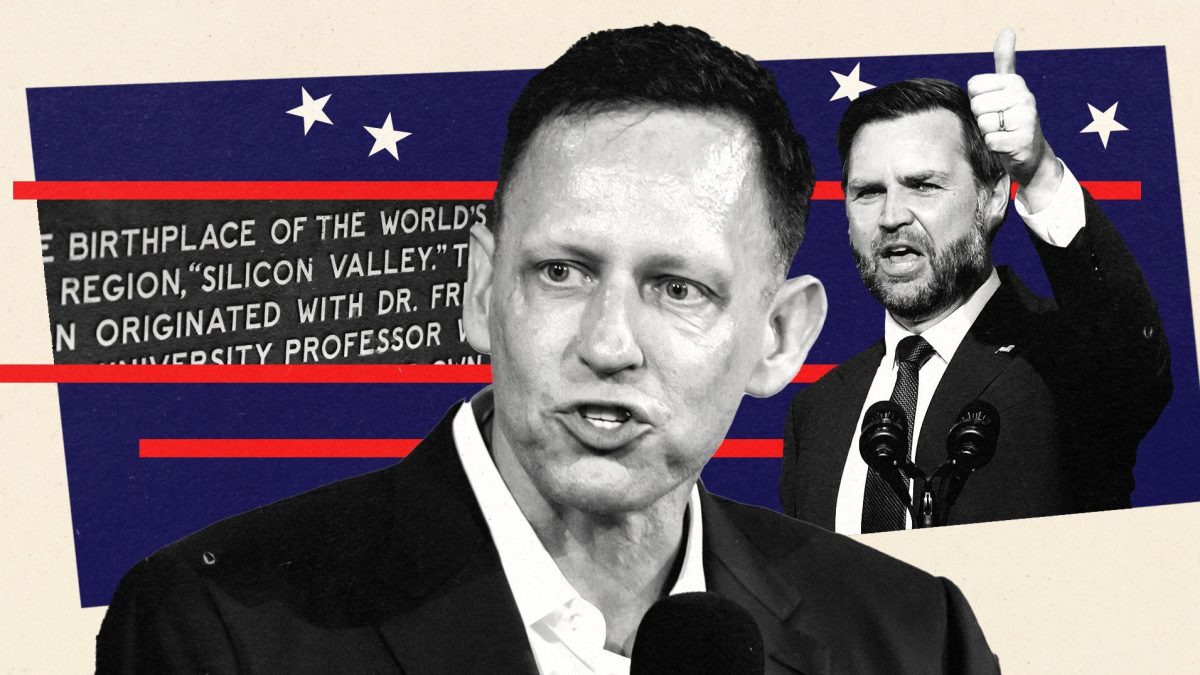
The Antichrist-obsessed billionaire who eased JD Vance into the White House
Full Article
Original Source
Read the full article at Inews →KhanList aggregates and links to publicly available news content. We do not host full articles from third-party sources. Always verify important information with original sources.