
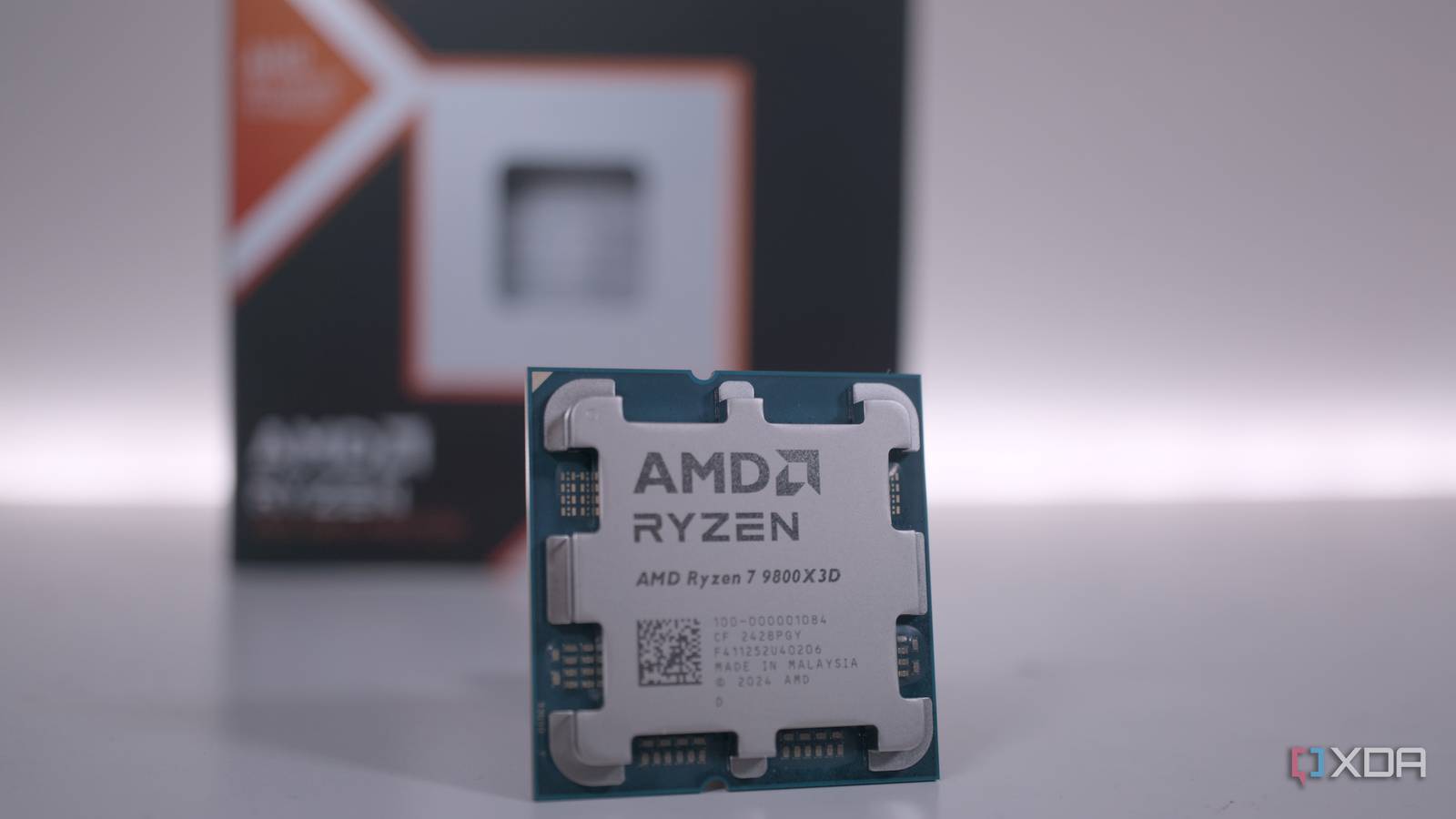
Published Sep 6, 2026, 10:00 AM EDT Hamlin has been in the tech field for over nine years. Since 2017, his work has appeared on MakeUseOf, Android Police, OSXDaily, Beebom, and more. He served as the Senior Editor at Valnet's MakeUseOf for over two years before joining XDA. He uses a high-end gaming rig for desktop use and a MacBook for traveling, but dislikes some of the quirks of macOS. You're more likely to catch him at the gym or on a flight than anywhere else. When I had the 5800X3D, I was convinced that I didn't need to move to AM5 until I upgraded my GPU. After all, when the RTX 4090 launched in 2022, the 5800X3D was one of the fastest CPUs you could pair it with. Even last year, when I played Assassin's Creed: Shadows at 1440p, it was able to keep up with my RTX 4090 just fine. That's why I always had second thoughts about splurging on a new AM5 motherboard and DDR5 memory to get a faster CPU. Still, I decided to bite the bullet and upgrade anyway when I started seeing RAM prices climb toward the end of last year. I figured that if memory was getting expensive because of demand from AI data centers, I was better off buying it before things got worse. And now that I've been using the 9800X3D for several months, I'm glad I made the jump, even though it didn't transform my gaming experience. It showed me I had more to gain from a faster CPU and a newer platform than just higher frame rates. The biggest improvement wasn't my average FPS Better 1% lows and frame pacing made performance feel more consistent Upgrading to the 9800X3D definitely gave me higher average frame rates in CPU-limited games, but here's the thing. I was already averaging 300+FPS in esports titles like Valorant and Counter-Strike 2 at 1440p, so while that 20% FPS uplift did help max out my 360Hz monitor, it wasn't actually the main reason games felt better. After all, even I can barely tell the difference between 300 and 360FPS. The performance metrics that ended up making a bigger impact were my 1% lows and frame times. 1% and 0.1% lows, for those who aren't familiar, basically tell you how your game performs at its worst moments. So while your average FPS might look great, poor 1% and 0.1% lows can still make games feel inconsistent. The 9800X3D improved those numbers and made mouse movements feel buttery smooth. Frame times, on the other hand, indicate how long each frame takes to render. Ideally, you want them to be as consistent as possible. After upgrading to the 9800X3D, I rarely see those spikes in the frame time graph while playing CPU-bound titles, which gives me much better frame pacing. I can finally use DLSS at 1440p Because at a 960p render resolution, the 5800X3D struggled to keep up Although my 5800X3D didn't bottleneck my RTX 4090 when I played AAA titles at 1440p, that changed the moment I enabled DLSS. At 1440p, using DLSS Quality renders the game internally at 960p, which is low enough for the CPU to easily become the bottleneck, especially when it's paired with a flagship GPU. You need to remember that this is a lower resolution than what reviewers use for CPU benchmarks, where the whole point is to expose differences in CPU performance. The result is that DLSS doesn't give me the same FPS uplift I'd get at 4K. In fast-paced AAA shooters like Battlefield 6 and Call of Duty: Warzone, I wasn't even getting a 10% improvement in frame rates with DLSS Quality because my GPU usage would drop well below 85%. At that point, I figured I was better off using DLAA and getting the best image quality possible. With the 9800X3D, though, my GPU usage sits close to 90%, and the FPS uplift is big enough to make DLSS worth using at 1440p for the first time in years. This was still an upgrade I could've skipped But I didn't want to be late to AM5 like I was with AM4 The 5800X3D is still a very capable CPU, and even if you pair it with something like the RTX 4090, it won't give you a hard time. Outside of the CPU-bound scenarios I mentioned, I'd say the 9800X3D just refined my experience at best. If I had upgraded to an RTX 5090, that could've been a different story. So if you play at 4K or have a mid-range GPU, you don't have to worry about CPU bottlenecks with the 5800X3D, at least for the foreseeable future. But this upgrade wasn't just about improving CPU performance and minimizing the chances of bottlenecks. I also wanted to move to AM5 because it still has a few years left in it, with AMD recently extending support through 2029. Looking back, I got into AM4 pretty late in its life cycle, building this PC with the 5900X. I was lucky to get the 5800X3D as a drop-in upgrade because I wasn't expecting a substantial uplift from the same architecture. I just don't want to make the same mistake with AM5 and wait until AMD is just about to move on to AM6 before finally making the jump. Upgrading now means I still have a shot at another drop-in upgrade by 2029, and that matters a lot to me. I don't think my 5800X3D would hold up by then, especially after I upgrade to a faster GPU. So if I'm forced to upgrade to AM5 sooner, I'd rather do it now and get a few years out of the platform than sit on one that peaked four years ago. The 5800X3D can only delay your inevitable move to AM5 The 5800X3D might be good enough today or even for the next year or two, but that doesn't change the fact that you'll eventually have no option but to move on from AM4. This platform has nothing more left to give, and the moment you need that extra CPU performance, you'll have to replace your motherboard and RAM anyway. By then, AM5 wouldn't have as much life left, and you might wonder why you didn't make the jump sooner. The better frame rates, 1% lows, and extra headroom to avoid bottlenecks are all nice to have, but knowing I can get a few more years out of AM5 is what ultimately changed my mind. AMD Ryzen 7 9800X3D 9/10 Socket AM5 Cores 8 Threads 16 Base Clock Speed 4.7 GHz AMD's Ryzen 7 9800X3D might be almost two years old already, but it's still one of the fastest gaming CPUs you can buy. It's second only to the newer 9850X3D, which delivers slightly better performance at the cost of higher power consumption.
The 5800X3D convinced me I didn't need AM5 — the 9800X3D changed my mind
Full Article
Original Source
Read the full article at Xda-developers →KhanList aggregates and links to publicly available news content. We do not host full articles from third-party sources. Always verify important information with original sources.