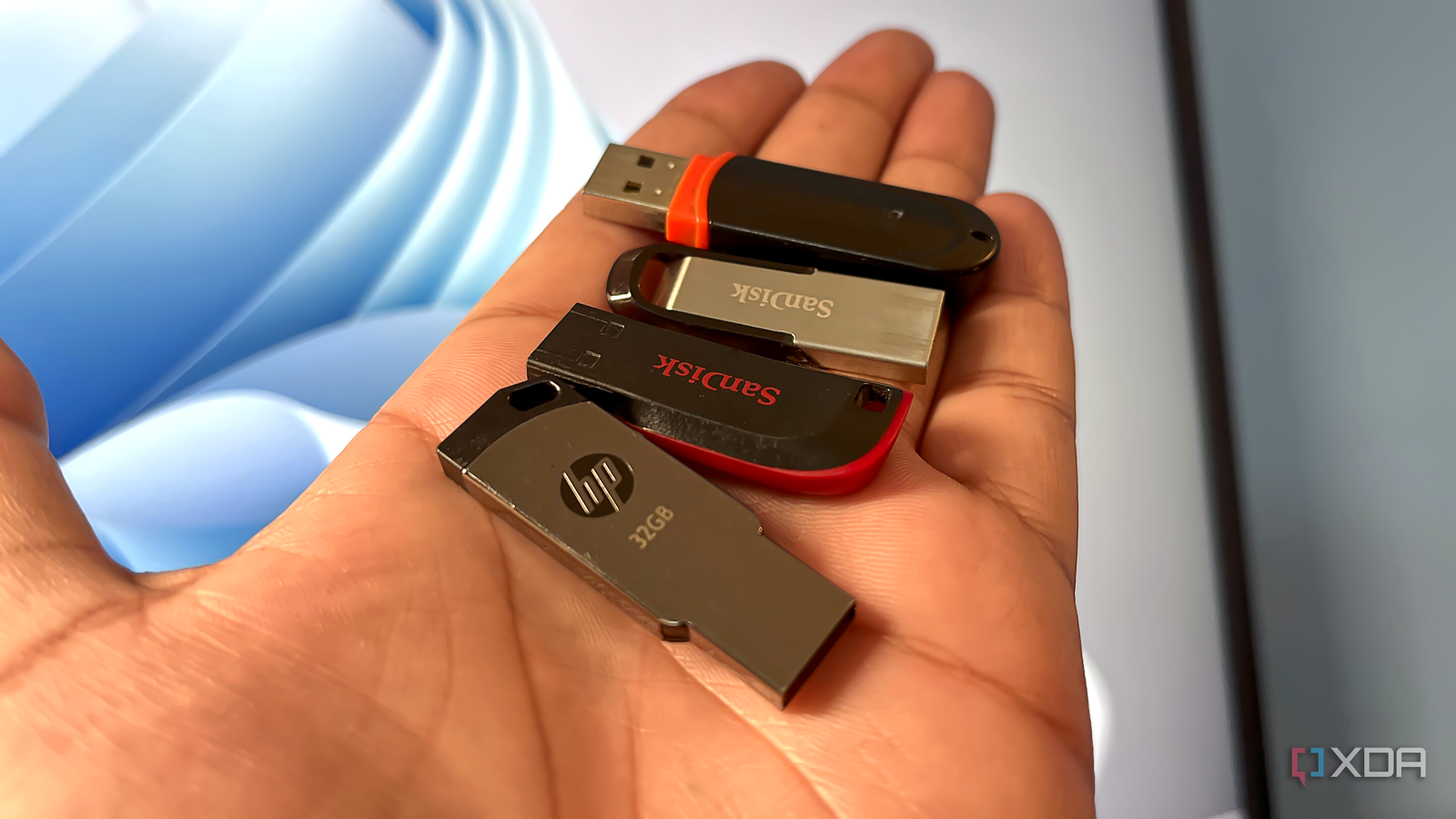
Published Aug 3, 2026, 7:00 PM EDT With over five years of experience in the tech industry, Kazim excels at simplifying complex topics, making them accessible to tech enthusiasts and general readers alike. He has extensively covered the Windows ecosystem, from Windows 7 to Windows 11. When he’s not writing, you’ll find Kazim planning weekend getaways or diving into tech verticals beyond his expertise. In the past few years, several arguments have been made against flash drives. While the logic behind it holds true in most cases, flash drives aren't altogether obsolete, and they don't seem likely to be anytime soon. That's because flash drives have distinct advantages over other storage media like SSDs, HDDs, and SD cards. I have all four, but most of the time I end up choosing the flash drive over anything else. I am not saying the other three are not useful. But for most everyday tasks, a flash drive is still the most convenient solution. Whether you want to transfer files between devices, create a bootable Windows media, or update a device's firmware, the good old flash drive does all that in a jiffy. Of course, if you are aiming for blazing-fast speeds, an SSD would be more practical, and for long-term storage, an HDD would be a better choice. But not everyone needs that. And when you consider the fact that HDDs and SSDs are getting expensive, flash drives suddenly feel more practical. That's why they remain the most useful storage device in my tech drawer. Flash drives are affordable storage solutions When compared to SSDs and HDDs, they cost a fraction One of the most compelling reasons I favor flash drives is undoubtedly the cost. I agree, it's not as cheap as it used to be, but a flash drive is still pretty affordable. You can easily get a 32 GB flash drive in the $15–20 range from a decent brand. I have three from a few years ago that cost me less than $5-10, and they still work exceptionally well. Since they are cheap, flash drives also feel less stressful to handle and use. I had one attached to my keychain for a long time, something that's practically impossible with other storage drives. It's not just the form factor; it comes naturally because they are more expensive. Presently, most of my flash drives sit in a drawer alongside all the other tech gadgets I have acquired over the years. They don't need that kind of attention. And even if I were to damage or lose one, it would be much less frustrating, since the replacement costs little. Flash drives offer convenience Less clutter, more freedom Another reason I have long favored flash drives over SSDs, HDDs, and SD cards is that they are universally compatible and don't require a cable or a dedicated reader, unlike SD cards. You just plug one in, and that's it. You don't need anything else. Of course, if you want to connect a flash drive featuring a Type-A connector to a Type-C port, you will need an adapter, but those, too, are small and really cheap. I have one to connect a flash drive to my smartphone. This directly translates into less clutter, easier handling, and better storage. When I say flash drives are convenient, it's also because you can dedicate one to a specific purpose without giving it much thought. I have reserved one for a bootable Windows setup, another for quick file transfers between devices, and a third flash drive connected to my router, acting as a cheap NAS. I have also created a portable Windows installation on a flash drive. Though I haven't used it much beyond the initial testing, the idea is certainly practical in a sense. With HDDs and SSDs, dedicating one to each purpose will be much more expensive, making it impractical for most people. You don't always need an SSD Sometimes, flash drives make more sense Ever since SSDs became mainstream, I have seen people vouching for them simply for the transfer speeds. That's a major benefit of SSDs, but you don't always need that kind of performance. Frankly, I spend more time dealing with smaller file transfers, running diagnostic and troubleshooting tools, or updating firmware, and a flash drive is more than capable of handling this. None of these tasks require an SSD. If you have one to spare, that's good, but a flash drive can do the same job at a fraction of the cost. Also, if I am sharing files with someone, I am much more likely to hand them a flash drive rather than an HDD or an SSD. For most of us, file transfers are a background activity. We don't usually sit and wait for a file transfer to complete. We start one and then move on to the more critical tasks while the transfer completes in the background. And that's why flash drives make sense to me, because transfer speeds are secondary here. Reliability and performance remain a concern But that's not necessarily a deal-breaker for everyone I agree, a flash drive is slower and generally less reliable than an HDD or an SSD, and it is not capable of the same level of performance. That's the general perception, and even if we look into the technicalities, it's true. A flash drive ideally doesn't last as long as an HDD or SSD. But I also can't ignore the fact that I have flash drives purchased over a decade ago that still work. On the other hand, I have a dead HDD sitting in my drawer that was purchased more recently. That said, I still wouldn't encourage you to use flash drives as long-term backup solutions. That's because a flash drive isn't designed for that purpose. A cloud storage solution will be a better choice for this. So, as long as you understand the drawbacks and use flash drives for purposes they're better suited for, the risk is far lower, and the benefits are far too many. I am all for SSDs, but they don't replace good old flash drives for me Honestly, I appreciate what SSDs bring to the table, and if they were as affordable and convenient as flash drives, I would gladly get more. But the fact is that they aren't. Flash drives, on the other hand, are near perfect for everyday tasks like file transfer and troubleshooting, anything where performance and long-term reliability are not a major concern. That's why I will, for the foreseeable future, have a few flash drives sitting in my tech drawer, ready for their next job.
The $5 flash drive is still the most useful thing in my tech drawer, and no SSD changes that
Full Article
Original Source
Read the full article at Xda-developers →KhanList aggregates and links to publicly available news content. We do not host full articles from third-party sources. Always verify important information with original sources.