
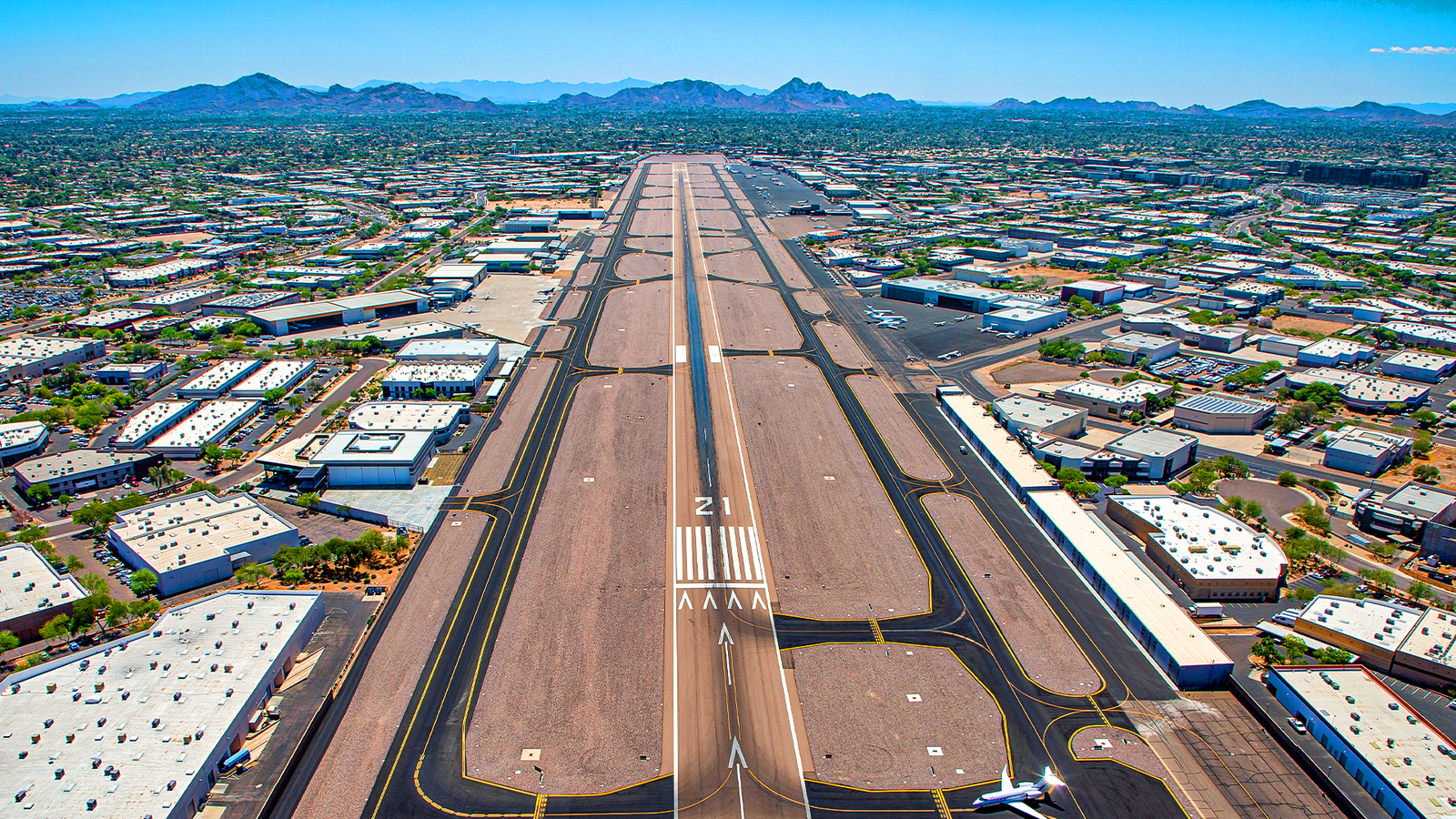
Credit: Tim Roberts Photography | Shutterstock, Simple Flying Published Oct 24, 2026, 3:00 PM EDT Passionate about promoting aviation, the beauty of flight and the science behind it, Antonio is an avid reader of aviation magazines and books, and he loves visiting airshows all over the world, taking photos and writing about airplanes and helicopters as well. He is currently based in Palermo, Sicily. Sign in to your Simple Flying account General aviation is the part of American flying that an average traveler rarely uses, yet it moves student pilots, air ambulances, police helicopters, and business executives every single day. It is also remarkably resilient. Simple Flying already covered when China reported a nationwide, indefinite suspension of general aviation in June 2026: that event highlighted just how much of the US aviation system depends on privately operated, training, and corporate flights staying open. In the US, a handful of airports handle staggering volumes of exactly that kind of flying, in some cases more than major airline hubs. This list ranks airports by operations, meaning individual takeoffs and landings, so one full traffic pattern counts as two. It draws on 2025 ACI data analyzed by AirAdvisor, the airport-by-airport ranking from Pilot Institute, and FAA-based business aviation figures. Because these sources cover different years and use different methods, the figures are not directly comparable in every case. The ranking offers a guide to the scale of general aviation activity rather than a standardized national league table. Training airports can accumulate large totals from local circuits, while corporate aviation generates more arrivals and departures between airports. Both contribute to the overall picture. The countdown runs from fifth place to first. 5 Rocky Mountain Metropolitan Airport 249,063 operations Rocky Mountain Metropolitan Airport (BJC) rounds out the top five in Pilot Institute's ranking, with 249,063 operations. Located between Denver and Boulder, the field hosts several flight schools, which generate a steady stream of training circuits. It is also a popular choice for business aviation, so student pilots and corporate crews end up sharing the same busy pattern. Spread over a year, 249,063 operations work out to roughly 680 takeoffs and landings every day. The business side shows up clearly in FAA traffic data compiled by NATA. In 2025, BJC recorded 13,553 business jet movements, up 5% from the year before, which placed it 81st in the country. It also logged 4,381 turbine movements, down 7%, and 1,234 piston movements, up 15%. Those numbers show an airport that serves everything from light trainers to private jets, with piston traffic growing fastest. That dataset filters out airlines and most flight training, so it captures the corporate side of BJC’s traffic rather than its student pilots. In other words, the real total at BJC is higher than the business-only counts suggest. BJC ranks fifth because its raw numbers trail Prescott’s by about 7,900 operations, even though its mix of training and business traffic is just as varied. Its place on the list also gives the Denver area two of the five busiest general aviation airports in the country, helped by Colorado’s favorable flying weather through much of the year. 4 Prescott Regional Airport 256,931 operations Prescott Regional Airport (PRC) logged 256,931 operations in Pilot Institute’s count. A considerable share comes from Embry-Riddle Aeronautical University, whose Prescott campus runs a renowned flight training program. That volume equals roughly 700 takeoffs and landings a day. Corporate and military flights add to the total, and the airport’s fixed base operator is Cutter Aviation. Pilot Institute is headquartered in Prescott, which is worth remembering when reading its ranking. According to the airport, Prescott Regional is the 17th-busiest airport in the nation by total aircraft operations. The FAA classifies it as a non-primary commercial service airport, and it handles recreational flying, corporate aviation, aviation businesses, flight training, and scheduled airline service. That makes it a true multipurpose field rather than a pure training base. The airport also carries some history. It honors Ernest Alexander Love, a Prescott native and Army Air Service fighter pilot who died in 1918 after being shot down near Verdun, France. The field was dedicated in his name on August 28, 1928. Prescott ranks fourth, with flight training and favorable flying weather helping sustain its high volume of operations. Pilot Institute credits the desert location with more than 300 days of ideal flying conditions each year, giving student pilots plenty of opportunities to train. The wider regional pattern is also striking: Arizona and Colorado each have two airports in this ranking, while California accounts for the remaining entry. 3 Montgomery-Gibbs Executive Airport 272,813 operations Credit: Conchi Martinez | Shutterstock Montgomery-Gibbs Executive Airport (MYF) ranked third in Pilot Institute’s list, with 272,813 operations, driven by year-round flight training in San Diego’s mild climate. It is also used for corporate aviation, military activity, and law enforcement flights, which makes it a general aviation gateway for the entire region. San Diego Union-Tribune reporting notes that the field dates back to 1937. The City of San Diego describes it as the busiest general aviation airport in the San Diego region, with tenants that include fixed base operators, flight schools, San Diego Fire-Rescue helicopters, the police Air Support Unit, emergency medical transport, and several hundred individual aircraft owners. City airports committee minutes reported more than 33,000 operations in April 2025, and the June 2025 minutes reported another month above 33,000 in May. Earlier minutes show more than 31,000 in January and more than 30,000 in March. At 33,000 a month, that works out to roughly 1,100 operations a day. Third place reflects Montgomery-Gibbs' strong training environment and the range of aviation activity it supports. FAA traffic data compiled by NATA shows a relatively modest business jet presence, with movements flat year over year, suggesting that flight training and light aircraft account for a substantial share of its activity. San Diego's mild weather helps sustain flying throughout the year, while its large metropolitan market provides a steady pool of student pilots and other general aviation users. The city also operates Brown Field Municipal Airport, which has the longest civilian runway in the region, but Montgomery-Gibbs remains the busier field by operations. The city's own monthly figures also offer a more recent view of its activity than the older national ranking. 2 Centennial Airport 312,153 operations Credit: BlueBarronPhoto | Shutterstock Centennial Airport (APA) is consistently one of the busiest general aviation airports in the country, logging 312,153 operations in Pilot Institute’s ranking. The FAA says it averages about 1,000 takeoffs and landings per day and counts it among the 25 busiest airports in the nation. It sits roughly 20 miles (32 km) south-southwest of Denver International Airport (DEN), near the Denver Tech Center, and its longest runway stretches 10,001 feet (3,048 meters). Pilot Institute calls it a preferred destination for business aviation thanks to its proximity to downtown Denver and the south metro area. The traffic mix is unusually rich. The FAA notes numerous flight schools, significant business jet activity, and helicopter operations, all sharing two very closely spaced parallel runways, 17R/35L and 17L/35R, and a complex network of uncontrolled ramp areas. The airport even serves as headquarters for Boom Supersonic, whose employees fly for fun from the field. The FAA also warns about a large concrete area called Hot Spot 2 that can confuse pilots unfamiliar with Centennial, a sign of how busy and complex the ramp can get. According to FAA traffic data compiled by NATA, Centennial handled 40,711 business jet movements in 2025, up 1%, placing 14th nationally for jets. It also logged 14,399 turbine movements and 2,893 piston movements. For a sense of how capable modern business jets have become, see what we have previously explained in Simple Flying about the Bombardier Global 8000. Centennial takes second place because it accommodates substantial flight training alongside a large business aviation market. Its proximity to Denver's Tech Center attracts corporate traffic, while its flight schools keep local operations high. That combination produces a demanding operating environment, consistent with the FAA's warnings about the airport's complexity for pilots and air traffic controllers. 1 Phoenix Deer Valley Airport 490,702 operations Phoenix Deer Valley Airport (DVT) is the clear number one. It logged 490,702 aircraft movements in 2025, up 13.4% from 2024, according to AirAdvisor. That was the biggest increase of any airport on the national top 10 for movements, and it made DVT the ninth-busiest US airport by movements, just ahead of Phoenix Sky Harbor, which logged 487,142. Phoenix Sky Harbor’s media kit adds that DVT ranked 13th in the world and was the busiest general aviation airport in North America. The airport sits about 17 miles (27 km) north of Sky Harbor and acts as its reliever. Deer Valley’s official site lists two runways, one 8,208 feet (2,502 meters) long and 100 feet (30 meters) wide, the other 4,500 feet (1,372 meters) long and 75 feet (23 meters) wide, plus nearly 1,100 based aircraft. The airport can accommodate every segment of civil aviation except scheduled airline service, with fuel, avionics, maintenance, parts, flight training, and aircraft sales on site. It is also home to two of the country’s largest flight schools, AeroGuard and Westwind School of Aeronautics. Spread across the year, 490,702 movements average about 1,340 takeoffs and landings a day, or nearly one every minute around the clock. Growth is visible on the ground, too. The Sky Harbor media kit points to a new 60,000-square-foot (5,574 square meters) corporate hangar complex from Cutter Aviation, a 100,000-plus-square-foot (9,290 square meters) hangar campus from Sky Harbor that opened in 2025, and a terminal modernization project now in planning. The airport has also been home to a brewery with seating for up to 200 people since 2024. Deer Valley takes the top spot because of its location, services, reliable flying weather, and heavy flight training. The FAA describes it as a convenient alternative to the larger, more congested Sky Harbor, which explains why so many pilots choose it. Busy training patterns demand sharp skills, a theme Simple Flying’s article on go-arounds explores through the go-around, one of the most important maneuvers in light aircraft.
The 5 Busiest General Aviation Airports In The US In 2026
Full Article
Original Source
Read the full article at Simpleflying →KhanList aggregates and links to publicly available news content. We do not host full articles from third-party sources. Always verify important information with original sources.