
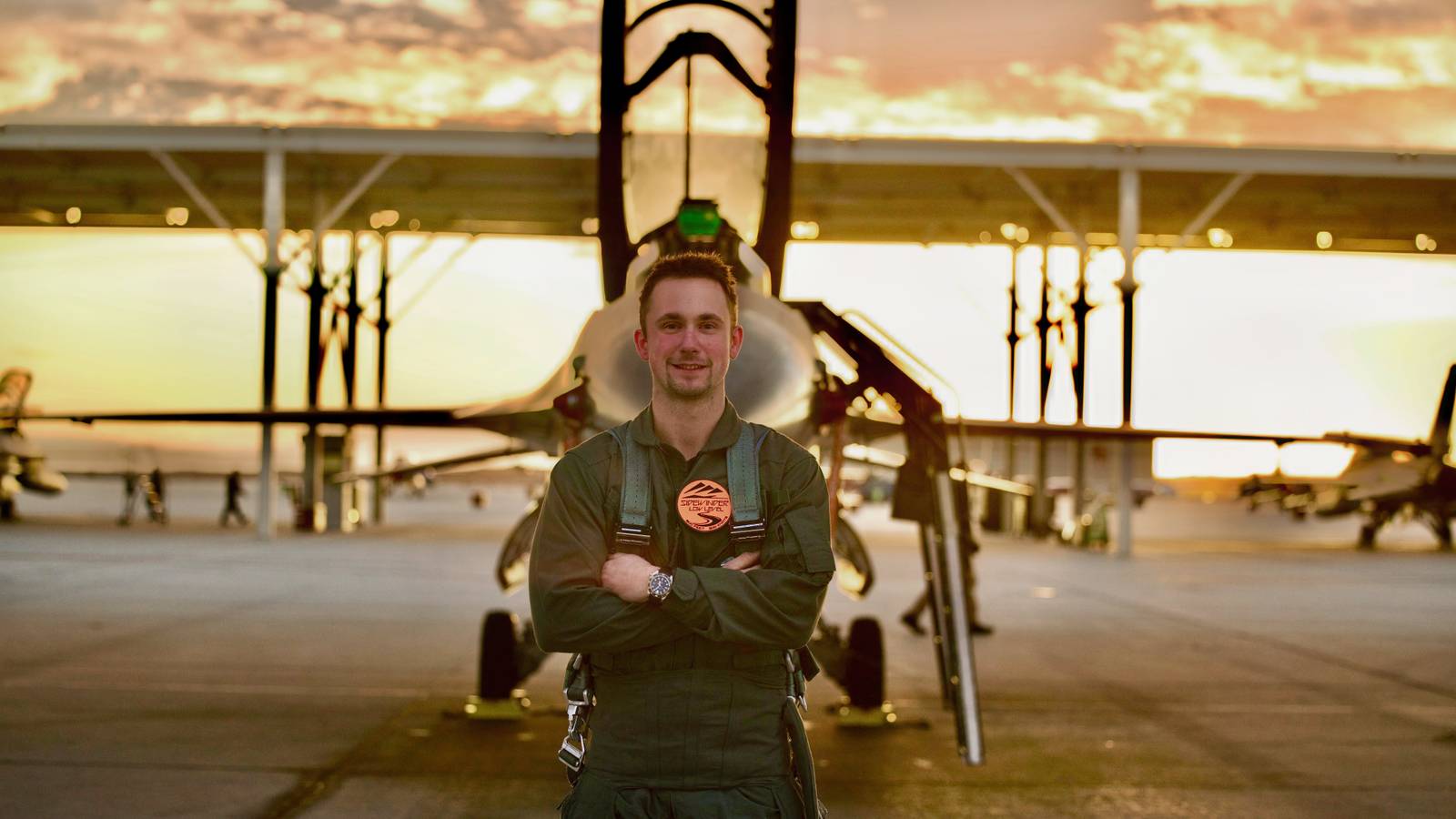
Credit: Louis Skupien Published Oct 25, 2026, 7:00 AM EDT Chris earned a Master’s degree in Defense and Strategic Studies (Highest Honors) from the University of Texas at El Paso. His graduate work concentrated on Global and National Security, Low-Intensity Conflict, Modern Warfare, and US grand strategy. He also undertook extensive regional studies, analyzing how key regions integrate into the broader US security architecture. This rigorous program provided him with a comprehensive understanding of U.S. military operations, global strategy, and weapons systems. Additionally, he gained a strong appreciation for great power competition.—an increasingly central force shaping international relations and conflict for the foreseeable future. Sign in to your Simple Flying account I had the great opportunity to talk with accomplished aviation filmmaker and content creator Louis Skupien regarding his recent visit to Edwards Air Force Base. We were able to discuss his strong interest in flight, how it developed, and the amazing journey this childhood interest has taken him on and where it may lead him next. In January, earlier this year, Louis made an incredible visit to Edwards, home of the 412th Test Wing, where he was able to meet and fly with one of the base's test pilots in the cockpit of the hot rod of fighters, the Lockheed Martin F-16 Fighting Falcon. This experience was like no other Louis had encountered, given the fighter’s incredible speed and agility. Amidst His Youth, Louis' Profound Interest In Flight Began To Take Shape Like many children, Louis visited his grandparents' house and spent time talking with them, asking questions, and listening to stories. Louis stated that his grandfather "was in the police force, but I know that he had always wanted to be a fighter pilot or be in the RAF." Given his desire to serve and his particular interest in the RAF, Louis said his grandfather had numerous model aircraft in his study, with the iconic Supermarine Spitfire as his main interest. In addition to the models, his grandfather's study was equipped with a PlayStation and one of the best-known flight simulators, IL-2 Sturmovik, a game featuring excellent graphics, realistic flight physics, engine management, and historic battles. Regarding his visits and time spent on the simulator, Louis shared that "every time I went over to his house, I'd go and play on the simulator with him, and it was flying the Spitfire, and I just remember absolutely loving it." This growing love for aircraft was further nurtured by a set of die-cast model aircraft his parents bought him, with fighter jets as his primary interest. However, Louis truly latched onto his grandfather's passion for aviation, which inspired him and provided a firm foundation that remained even as he moved beyond his early interest in aviation to pursue years as a national and international award-winning tennis player. Reigniting His Passion For Flight and The Development of Full Throttle Credit: US Air Force By 2022, at 20, two years after leaving tennis, Louis launched the TALK4 podcast. The show centered on outstanding individuals with exceptional performance in their fields and the lessons they could share with him and his audience. TALK4 featured business leaders, serving military personnel and veterans (both enlisted personnel and officers), endurance athletes, first responders, authors, scientists, and other high performers. In May 2022, with TALK4 still in its infancy, Top Gun: Maverick arrived in cinemas in the United Kingdom. At that time, the podcast had not ventured into the military realm, and the film immediately sparked Louis's interest, possibly rekindling childhood memories as well. Regarding his excitement, Louis stated "I just went and booked a cinema ticket, basically, to the town near home. And I went to watch Top Gun Maverick in the cinema, and I didn't have a clue what an F-14 actually was. I didn't know an F-16 existed." The movie was a major turning point. Louis elaborated: "I left the cinema just so, so hyped up about it, wanting to learn more. You know, on my phone Googling, and I just thought, oh my god, I've got to, I've got to speak to a Top Gun guy or a fighter pilot on my podcast, and then it kind of went from there." And it certainly did go from there. His first interview within the aviation community was TALK4 Episode 38, in October 2022, when he interviewed Lieutenant Commander Mark “Slider” Keller (USN, Ret.), a Radar Intercept Officer aboard a Grumman F-14 Tomcat. Shortly thereafter, in Episode 40, Louis spoke with Lieutenant Keegan "Smurf" Gill (USN, Ret.), who piloted a Northrop Grumman F/A-18 Super Hornet and survived an ejection at nearly 700 mph (1,127 km/h). From that point on, TALK4 featured many more military interviews, including Lieutenant Matthew "Whiz" Buckley (USN, Ret.), a TOPGUN graduate and adversary instructor at the school. Since rebranding as Full Throttle, Louis has primarily focused on military topics, interviewing military personnel, taking viewers behind the scenes of the world's most extraordinary aircraft and top-tier military units, and exploring the cutting edge of military technology. The Trek Towards Edwards The journey to fly in an F-16 at Edwards began with gradual networking and consistent production of military-related content. Louis went from skydiving with the US Army Red Devils to speaking with the Raptor Demo Team. These experiences put Louis through various vetting processes while building trust. Regarding the step-by-step process, Louis shared that, "I think because I'd been vetted for doing the interviews and the podcasts with various leaders and commanders within, you know, the teams and commands, I built up this trust level already, and then the videos were kind of like a bit of a track record". These experiences helped build his confidence to speak with higher-ranking officials and request access to more secure environments. By early May 2025, Louis had secured an interview with Brigadier General Douglas Wickert (USAF), former commander of the 412th Test Wing at Edwards. During the interview, General Wickert and Louis "spoke about the F-47" and the technology "they're developing at Edwards and the next generation fighters, the bomber fleets. And we had this conversation that just went really, really well." Following the recorded interview, "I kind of said to him, I make these documentaries now, and they had started becoming access-led documentaries taking the public into places where they normally wouldn't have a chance to go or see these programs and really take people behind the scenes in these places." Following this pitch, the general welcomed the idea as a great opportunity to show the public the story behind the flight tests conducted there, the base's history, and the future of flight being developed on the premises. Roughly a year after the interview and following an extensive approval process involving the Department of the Air Force and relevant military authorities, Louis and his team entered the gate at Edwards for what would become an incredible documentary. On Base With A Full "To-Do" List, Prior To Flight Credit: Louis Skupien The moment Louis set foot on Edwards for his three-day tour, there was never a dull moment. Recalling his initial experience, Louis explained that after passing through the front gate, he met with officials he had previously spoken to online. He was then "taken straight over to the public affairs office, and then shipped over to this facility, and thrust into a room with probably 30 or 40 fighter pilots, and coincidentally, the commander of the base as well." From that point, Louis was instructed in basic survival and egress training in the unlikely event of an ejection. He learned how to exit the F-16, what to do in case of injury, and what in the surrounding area was safe or unsafe to eat. This was followed by parachute training, during which he stated that the trainers "hung me up in the harness. They got me to do some simulated sorts of rolls to simulate the landing." He also learned how to steer the parachute and avoid obstacles, such as trees, in case he had to cut himself loose. The next stop was Flight Medicine, where a doctor ensured that Louis was healthy and had no psychological issues that might prevent him from flying. Louis was then fitted for an oxygen mask and ensured that it remained properly sealed to provide oxygen at extreme altitudes. Regarding this experience, Louis stated that his mask was tested with a device, likely a System Communication and Oxygen Tester, which tests the mask's physical seal, valves, and other components. Louis relayed that the device "simulates the pressure at 10, 20, 30,000 feet" and above to "test the seal, and then you know, at that point it was like, right, this is getting real now." The reality set in further as Louis was shuttled to the 416th Flight Test Squadron, where he met his pilot, Major "Hash" Pipe, who would take him up for the day. He and the major discussed the flight, including their route, expected altitudes, and how long Louis could expect to be airborne. Following this meeting, he suited up and made his way to the flight line. Approaching The F-16 On The Flightline And Rapid Take-Off Credit: Louis Skupien Having oriented his interviews significantly towards the military, military equipment, and technology, and with a deeply rooted love and appreciation for flight, approaching the F-16 was an awe-inspiring experience. It was something Louis had been working towards, quite literally, his whole life. Louis shared his feelings at that pivotal moment. "So walking up to it, you know, the child inside me, was just absolutely giddy. I mean, I just cannot believe the opportunity. You know, you're walking past all these other F-16s as well, on the flight line at Edwards, not only the gravity of the place, but where it's happening, the first place where the F-16 ever flew, the YF-16. You know, where Chuck Yeager broke the sound barrier for the first time . . ." Having watched Louis's Edwards video before the interview, the author was shocked by the takeoff. Watching Louis go from taxiing to shooting up thousands of feet in a vertical or near-vertical climb was absolutely impressive. When asked about that incredible takeoff, Louis stated, "Obviously, we got off the runway, Hash the pilot, put the gear up, and you know we accelerated, I believe, to sort of 500 miles an hour, and you know that that just takes a split second." As they accelerated, Louis humorously recalled Major Pipe's instructions before the immensely steep climb. Pipe said, "'All right, go ahead, put your head back. Here we go', and I think I didn't really take that too seriously, it wasn't all the way back, and then he pulls back on the stick, and my head just goes . . . right back in that seat." The extreme acceleration and maneuvering were unlike anything Louis had ever experienced. He stated that "obviously, what happens straight away is, your're just hit with a boat load of G's, so probably I guess 7g or something like that straight away, right off the bat." As the aircraft climbed and the G-forces mounted, Louis found himself putting his training and rapidly acquired flight skills to use: "you're trying to do your anti-G strain maneuver and breathe, and you're feeling the bladders inflate. And by the time you know the G's have sort of come off, you look out to the side and, oh my God, you're, you know, thousands of feet up in the air, and that was just, that was just incredible. I mean, I've never felt anything like that in my whole life. It is literally, the F-16, it is just an absolute rocket ship." Stick Time, Taking Control Of The Falcon Credit: Louis Skupien Once in the air, when asked about flying the F-16, Louis replied, "I mean, really, I was controlling it for probably, I reckon, around 20 minutes or something like that. It's hard to fit it all into the video, but I mean, when it actually came down to it, it was probably around 20 minutes of stick time on it". Curious about the Falcon's responsiveness, and amazed he had been given the chance to fly it, Louis described the side-stick controller on the right-hand side of the cockpit, which surprised him, since one might generally imagine the control stick would be in the center. He described the aircraft's control stick as very sensitive: "The stick actually feels the pressure that you're applying from your hand, so it's not like you're moving your hand a lot. You're just applying a little bit of pressure. So, when you're actually doing it, it kind of is like a really sensitive joystick on a PlayStation." He further elaborated, "And the interesting thing about it, I found, was that, because you're not making these massive movements, really, it's all just a little bit of pressure up, down, sideways. It actually integrates with you incredibly well. So it, in some ways, feels like it's almost an extension of your body." F-16 Fighting Falcon Primary Function Multirole fighter Contractor Lockheed Martin Corp. Power plant F-16C/D: one Pratt and Whitney F100-PW-200/220/229 or General Electric F110-GE-100/129 Thrust F-16C/D, 27,000 pounds (12,247 kg) Wingspan 32 feet, 8 inches (9.8 meters) Length 49 feet, 5 inches (14.8 meters) Height 16 feet (4.8 meters) Weight 19,700 pounds without fuel (8,936 kilograms) Maximum Takeoff Weight 37,500 pounds (16,875 kilograms) Fuel capacity 7,000 pounds internal (3,175 kilograms); typical capacity, 12,000 pounds with two external tanks (5443 kilograms) Payload Two 2,000-pound bombs, two AIM-9, two AIM-120 and two 2400-pound external fuel tanks Speed 1,500 mph (Mach 2 at altitude) Range More than 2,002 miles ferry range (1,740 nautical miles) Ceiling Above 50,000 feet (15 kilometers) Crew F-16C, one; F-16D, one or two Beyond the incredible fact that Louis was allowed to take control of the aircraft, he revealed another surprise: he could also perform some aerobatic maneuvers. Describing this experience, Louis emphatically stated, "Yeah, he [Major Pipe] let me do a couple of barrels. Oh, I loved it. I've done way too many of those in the simulator and on my phone and on the PlayStation. So I knew what I was trying to do." Detailing how he performed the barrel rolls, Louis stated: "So. Pulled the nose up a tiny bit to start with, obviously, to account for the decline it will have, and then rolled it as hard as I could to the left and tried to stop it dead on the horizon line. The first time, I kind of missed it just a little bit and then corrected it. And the second time, I felt like I kind of nailed it to be honest." He noted that the F-16's maneuverability was difficult to comprehend, as he had never experienced anything like it before: "But just insane how fast it rolls. I mean, you push your hand to the left, and it is literally—it's like wow. I mean, it really, —it has some serious agility, and you know that's what they say about the F -16. I mean, the F-16 is like the undisputed king of agility in fighter jets. It's so agile." What's Next For Louis, And What Rapidly Developing Aerospace Trend Has His Focus? Credit: Louis Skupien Beyond flying at around 1,300 miles per hour at 50,000 feet, Louis may soon slow down to comparatively turtle-like speeds aboard the Boeing B-52 Stratofortress. Regarding the latter, Louis said he is working with the US Air Force on a documentary about the long-serving, venerable bomber, which will take him to Barksdale AFB, likely this November, barring any sudden scheduling issues. Yet, he is particularly interested in covering the B-52's' history, mission, and the dedicated crews who operate them. Regarding the future of military aviation, Louis is fascinated by autonomous systems, particularly the loyal wingman concept, which will help define the near-future battlespace. Discussing this sophisticated technology, Louis stated, "What’s particularly interesting to me is how that changes the relationship between the pilot, the aircraft and the wider battlespace. We’re moving towards a world where a pilot might not just be flying their own aircraft, but working alongside autonomous systems, managing multiple assets and making decisions in an increasingly complex environment."
Mach 1.58 & 9G: How This British YouTuber Flew A US Air Force F-16
Full Article
Original Source
Read the full article at Simpleflying →KhanList aggregates and links to publicly available news content. We do not host full articles from third-party sources. Always verify important information with original sources.