
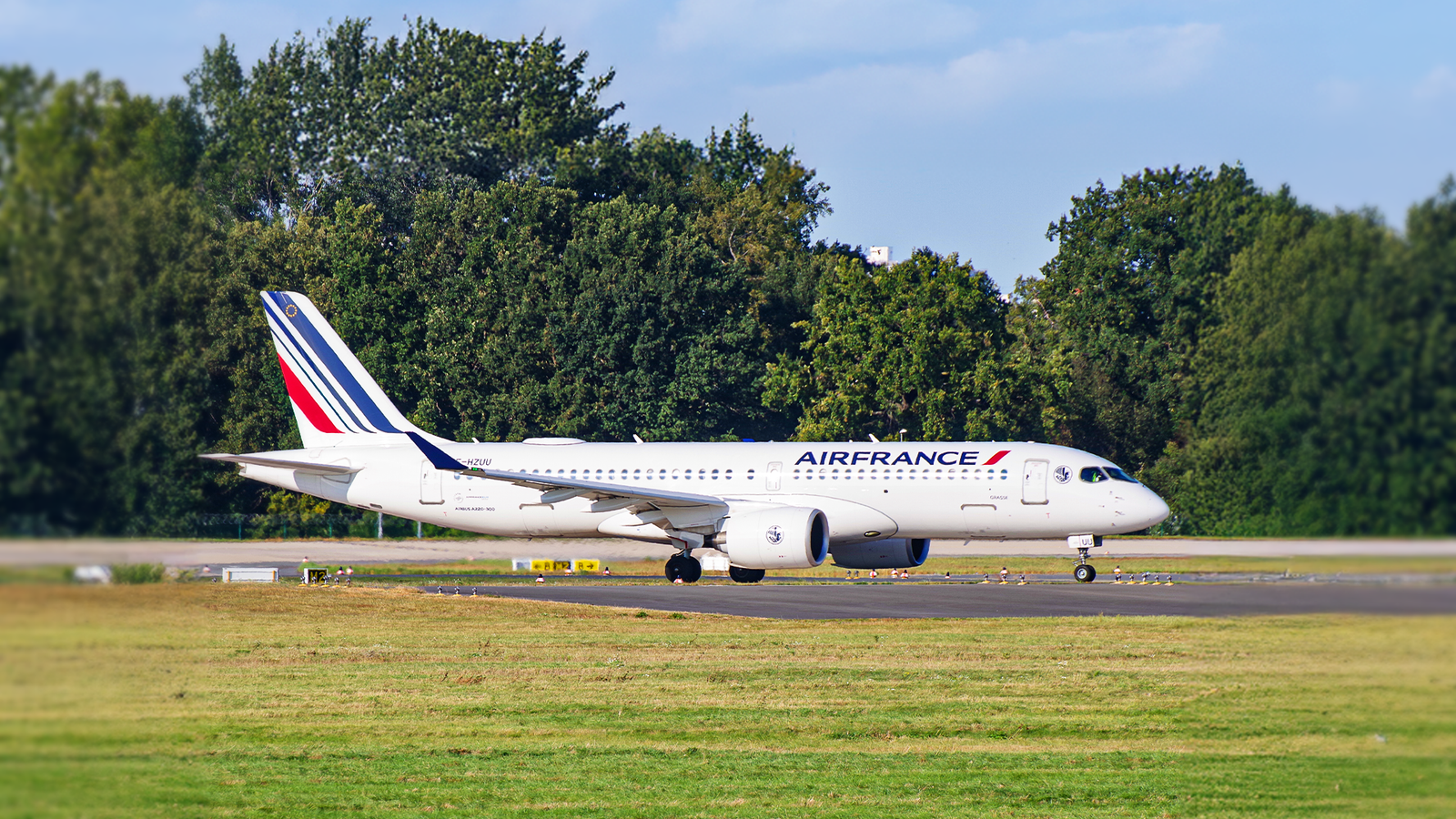
Published Nov 26, 2026, 5:01 PM EST Luke Diaz is a freelance military writer with experience with active duty experience in the US Navy as well as defense and industrial engineering. He is a former Naval Flight Officer who performed tactical air control on the carrier-based E-2 Hawkeye. Air France took delivery of its 60th Airbus A220-300 on November 6, closing out a five-year narrowbody renewal program. That milestone underscores the regional jet's growing global fleet and its place among the world's largest operators. Joining the French flag carrier on that podium are two airlines that exclusively fly the A220: Breeze Airways, with 57 and growing, and airBaltic's 55-strong fleet. The budget carriers on opposite sides of the Atlantic Ocean join Delta Air Lines, which boasts 92 as of now, and JetBlue Airways with 65, to round out the top five. Notably, SWISS International Air Lines, which was the launch customer for the airframe, still owns just 30 aircraft. The jet's difficult development and launch after Airbus acquired the platform from Bombardier is just one part of the story. The A220 began as the CSeries before Airbus acquired a controlling stake in 2018. The Swiss order ended after it replaced its aging Avro RJ100 regional fleet, partly due to the ongoing engine crisis that has plagued the plane despite the otherwise popular airframe. Persistent durability issues and supply-chain bottlenecks with the Pratt & Whitney PW1500G engines forced operators worldwide to ground jets and even strip some for viable powerplants, keeping as many flying as possible. 5 airBaltic 55 A220s Credit: Bargais | Shutterstock Latvian flag carrier airBaltic introduced the stretched A220-300 in December 2016 and retired every turboprop and Boeing 737 by 2020 to run a pure single-type fleet. The most recent data places the carrier fifth globally with 55 aircraft listed on its roster, according to Airport Spotting. However, not all of those are airworthy. Groundings peaked at 13 parked jets in early 2025, wiping out thousands of seasonal flights across Europe and forcing costly replacement wet leases. Restructuring plans shrink the active fleet from 54 jets to 36 by year-end and put 40 undelivered orders under review, even though the airframe itself never caused the crisis. Operated purely on its merits, the airframe exceeded expectations across both scheduled flying and wet lease contracts. Its low fuel burn let airBaltic restart routes profitably at lower passenger loads after the pandemic while leasing up to 13 aircraft to SWISS and Lufthansa Group partners. Flying one 145-seat cabin simplified crew training, cut maintenance complexity, and supported flights stretching 3,450 nautical miles (6,389 km) from Riga to leisure markets like Tenerife. The vulnerability sat beneath the wing, where the A220 certifies only Pratt & Whitney's PW1500G geared turbofan. When metal defects in turbine blades triggered urgent inspections and stretched engine overhauls past 200 days, airBaltic had no alternative supplier to fall back on. Engine availability recovered early this year, yet years of grounded aircraft left airBaltic financially fragile when unhedged fuel bills spiked following the recent conflict in Iran. On September 14, the carrier filed for Chapter 11 bankruptcy protection in New York, naming Pratt as its largest creditor. 4 Air France 60 A220s Credit: Ellen Bones | Shutterstock Air France secured third place globally on November 6 when its 60th A220-300 arrived in Paris before opening service to Prague three days later, per Airline Geeks. That handover fulfilled the 2019 commitment to retire outdated Airbus A318 and A319 aircraft serving its network. Five years after entering service, the 148-seat fleet has carried nearly 24 million passengers and established the A220-300 as Air France's new medium-haul mainstay. Finishing the original batch roughly a year behind its initial 2025 target still left four 20-year-old A318s on the winter schedule. Industry-wide delivery delays and Pratt's PW1500G recalls tightened spare availability. As a result, Air France extended A318 operations to March 27, 2027. Rather than stopping at 60 jets, however, Paris now anticipates a 61st A220's arrival and is keeping 30 options plus 30 purchase rights. Route economics and passenger demand are driving Air France-KLM Group leadership to envision growing toward 90 or 95 A220s. Its five-abreast cabin puts 80% of travelers in a window or aisle seat with 20% more overhead bin volume, while free high-speed WiFi already reaches 85% of the fleet, with full installation expected by February 2027. 3 JetBlue Airways 66 A220s Credit: Wangkun Jia | Shutterstock JetBlue holds second place globally after counting 66 A220-300s in October out of its 100-aircraft total order, according to the Center for Aviation. That expansion completed the carrier's September 2025 phase-out of the Embraer E190. Trading 100-seat E190s for 140-seat A220-300s cut operating costs per seat by 29% and fuel burn per seat by 40%, projecting $4 million to $5 million in annual gains per jet. Meanwhile, passengers benefit from bigger seats measuring 18.6 inches (47 centimeters) wide, the roomiest economy seating in JetBlue's fleet. That comes alongside 35 inches (89 centimeters) of pitch in extra-legroom rows and 32 inches (81 centimeters) in standard rows. The jets also have upgraded seatback screens and free high-speed WiFi. Even at scale, JetBlue saw disruption from Pratt's engine recall as well as the Airbus factory bottlenecks in Mirabel and Mobile. Fiscal reports showed the airline opened the year with four aircraft parked over PW1500G shortages. After engine removal, the planes spent roughly 200 days in overhaul shops. Supply-chain delays also forced Airbus to trim JetBlue's delivery schedule, pushing its final three firm aircraft into 2030 and beyond. Eliminating the E190 still consolidated JetBlue into an exclusively Airbus operator, streamlining pilot and mechanic qualifications alongside its A320 and A321neo fleets. The transition also unlocked longer transcontinental routes for its smallest aircraft. 2 Breeze Airways 68 A220s Credit: Markus Mainka | Shutterstock Breeze climbed to fourth worldwide when its final Embraer E190 revenue flight landed in New Orleans from Orlando on September 7, following acceptance of the 57th A220 in July, per Airport Spotting. This autumn deliveries pushed the Salt Lake City carrier over 60 jets out of 90 firm orders and 30 options for more. That fleet blueprint follows the design of Chief Executive David Neeleman when he ordered 60 jets in 2018, right after Airbus took over the program. Neeleman revisited the decision in an Aerospace Global News story in September of this year, saying: "Our long-term strategy has always been to leverage the strengths and efficiencies of the Airbus A220-300 to help us cost-effectively scale our unique business model which centers around offering affordable, nonstop flights from unserved and underserved markets." Airline Fleet Variant Mix Firm Orders Delta Air Lines 92 A220-100 & A220-300 145 Breeze Airways 68 A220-300 90 JetBlue Airways 66 A220-300 100 Air France 60 A220-300 60 airBaltic 55 A220-300 90 Air Canada 44 A220-300 60 ITA Airways 31 A220-100 & A220-300 TBD SWISS International Air Lines 30 A220-100 & A220-300 30 Breeze fits 137 seats inside the A220-300, pairing 125 economy chairs behind 12 Ascent first class recliners pitched at 39 inches (99 centimeters), flying 91 cities across more than 300 routes where 85% to 90% carry zero nonstop rivals. That 3,400 nautical miles (6,297 km) reach outclasses the Embraer E195-E2 and older Boeing 737-700s, opening cross-border flights to Cancun, Punta Cana, Montego Bay, Nassau, Costa Rica, and Santo Domingo. Running one modern airframe slashes spare parts inventory and simplifies pilot scheduling compared with airlines splitting narrowbody flying across multiple cockpits. Meanwhile, the premium front cabin fills faster on thin leisure routes than any other regional jet could match. The airline has seen its 'long and thin' city pairs become steadily more profitable routes as a result. 1 Delta Air Lines 92 A220s Credit: Joe A. Kunzler | Shutterstock Delta Air Lines has consistently led the global rankings by a wide margin, with 87 counted in July before third-quarter figures raised its roster to 92 jets, per Aviation Daily Report. Unlike the single-variant fleets run by JetBlue, Breeze, Air France, and airBaltic, Delta flies a split roster of 45 A220-100s averaging seven years old and 47 newer A220-300s with 145 firm orders. Atlanta built its fleet on an order of 75 Bombardier CS100s from April 2016. That triggered Boeing's 2017 trade complaint, which was later linked to the proposed 292% US tariff. Chief Executive Ed Bastian held firm in October 2017, according to Reuters, saying, "We are not going to pay any tariff, and we do expect to take the airplanes," just before Bombardier transferred majority control to Airbus and set up final assembly in Mobile, Alabama. US trade commissioners unanimously threw out those tariffs in January 2018, clearing Delta to launch A220 service from New York's LaGuardia. Today, it deploys two variants from coast to coast as 25-year-old Boeing 717-200s and even older A319s are phased out. Looking ahead, the gap between top operators will widen further as Airbus eyes a 2027 launch decision on a stretched Airbus A220-500. The new variant would seat 160 to 185 passengers, with deliveries targeting 13 jets per month from 2028.
The 5 Biggest Airbus A220 Fleets In 2026 Don't Even Include The Jet's Launch Operator
Full Article
Original Source
Read the full article at Simpleflying →KhanList aggregates and links to publicly available news content. We do not host full articles from third-party sources. Always verify important information with original sources.