
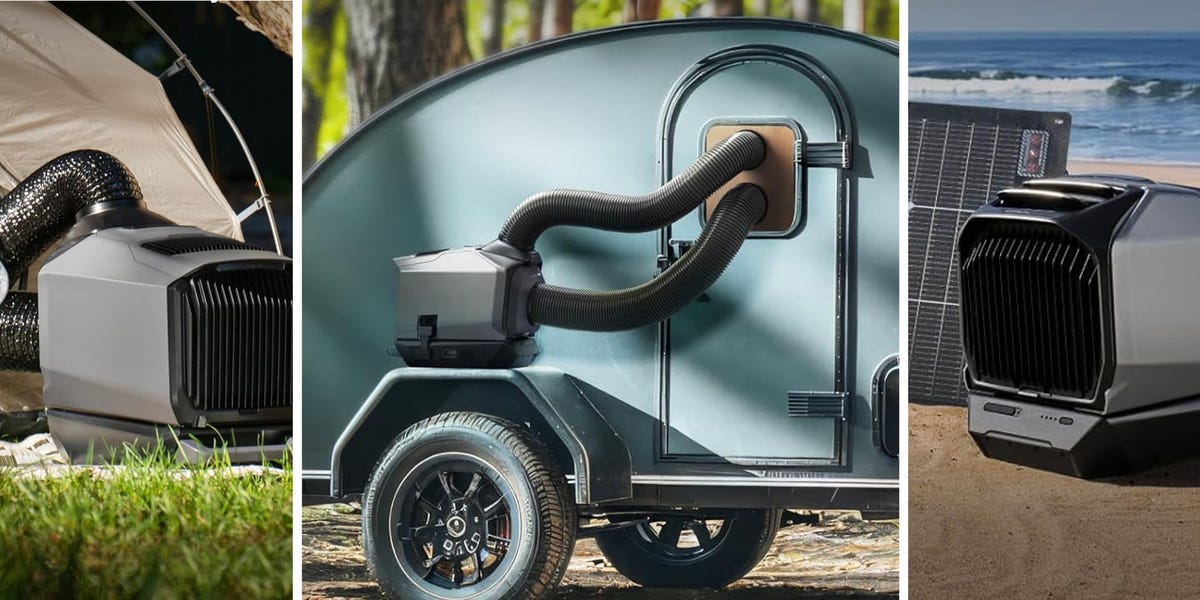
Every product was carefully curated by an Esquire editor. We may earn a commission from these links. Here’s how we test products and why you should trust us.AmazonProsHose-in-hose design for efficient coolingApp reminds you to clean filtersWi-Fi and digital assistantConsOn the heavy side, so portability can sufferIf we had to drop everything and buy a portable AC right now, it would be the Midea Duo. It's our top pick for its cooling efficiency, quietness, and suite of “smart” features like digital assistant voice control. We genuinely don't mind the Midea Air app. It makes setup easier and conveniently reminds you to clean your filters periodically—something we dearly need from all filtered devices. If you don’t need all that, you can just use the included remote for the basics of turning the thing on and off, changing mode, and setting sleep timers.What really makes the Midea Duo state-of-the-art is its hose-in-hose design. Typically, a dual-hose unit will cool much quicker than a single-hose unit. It will have a longer life too. The Duo has all the advantages of a dual-hose setup without the hassle of running two hoses from the unit to your window. It's a cutting-edge design and the reason that the Duo wins out over AC units that have functionally more cooling capacity.At 77 pounds, it is on the heavier side, so it's less portable than some others. If you know it will be staying in one room and you won't need to fuss with it, this is the AC to get.ProsExtremely quietPowerful cooling for spacesSmart featuresConsSingle hose setup is trickyHere’s another high-tech “smart” AC that, when connected to WiFi, can be commanded with your voice and set to climate control your room on its own, no need to touch that remote control. It uses a single-hose evaporative system to ensure that, unless humidity levels are high, you don’t have to go through the gross and annoying process of draining your unit.All that is fine and dandy, but here’s why you should buy this Dreo unit. It can cool a large bedroom (or equivalent) super quickly and does so without making as much of a peep of extra noise. It's so whisper-quiet, in fact, that if you need an AC to double as a white-noise machine, you may want to look at other options.Advertisement - Continue Reading BelowProsIdeal for 250 square ft or lessComes with window installation kitSimple remote controlConsNot enough BTU for larger roomsNo smart controlsHere’s a great little AC that aren’t smart or fancy or any of that. It just cools when you tell it to cool and does it without making as much noise as a typical tall portable unit. It comes with a remote control (which, mind you, only has a few buttons), but it also has a really neat LED control panel up top that fades into the background when you’re not using it.The caveat here is the power and range isn’t quite up to snuff with the other selections here. The Dreo and Midea ACs are great for bedrooms, but can be used in smaller living rooms or studio apartment situations to great effect. Not as much here. Still, if you are working with a smaller living space, going this route could save you some money.ProsGreat if you need to move it on a daily basisDehumidifying functionEasy-to-set-up Window KitConsGets loudIf you do want to use the app, it's not greatThis Black + Decker portable model is the quintessential AC unit, for better or worse. If you don't want another goddamn smart device in your home, this affordable model is the one for you. Just use a simple remote control and a single-hose setup, plug this sucker in, and you now have a fan, an AC, and a dehumidifier ready to go for the summer. Is there an app? Sure is, and it's not great, but the wonderful news is that you never need to use it.The unit can be loud, and there’s no app telling you when to clean. (Put that shit in your calendar.) Nothing fancy here—just a product that excels at exactly what it says it does. We can't fault it for that.Advertisement - Continue Reading BelowProsThe only one of these portable enough to take campingSupports various forms of charging, including solarAlso heats and dehumidifiesConsCooling area is smallExpensive AFFor those looking to cool down a tent in the middle of the woods on a sultry summer’s night, you only really have one option. This high-tech air conditioner is battery-powered and weighs in at just thirty-three pounds, making it the most portable you can get by far. It’s the perfect gadget for making real camping comfortable, without paying an arm and a leg for “glamping” amenities.You can power it with rechargeable batteries or from your car's AC power, or you can get that energy from solar panels. For heating, cooling, or even just dehumidifying small spaces, this works fantastically. This versatility makes it an excellent all-in-one device for camping in all types of weather. Or if you have a modest cabin, it may be just what you need.Frequently Asked QuestionsWhy get a portable air conditioner?If you live in a home where window units aren't feasible, you don't have central air, and it still gets hot and humid in the summer, you might need a portable AC. It can hook up to pretty much any window, and you can even move it between rooms at your leisure.How do portable ACs compare with window units?Window AC units can admittedly often be better at cooling a room in a power-efficient manner. It's true your energy bill may likely be higher when using a portable unit—at least this has been the case for us in the past. But what the portable variety offers is flexibility and portability. It can also be quite fast and furious. Where a window unit can maintain a temperature all day, it can take a while to cool down a room. The top end of the portable kind focuses on quickly removing all heat from a room to reach your desired temperature as fast as possible.What is a BTU?BTU stands for British Thermal Unit, which are a measure of how much energy an AC is using—basically how powerful it is. The current high end of portable units is 14,000 BTU, which many of these selections hit. It is worth noting that recently the Department of Energy developed a new standard of BTU measurement; SACC (Seasonally Adjusted Cooling Capacity). The previous BTU testing method (ASHRAE) was done purely under lab conditions and resulted in numbers that don’t often reflect what you get at home. The BTU SACC is closer to what you’ll actually be feeing at home. When shopping on Amazon these days, most portable ACs list both numbers. It’s important to know the difference.
The 5 Best Portable Air Conditioner Units
Full Article
Original Source
Read the full article at Esquire →KhanList aggregates and links to publicly available news content. We do not host full articles from third-party sources. Always verify important information with original sources.