
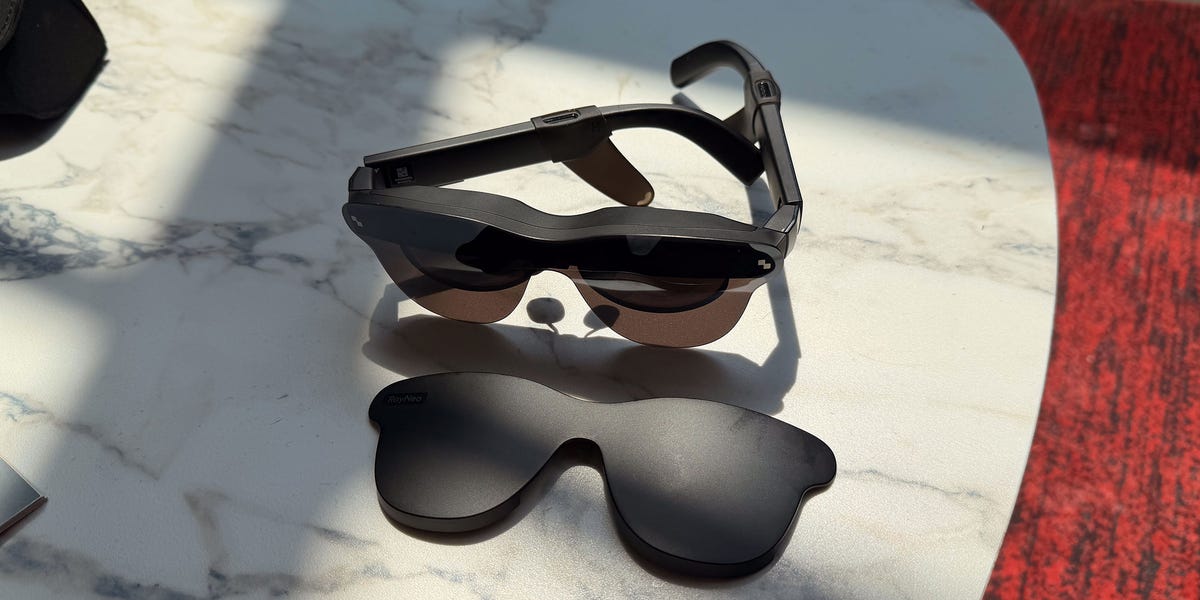
ProsWide field of view with native 3DoF trackingPocket Pro provides standalone streamingDolby Vision support (with Pocket Pro accessory)ConsYou miss out on Dolby Vision playback if you don’t have the Pocket TV ProRayNeo’s GT Max works well as a conventional display, but its primary appeal is its ability to function as a fully autonomous video streaming device. When paired with the Pocket TV Pro, an optional processor box that augments the glasses with additional built-in storage, battery, and processing power, you can stream video from Google TV, Netflix, YouTube, and many other popular streaming services without taxing your phone or laptop.The GT Max has dual 1080p Micro-OLED displays with a 120-Hz refresh rate and a 59-degree field of view. The virtual screen expands up to 307 inches, which is the largest virtual screen I’ve tried to date. It also features 3DoF head tracking that allows you to anchor the screen or have it “follow” your eyes. When watching Royal Court (my favorite YouTube podcast set in medieval times), I could make out details and features just as well as I could if I was watching on my television, which sits about eight feet in front of my couch.A little more on the Pocket TV Pro: It adds 64GB of onboard storage, and a 6,500mAh battery rated up to 5.5 hours of viewing. It’s also the key to getting Dolby Vision. When I used the accessory with the GT Max, I felt like I was getting a more traditional streaming device experience without needing to keep my phone connected.On the audio side, The GT Max features a quad-speaker system, which sounded solid, though their open-ear design lets in some background noise (while that’s expected, you can always pair these with your favorite headphones or earbuds if it’s really a bother). In quieter settings, I had no issues hearing my YouTube videos, but if you were using these on a commute or an airplane, ambient noise might overpower what you’re listening to.While the Pocket TV Pro gives the advantage for standalone streaming, the glasses still function just as well when connected to a phone or laptop. Video stayed sharp across my devices, and the fixed-screen mode was useful when I was working on my computer, though I occasionally had to zoom in on documents to make text easier to read at the display’s viewing distance. Whether you want a private theater experience or a more flexible external display, the GT Max does both.Key SpecsDisplay TypeMicro-OLEDResolution (per eye)1920 x 1080pRefresh RateUp to 120 HzField of View59 degreesVirtual Screen SizeUp to 307 in. Tracking3DoFWeight2.75 ozConnectionUSB-CProsLightweight frame is comfortable to wear Image quality is clear and vibrantQuad speakers deliver consistent soundConsNo spatial head trackingThe XReal xbx a01+ is a more affordable entry-level option if you’re just dipping your toe in the wearable display pool. With a lightweight frame and a plug-and-play USB-C connection, these are easy to use and good for casual gaming, streaming, and basic productivity work like email.I also like that the xbx a01+ looks more like a pair of sunglasses than a set of generic black tech goggles. Blue polarized lenses give the design a little more personality, and the flexible temples and nose pad options help accommodate different sizes and fits. And with that lighter weight, you might actually be able to wear these around on your head regularly instead of keeping them tucked away in your bag.The directional speakers handle audio well, and the USB-C cable supplies both the video signal and power. These also don’t skimp on features in the way you might expect for a more affordable model. You still get dual 1080p Micro-OLED panels, 120Hz refresh rate for gaming, a 50-degree field of view, and a plug-and-play setup.One important caveat: the a01+ uses 0DoF stabilization instead of full 3DoF spatial tracking. The image is stabilized in front of you, but you don’t get the same anchored virtual monitor experience like you do with more expensive displays like the RayNeo GT Max or Viture Beast. For the price, though, it delivers the essentials without piling on a ton of extra features.Key SpecsDisplay TypeMicro-OLEDResolution (per eye)1920 x 1080pRefresh RateUp to 120 HzField of View50 degreesVirtual Screen Size147 in.Weight2.18 ozTracking0DoFConnectionUSB-CAdvertisement - Continue Reading BelowProsImpressive picture with vibrant colors and deep contrastLens shield blocks out ambient lightSound tubes improve audio clarity and reduce sound leakageConsSmaller field of viewThe RayNeo Air 4 Pro has strong display specs, with 1080p-per-eye Micro-OLED panels with a 120Hz refresh rate, 47-degree field of view, and HDR10 support. Adding HDR, which not all of these glasses have, improves image quality in a lot of streaming content, enabling bigger pops of color and more dynamic lighting. Podcasts and movies were vibrant and had impressive contrast without being overly saturated.The 201-inch virtual screen, bigger than the xbx a01+, but smaller than the RayNeo GT Max, hits a sweet spot that feels a lot like a movie theater. Adding to the theater experience, these glasses come with a lens shield that blocks out ambient light, and “ear tube” attachments pump audio directly into your ears for fuller, louder audio playback from the Air 4 Pro’s 4-speaker sound system. The lens shields are incredibly helpful if you’re in a brightly lit space. The ear tubes, less so, but they are worth using if you don’t have headphones to bring to the party.The glasses connect easily via USB-C, but like most other AR glasses that pair directly to your device, you can expect your battery level to take a hit. With the Air 4 Pro, streaming drained my phone’s battery by around 20 percent per hour—the others I tested lost battery at around the same rate. That’s fine for shorter watching sessions, but you’ll likely need to plug your device into power for movie marathons.Comfort was another sticking point. Despite a light overall weight of just 2.68 ounces, the Air 4 Pro feels front-heavy, so they slid forward a bit when I was looking down. I struggled to find a secure fit. Finally, the screen display is center-fixed in your field of view, so it follows your head rather than staying anchored in space, making these better for stationary viewing than virtual-monitor multitasking.Despite some fit and tracking quirks, the RayNeo Air 4 Pro delivers a solid personal theater experience. HDR support, punchy colors, and good contrast make movies and shows look great, while the light shield helps to stay immersed in what you’re watching. If your main goal is turning your devices into big-screen entertainment, these glasses are still a respectable option.Key SpecsDisplay TypeMicro-OLEDResolution Per Eye1920 x 1080pRefresh RateUp to 120 HzField of View47 degreesVirtual Screen Size201 in.TrackingFollow modeWeight2.68 ozConnectionUSB-CProsWide field of viewHigh per-eye resolutionBuilt in 3DoF trackingElectronic lens dimmingConsHeavier than other wearable displaysThe Viture Beast is a bit pricey, but moves the needle a bit on both images and field of view. Its Sony Micro-OLED displays output at 1920 by 1200 pixels per eye (slightly higher than standard 1080p), and stretch across a wider 58-degree field of view. That’s great for gaming, sports, and other viewing experiences where you really want to see everything. The 174-inch virtual screen isn’t the biggest I’ve seen, which is a shame given these specs, but the viewing distance is four meters, which is closer than average, so the screen feels bigger because you’re up close.The glasses use 3DoF tracking, with options to anchor the screen, follow your head movements, or adjust the viewing layout. The Beast also has an electrochromic dimming system built directly into the lenses with nine adjustable levels to go from mostly transparent to completely dark, and you can manage these settings on the glasses themselves. No lens shields to deal with here.My one gripe here is the weight: At a little over three ounces, they can start to tire you out in a long session. You may also balk at the price, which is about the same as the RayNeo GT Max and its optional processor box combined, but they’re definitely an appealing pick if you want to maximize for a wide, immersive screen.Key SpecsDisplay TypeSony Micro-OLEDResolution Per Eye1920 x 1200pRefresh RateUp to 120 HzField of View58 degreesVirtual Screen Size174 in.Weight3.10 ozTracking3DoFConnectionUSB-CAmber is a Reviews Editor with bylines on Popular Mechanics, Runner’s World, Bicycling, and Best Products sites. Specializing in kitchen gadgets, small appliances, lifestyle, and consumer tech, she brings hands-on testing and a detail-oriented approach to every review. In her free time you can likely find her trading trinkets at an EDM festival, searching for hidden gems at thrift stores, or cuddling with her two cats.
The 4 Best Wearable Displays Project a Virtual Big-Screen Anywhere You Need
Full Article
Original Source
Read the full article at Popularmechanics →KhanList aggregates and links to publicly available news content. We do not host full articles from third-party sources. Always verify important information with original sources.