
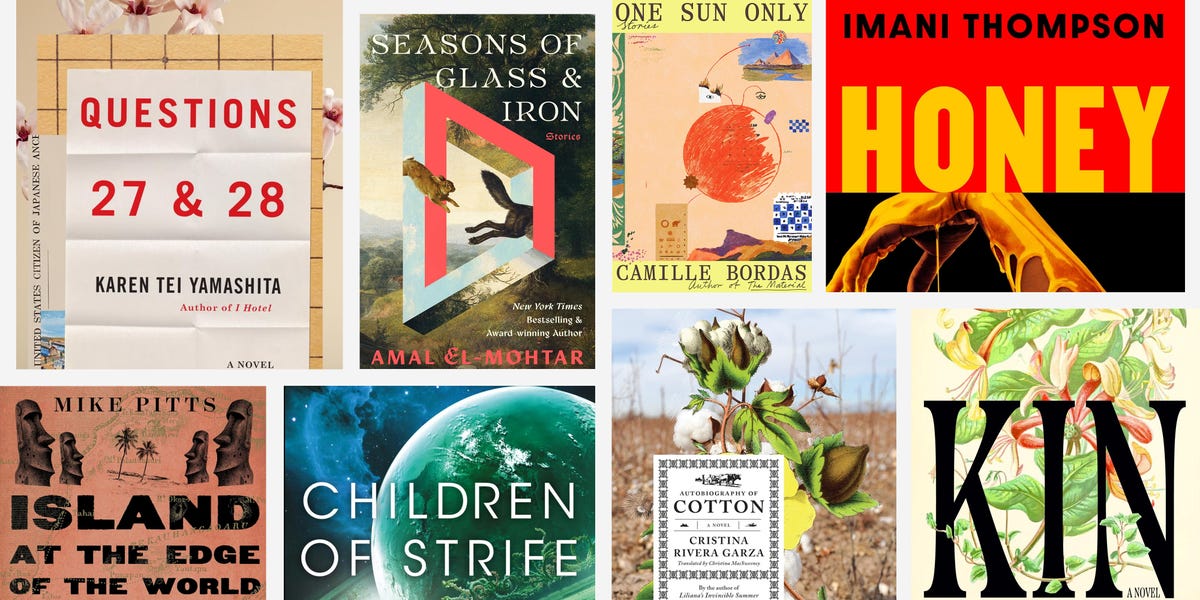
Every product was carefully curated by an Esquire editor. We may earn a commission from these links. Here’s how we test products and why you should trust us.Amazon1 min readBack in January, I had a feeling 2026 was going to be a special year for books, and here at the onset of autumn, my optimism has been rewarded. After a spring filled with highlights by Louise Erdrich, Amal El-Mohtar, Namwali Serpell, and Ben Lerner, the summer delivered another crop of new, award-worthy books.Household names like Emily St. John Mandel, Marlon James, Ann Patchett, and Robert Jackson Bennett returned with spectacular new novels, while Mahmud El Sayed and Shannon Sanders penned praiseworthy debuts. The journalists Yeganeh Torbati and Bozorgmehr Sharafedin wrote a nonfiction mosaic that rivals Patrick Radden Keefe’s London Falling among the year’s best, and the ever-reliable novelists Grant Ginder, Téa Obreht, and Ray Nayler turned in some of their best work yet.As the nights grow longer and colder, cuddle up with one of the science fiction, fantasy, history, mystery, or short story books on our list.After the success of Station Eleven, The Glass Hotel, and Sea of Tranquility, Mandel's new novel was one of the year's most hotly anticipated books—and it absolutely delivers. Exit Party is a swirling kaleidoscope of a novel set in two very different versions of the future. In one reality, the United States has collapsed into a chaotic battleground between warring territories. In another, advanced technology has blossomed courtesy of an autocratic government with unlimited power. As Mandel weaves in threads from her previous novels, connecting them once again into a kind of Mandel Cinematic Universe, unraveling the mysteries behind Exit Party's realities is one of the book's greatest joys.Grant Ginder’s sixth novel is his best yet—a breezy, funny, instant classic that charts the millennial generation’s transition from young adulthood to midlife across the late 2000s, 2010s, and early 2020s. The story follows five friends—Richie, Marco, Mia, Sasha, and Adam—who first met as students at the University of Pennsylvania, where Ginder got his own B.A. After opening on a clever note of suspense (an impending funeral in 2024), the novel goes back to a New Year’s Eve party on the Lower East Side in 2007 before careening around the century-so-far until we eventually learn who dies first.I won’t go as far as Dwight Garner—who called this “the novel of the decade, if not the century” in The New York Times—but I do think it’s among James’s best work alongside A Brief History of Seven Killings and Moon Witch, Spider King. Opening in Kingston, Jamaica, in 1988, The Disappearers is another sprawling, visceral epic that traces the lives of eight gay men after they are viciously attacked by homophobes while rehearsing a play, John Herbert’s Fortune and Men’s Eyes.It takes a special writer to come up with a fresh take on the haunted house, but that’s exactly what Sanders has done in her debut novel. The Great Wherever is set in rural Tennessee, where a thirty-something named Aubrey Lamb inherits her father’s share of a farm filled with the gossipy ghosts of her ancestors. Inspired by Sanders’s own family history, it’s a masterful, propulsive, and suspenseful literary dramedy.Don’t be fooled by the cover art—this is (largely) not a book about horses! Set in Manhattan and upstate New York, it’s about a middle-aged woman named Daphne Fuller who runs into her former stepfather, Eddie Triplett, in the Museum of Modern Art. Decades since they last saw each other, this chance encounter propels them into a newfound friendship as they remember their past. Both heartwarming and heartbreaking, Whistler is Ann Patchett at her finest.Ray Nayler has become one of the most consistently fascinating science fiction writers working today thanks to his cerebral tech-thrillers, including The Mountain in the Sea (about superintelligent octopuses), The Tusks of Extinction (about cloned woolly mammoths), and Where the Axe Is Buried (about an AI-centered technocracy), each of which has wound up on my year-end best-of lists. Now, Palaces of the Crow is a clever, pacy blockbuster about a flock of hyperintelligent crows that help four teenagers survive in the wilderness after getting caught between the Nazis and the Red Army at the onset of World War II.El Sayed’s debut science fiction novel is a fascinating and awe-inspiring vision of the future I can’t stop thinking about. Set hundreds of years from now, when a multigenerational colony ship is halfway through a four-century journey between Earth and a distant star, The Republic of Memory imagines life aboard a gargantuan spacecraft where thousands of people live in an interstellar city with its own neighborhoods, cultures, and conflicts.Obreht just doesn’t miss. After The Tiger’s Wife, Inland, and The Morningside, her fourth novel Sunrise is a taut, hatchet-sharp literary thriller set in a Wyoming ghost town. Bouncing between 1902, 2003, and 2024, it’s about a pilot who crashes in the wilderness, a historian obsessed with local history, and a dying gunslinger searching for a missing boy.Nobody is writing better fantasy trilogies than Robert Jackson Bennett, including The Divine Cities and The Founders Trilogy. Now, A Trade of Blood is the third book in his latest series, The Shadow of the Leviathan, a Victorian-tinged, biopunk-fantasy murder mystery starring Ana, an investigator who wears a blindfold to avoid overstimulation, and Din, her assistant with a photographic memory. Like all of Bennett’s novels, it’s a wildly clever mix of genres with sumptuous payoffs and reveals.The most timely and essential work of nonfiction I’ve read this year, Stolen Revolution is a stunning chronicle of Iranians whose lives were impacted by the 1979 revolution, when the Pahlavi monarchy was replaced by the Islamic Republic of Iran. Torbati and Bozorgmehr follow the stories of six individual Iranians across the ensuing decades as the initial optimism around the revolution fades into grief for what might have been.Nearly two decades after his short story collection In Other Rooms, Other Wonders was a finalist for the Pulitzer Prize and National Book Award, Mueenuddin returns with a masterful debut novel set in Pakistan. It begins in 1955 with an orphaned tea seller in the Rawalpindi bazaar, and expands to follow the “upstairs, downstairs” lives of a wealthy family and the men and women who work for them. It is a startling and breathtaking work of fiction that will be remembered as a classic multigenerational epic.Chuck Klosterman’s The Nineties was one of the most interesting and satisfying nonfiction reads of 2022 for me, so I was thrilled to hear he was turning his inquisitive eye on American football next. “In 2023, 93 of the 100 most-watched programs on U.S. television were NFL football games,” says Penguin Press. “This is not an anomaly.” I particularly enjoyed Klosterman’s investigation of the socio-cultural layers of football in places like Texas and the Southeast.In 1994, the British archaeologist Mike Pitts found himself, rather unexpectedly, in one of the most remote places in the world—Easter Island, home to the giant stone statues immortalized as the 🗿 emoji. When he learned about a lost goldmine of research conducted by an English couple during the early twentieth century, Pitts spent decades tracking it down in archives and libraries. As a result, Island at the Edge of the World is a groundbreaking, eye-opening work of history and adventure that challenges the prevailing story of Easter Island among tourists and scholars.I’ve been telling people for years that Bordas is one of our greatest living short story writers. Her new collection, One Sun Only, showcases her unique command of voice, tone, and tension. In “Chicago on the Seine,” a man who repatriates American bodies after they die in France is asked to spend the night with one in a morgue. In “The Presentation on Egypt,” a surgeon’s unexpected death changes the way his surviving wife perceives time. It’s a great concept album on how we experience life, death, time, and space—with no skippable tracks.Now 61 years old, the Mexican novelist and memoirist Cristina Rivera Garza remains one of the most innovative and fascinating writers in the Western Hemisphere. Her latest, Autobiography of Cotton, is a stunning work of autofiction based on her grandparents’ journey to the cotton fields along the US-Mexico border. Originally published in Spanish in 2020, this new translation from Christina MacSweeney is silky smooth.Namwali Serpell is a brilliant novelist herself, but also a Professor of English at Harvard, where she teaches a course on Toni Morrison, the Nobel Prize-winning author of The Bluest Eye, Sula, Song of Solomon, and Beloved. Serpell’s deep but clear investigation of Morrison’s literary genius is one the best primers to an author’s oeuvre I’ve ever read.Following the massive success of An American Marriage, Jones returns with Kin, an intense, heartbreaking story about a lifelong friendship in the American South during the Jim Crow era. Annie and Vernice, two “cradle sisters” in the small town of Honeysuckle, Louisiana, have been “friends since we smiled with our milk teeth.” But Annie’s mother abandoned her shortly after giving birth, while Vernice’s mother was murdered by Vernice’s father. Years later, as adults, they wind up in very different places, geographically and socially, until Annie becomes desperate for an escape that only Vernice has the power to provide.Seven years after her memoir Long Live the Tribe of Motherless Girls, T Kira Madden’s debut novel has arrived, and it’s a tense, atmospheric thriller set on an island near Seattle. When a sex criminal is murdered, three women—his mother and two of his victims—must reckon with the ensuing secrets, confusion, and darkness.When I read the first chapter of Charlotte Wood’s fifth novel, I was completely entranced and kept reading until well after midnight. First published in Australia 10 years ago, The Natural Way of Things is a subtle, haunting, sunbleached nightmare of a novel. When several women wake up in a spartan compound somewhere in the desert, with no memory of how they arrived, they share stories and realize they all have something in common: abuse at the hands of powerful men. Wood’s sparse and evocative prose makes this an unforgettable reading experience.Tchaikovsky’s 2015 novel, Children of Time, is one of the most popular works of science fiction of the century so far. Each book in the ensuing series has introduced a new intelligent species “uplifted” by human technology, including spiders, octopi, and ravens. This year’s Children of Strife, the fourth entry in Tchaikovsky’s franchise, features an interstellar ship piloted by a giant mantis shrimp, which discovers a forgotten planet terraformed by Earth’s diaspora long ago. It’s a fast-paced romp that showcases Tchaikovsky’s galactic imagination once again.Now 71 years old, Louise Erdrich has written more than 30 books, but Python’s Kiss is only her second short story collection. These stories were written over the past two decades of her career, including her 2022 standout “The Hollow Children,” set in Minnesota during the deadly 1923 blizzard where a bus driver holds the lives of children in his hands.A fascinating speculative short story collection (plus a few poems) from the author of The River Has Roots and the co-author of This Is How You Lose the Time War. These deliciously imaginative stories have won and been nominated for Hugo, Locus, Nebula, and World Fantasy Awards, and there’s not a single dud in the bunch.Chances are you’ve already heard the hype around Lerner’s first novel since 2019’s The Topeka School. But is it really that good? Yes—resoundingly. This will likely be remembered as one of the year’s best works of fiction, if not the decade’s. It starts with every journalist’s nightmare: showing up to a once-in-a-lifetime interview without a recording device. At less than 150 pages, Transcription joins the ranks of “weird little novels” that are moving and challenging enough to change your perspective.The author of Say Nothing—which was adapted by FX into one of the best TV series of the decade so far—returns with another blockbuster feat of reportage. This time, Keefe investigates the mysterious death of Zac Brettler, a teenager who jumped in the River Thames just outside the headquarters of MI6 in 2019 after pretending to be the son of a Russian oligarch. I sprinted through this addictive book in three days and gasped more than once at the true story’s twists and turns.Karen Tei Yamashita deserves to be a literary household name courtesy of her previous novels Brazil-Maru, Tropic of Orange, I Hotel, and Through the Arc of the Rainforest. I devoured her ambitious fifth novel, Questions 27 & 28, titled after the “so-called loyalty questionnaire” that 120,000 Japanese Americans were forced to take in order to be considered for release during their internment in concentration camps after the attack on Pearl Harbor.Honey was one of the most-anticipated debut novel of the year thanks in part to its perfect-for-Hollywood premise: a Cambridge PhD student “who murders bad men and justifies it in the name of feminism.” Based in London, Imani Thompson studied Sociology at Cambridge herself, and her fast-paced novel feels expertly grounded in the reality of British academia while subverting your expectations and delivering plenty of thrills.The Scottish writer Douglas Stuart became a literary star after his debut novel Shuggie Bain (2020) and its follow-up Young Mungo (2022). Now, Stuart moves from Glasgow to the mountainous island of Harris in the Outer Hebrides, where a young art student returns to his hometown and faces cultural and personal reckonings with his father and mother. John of John is another masterful, heartbreaking character study that will likely get awards attention later this year.A stunning and lyrical literary horror novel set in the city of Lagos, Nigeria, where rumors contend that pregnant women are inexplicably walking into bodies of water and drowning themselves. When a 23-year-old woman named Yosoye arrives in Lagos to start her career at a prestigious architectural firm helping build Omi City—a luxury development on reclaimed land—she soon discovers her own pregnancy. Aguda was a finalist for her 2024 short story collection Ghostroots, but One Leg on Earth is even more richly imagined and deftly executed.
The 28 Best Books of 2026 (So Far)
Full Article
Original Source
Read the full article at Esquire →KhanList aggregates and links to publicly available news content. We do not host full articles from third-party sources. Always verify important information with original sources.