
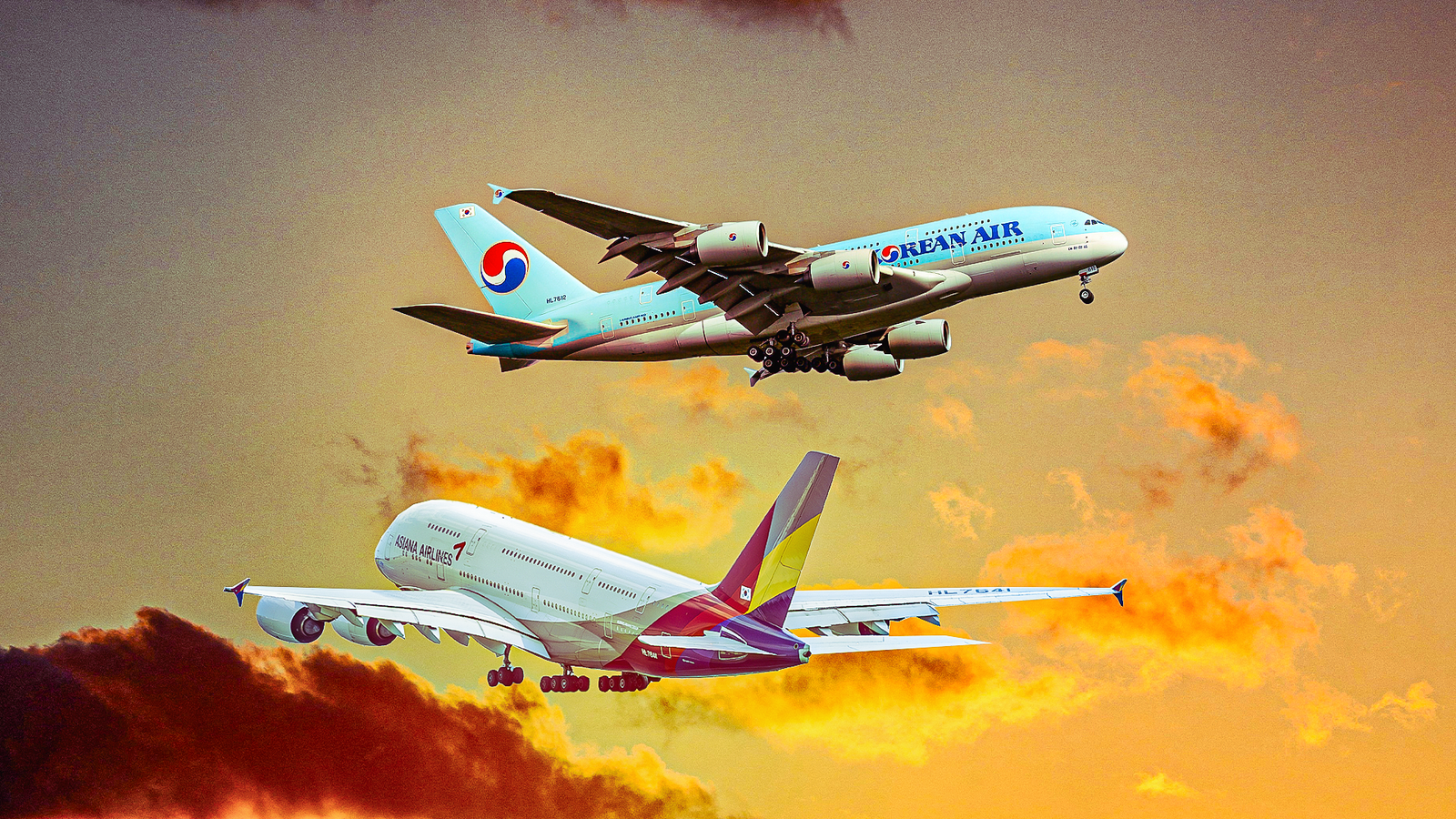
Published Nov 16, 2026, 1:00 AM EST Aaron is an aviation enthusiast and world traveler with a deep interest in aerospace history and technology. He has traveled around the world numerous times, often incorporating visits to aviation museums and historic aircraft collections into his journeys. A native of New Zealand, he is an expert in aviation and maintains a broad interest in a variety of other subjects. At the end of this year, Korean Air is expected to absorb Asiana Airlines' fleet of six Airbus A380s, adding them to its fleet of five. This will create one of the largest fleets of Superjumbos over the Pacific. That said, one of Asiana's superjumbos appears parked, and it's unclear whether it is expected to return to service. If not, this would give it the same operational fleet as Qantas, which also operates 10 (down from 12). Singapore Airlines sits at the crossroads of the Indian Ocean and Pacific Ocean and operates a fleet of 12 A380s, down from 24 before COVID-19. The only other carrier in the Indo-Pacific to operate the giant aircraft is All Nippon Airways (ANA), with its diminutive fleet of three aircraft. China Southern Airlines scrapped its fleet years ago. How Asiana's A380s Are Configured Credit: Karolis Kavolelis l Shutterstock In 2024, Korean Air acquired Asiana, although for now, Asiana continues to operate under its own brand. Both of the Korean airlines operate fleets of A380 superjumbos, and these are configured significantly differently from each other. A380s flying for Asiana operate with a relatively high-density 495-seat configuration. Korean Air has opted for a more spacious 407-seat configuration that is more premium-heavy. Asiana's superjumbos have 12 Business Suite seats located on the main (lower) deck (configured 1-2-1), 66 Business Smartium seats on the upper deck (also configured 1-2-1), and 417 economy class seats. The Business Suites were originally sold as First Class, but are now marketed as premium Business Class. They are available to eligible business class passengers for an additional fee. Economy seats are configured 2-4-2 on the upper deck and 3-4-3 on the lower deck. There are 311 economy seats on the main deck and 106 economy seats on the upper deck. Asiana's brand is due to be retired in mid-December 2026, when Korean Air completes absorbing it. Korean Air will take over Asiana's A380's, although the time is ticking on how long these giant aircraft will continue flying. Korean Air's A380 Seating Configuration Credit: Evan El-Amin l Shutterstock Korean Air's A380s are fitted with 12 first class (Kosmo Suites), 94 business class (Prestige Class) seats configured 2-2-2, and 301 economy class seats configured 3-4-3. The main deck has the 12 first-class suites and all 301 economy seats. The upper deck is dedicated to the 94 business class suites and is complete with a bar/lounge area. There was a duty-free shop at the back of the lower deck (now a self-serve snack area). When the aircraft entered service, Korean was the only airline to fill the entire upper deck with business class. Overall, 15.8% of Asiana's seating is premium, with the share rising to 26.0% for Korean Air. At the time when they were delivered, Korean's A380 also came with the fewest seats of any airline operating that superjumbo. With the two carriers set to merge, Asiana's A380s will get a new livery and fly with Korean Air colors. It is also likely that Asiana-specific products like Smartium will be rebranded or changed. "Your dream flight begins with the A380. Enjoy the special experience of a business aircraft with our First Class seats that offer complete privacy and quality service, as well as Prestige Class that offers the world’s first exclusive 2nd floor," the airline says on its website. Inside Korean Air's New Airbus A350-900s On Incheon-Osaka & Fukuoka Routes In March 2024, Simple Flying reported Korean Air had placed a massive $13.7 billion order for 33 new Airbus A350s (including six A350-900s and 27 A350-1000s). Korean Air has now received the first two A350-900s and is placing them on short-haul routes to Osaka and Fukuoka in Japan from South Korea's primary international airport, Seoul-Incheon. Korean Air is the largest airline in Korea and the country's flag carrier. Korean Air is undergoing some significant changes; not only is it taking delivery of its first A350s, but it is also completing its merger with its previous rival, Asiana Airlines. Korean Air announces its first A350-900s coming into service Read Article > Aging Cabin Designs Credit: KITTIKUN YOKSAP l Shutterstock While Korean's configuration was a premium-heavy configuration for the time, the cabins are also dated. Korean's first-class seats have no doors, and its upper-deck business seats are in an older 2-2-2 layout, meaning that window seat passengers lack direct access to the aisle. As stated, Asiania's business class configuration is a staggered 1-2-1 for business class, allowing business class passengers to have direct aisle access. One of the notable issues with these older cabin designs is the lack of premium economy seating. Other airlines such as British Airways and Emirates are busy reconfiguring their superjumbos with significant premium economy options. Emirates has previously said that these sell "like hot cakes" and installing them is one of its best decisions. Emirates' newly reconfigured A380s come with 569 seats made up of 76 business class seats, 56 premium economy seats, and 437 economy seats. The configuration is replacing its older, high-density 615-seat configuration, among others. Both British Airways and Emirates are investing heavily in the new cabins, demonstrating that the airlines plan to keep them in service for years to come. However, the story is different with Korean Air, and its A380s are not likely to receive new cabins. Delays In Replacement Aircraft Credit: Angel DiBilio l Shutterstock Given a choice, Korean Air would likely have retired its A380 Superjumbos already. During COVID-19, Korean Air originally purchased 10 superjumbos and then retired four of its A380s, which were only nine years old at the time. It retired a fifth aircraft in 2023 and has since scrapped four of them (one remains stored). It then scrapped four of its A380s. Asiana purchased a total of six and all six remain in inventory. As of the time of writing, four are active, one is in maintenance, and one has been stored since May 2026. In mid-2025, Korean Air's airline chief Walter Cho said the airline had previously planned to retire all of its A380s by 2026, but was forced to extend their service due to delays in replacement aircraft. New-generation aircraft Korean is purchasing include the A350, 787 Dreamliner, and 777-9. The group has orders for 40 examples of the type. Aircraft Type (Planespotters.net) Korean Air (Current Widebody Aircraft) Asiana (Current Widebody Fleet) Combined On order (Passneger only, Both brands) Airbus A330-300 17 14 31 - Airbus A350-900 3 15 18 18 Airbus A350-1000 - - - 20 Airbus A380 5 6 11 - Boeing 747-8 4 - 4 - Boeing 777-200ER - 8 8 - Boeing 777-300 4 - - - Boeing 777-300ER 25 - 25 - Boeing 777-9 - - - 40 Boeing 787-9 Dreamliner 14 - 14 6 Boeing 787-10 Dreamliner I12 - 12 53 Total Passenger Widebodies 85 43 128 137 Without sufficient replacements, Korean Air has had little choice but to hold onto its aging 747-8s, A380s, and very old 777s for longer. "As soon as we get new aeroplanes, as soon as the next opportunity comes, those two airplanes (A380s and 747s) will be phased out," Cho explained. Ironically, instead of getting rid of its superjumbos, Korean Air is finding its A380 fleet doubling back to what it originally operated. Korean has three more orders for the A350-900 and 10 for the stretched A350-1000. It has six more 787-9s on order alongside an impressive order book for 53 outstanding 787-10 orders. The 2028-2031 Phase Out Timeline Remains Contingent Credit: KITTIKUN YOKSAP l Shutterstock Replacements are coming. In 2024, Korean Air received its first two A350-900s, with another arriving this past March. Last year, it received nine new 787s (mostly 787-10s), and another five have arrived so far this year. One major issue is the delay in the 777-9 entering service. For now, Korean Air's updated plan is to keep the superjumbos in service until 2029-2031. The feasibility of the schedule is at least partially contingent on when the 777-9s are delivered. Something is similar for Asiana. The previous plan to retire them in 2026 is now pushed back to 2028-2030. It should be remembered that these timelines are contingent. Should there be a sudden 9/11 or COVID-19-like slump in the aviation sector, these quadjets would likely be among the first on the chopping block. Even this year's impacts on fuel prices pushed Lufthansa to retire its remaining fuel-hungry A340s early. But even without a major downturn or oil shock, retirements could be brought forward. For example, apparently due to increasing confidence in its incoming Airbus A350-1000ULRs, Qantas has announced it is bringing forward the retirement of its A380s by four years. Those will start retiring in 2028. Where Korea's A380s Are Flying Today Credit: Sergey Kustov l Shutterstock Today the fleets of Korean A380s fly select long-haul flagship routes. Both sets of superjumbos are operated exclusively out of Seoul Incheon and focus on core transpacific trunk routes, although these are paired with short-haul Asian utilization hops. As Korean absorbs Asiana, the A380 capacity is being concentrated on the New York and Los Angeles routes while scaling back the European and Australian routes. Korean Air's A380s' two main long-haul routes are to New York-JFK (daily) and Los Angeles (up to daily), with short ad-hoc flights to Tokyo Narita, Taipei (Taiwan), and Hong Kong. Asiana's fleet is currently serving daily flights to Los Angeles and seasonal/peak periods flights to New York JFK, as well as seasonal summer flights to Sydney. Regional flights include Tokyo Narita, Bangkok, and Taipei. Asiana's seasonal deployment to Sydney has entered its final run, while the A380s have already been permanently pulled from European routes (e.g., Frankfurt) in favor of twinjets like the A350-900 and 777-200ER. One of the biggest shifts over the last 12 months has been doubling down on New York-JFK. Instead of being competing aircraft on Los Angeles and New York routes, as in the past, these aircraft are now complementing each other.
The 2 Airlines Forming The Largest Carrier Over The Pacific Operate Superjumbo Aircraft That Are Drastically Different
Full Article
Original Source
Read the full article at Simpleflying →KhanList aggregates and links to publicly available news content. We do not host full articles from third-party sources. Always verify important information with original sources.