
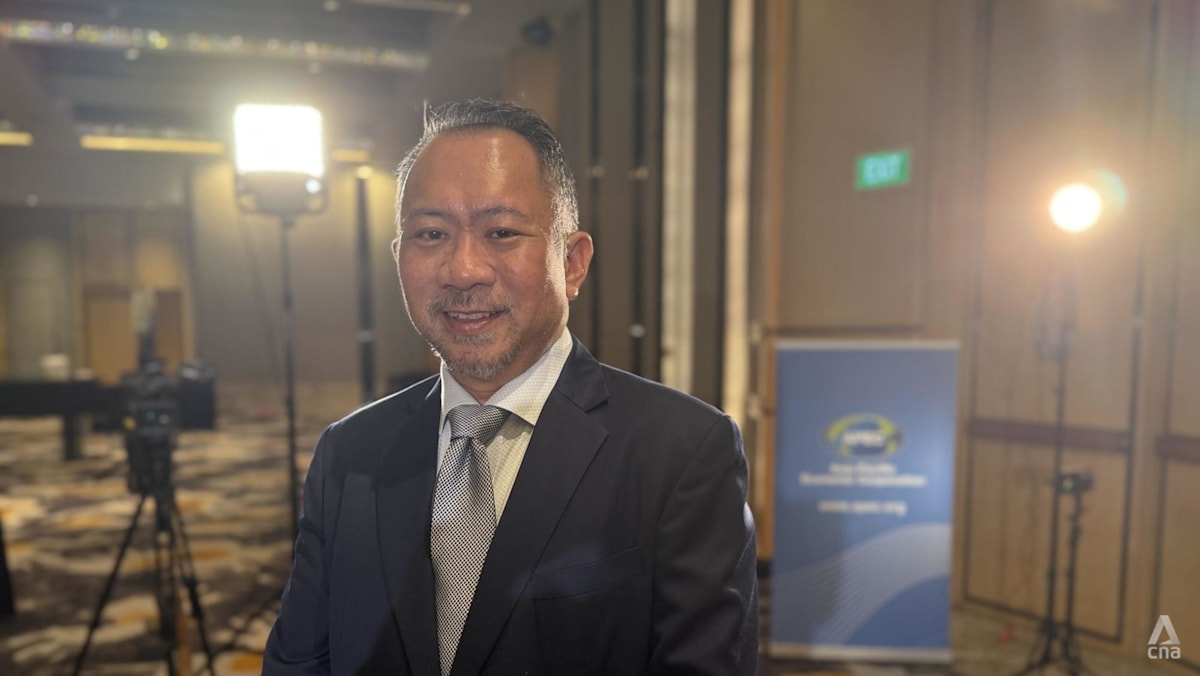
Asia APEC Secretariat executive director Eduardo Pedrosa tells CNA about progress in trade discussions, while highlighting supply chain resilience, global economic imbalances and AI as key areas of cooperation. Executive director of the Asia-Pacific Economic Cooperation (APEC) Secretariat Eduardo Pedrosa speaks to CNA ahead of the 33rd APEC Economic Leaders' Meeting in Shenzhen. (Photo: CNA/Olivia Siong) New: You can now listen to articles. This audio is generated by an AI tool. SINGAPORE: Conditions for regional trade cooperation are improving, even as tensions persist between the United States and China, according to the executive director of the Asia-Pacific Economic Cooperation (APEC) Secretariat.Speaking to CNA ahead of the two-day 33rd APEC Economic Leaders' Meeting in Shenzhen from Wednesday (Nov 18), Mr Eduardo Pedrosa said APEC's 21 member economies are continuing to find common ground on trade issues."I think it's actually getting better," he told CNA when asked whether conditions for cooperation had improved compared with a year ago.He highlighted progress made by APEC trade ministers during a meeting in Suzhou in May, saying they had agreed on areas for further discussion, including trade and the environment, labour and state-owned enterprises. While APEC includes the world's two biggest economies, the US and China, Mr Pedrosa said its 19 other member economies also play an important role in advancing regional trade cooperation.He pointed to initiatives by the Association of Southeast Asian Nations (ASEAN) – seven of whose 11 members are also part of APEC – as well as trade agreements such as the Comprehensive and Progressive Agreement for Trans-Pacific Partnership (CPTPP).Mr Pedrosa said such initiatives show how economies can work together to develop trade rules and practices that others, including the US and China, may find useful."We're still moving together through these agreements. APEC provides a platform for those discussions as well," he said. FOCUS ON SUPPLY CHAIN RESILIENCEAsked about the long-term goal to establish the Free Trade Area of the Asia-Pacific (FTAAP), Mr Pedrosa said APEC's immediate priority is to strengthen supply chain resilience amid growing global uncertainties.He cited disruptions caused by the COVID-19 pandemic, as well as difficulties moving oil through the Strait of Hormuz due to the war on Iran, as examples of challenges facing regional supply chains."It is minimising that fragmentation, maintaining stability (and) removing frictions," he said.He added that improving "interoperability", or the ability of different systems and trade arrangements to work together, is another focus of APEC.Mr Pedrosa also stressed the importance of reducing barriers that affect businesses and consumers, and creating opportunities for governments and companies to work together on solutions. ADDRESSING GLOBAL ECONOMIC IMBALANCESAnother issue on APEC's agenda is global economic imbalances, which finance ministers have identified as posing risks to growth and stability.The discussions come amid concerns over China's widening trade surplus, which is expected to exceed last year's record of US$1.2 trillion.The figure has led to debate over whether US trade restrictions have failed, given that China is still exporting more than ever.But Mr Pedrosa said economic imbalances are a wider global issue."It's not about imbalances between two individual economies. These are really global imbalances that include everyone," he added.He noted that some economies save more due to factors such as social safety nets, pensions and healthcare, while others consume more.The challenge, he said, is finding a balance that would support global economic stability.Mr Pedrosa said that APEC finance ministers have called for greater transparency and cooperation on the issue, noting that it is a significant development for the grouping.However, Mr Pedrosa acknowledged that reaching a common understanding of what constitutes global economic imbalances would be an important first step before identifying possible areas for action."That's part of the beauty of APEC, trying to find a common understanding of what these words mean," he said, adding that discussions would continue over the coming years. AI COOPERATIONBeyond trade, artificial intelligence is expected to feature prominently when APEC leaders gather in Shenzhen, as economies seek to harness the technology's benefits while addressing the challenges it poses."AI has really dominated our discussions," Mr Pedrosa said, noting that the technology had featured in ministerial meetings covering areas such as trade, small businesses, energy and workforce development.He identified three areas of cooperation: financing digital development to prevent widening digital divides, ensuring sufficient energy supplies to support AI adoption, and using the technology to improve food productivity and security."Technology is moving so quickly, everyone has to be able to catch up with that," he said.While the US and China have the most active AI development sectors among APEC economies, Mr Pedrosa said other economies and small- and medium size enterprises (SMEs) also have a role to play in AI's value and supply chains.He added that APEC's non-binding nature provides a platform for governments and businesses to discuss issues such as AI regulation and consumer protection, even as economies take different approaches to the technology."A lot of it is about what kind of guardrails are needed to protect consumers," he said.Mr Pedrosa stressed that the process of dialogue itself is an important part of APEC's work, allowing economies to better understand one another's approaches and find ways for their systems to work together.
Regional trade cooperation improving despite US-China tensions: APEC chief
Full Article
Original Source
Read the full article at Channelnewsasia →KhanList aggregates and links to publicly available news content. We do not host full articles from third-party sources. Always verify important information with original sources.