
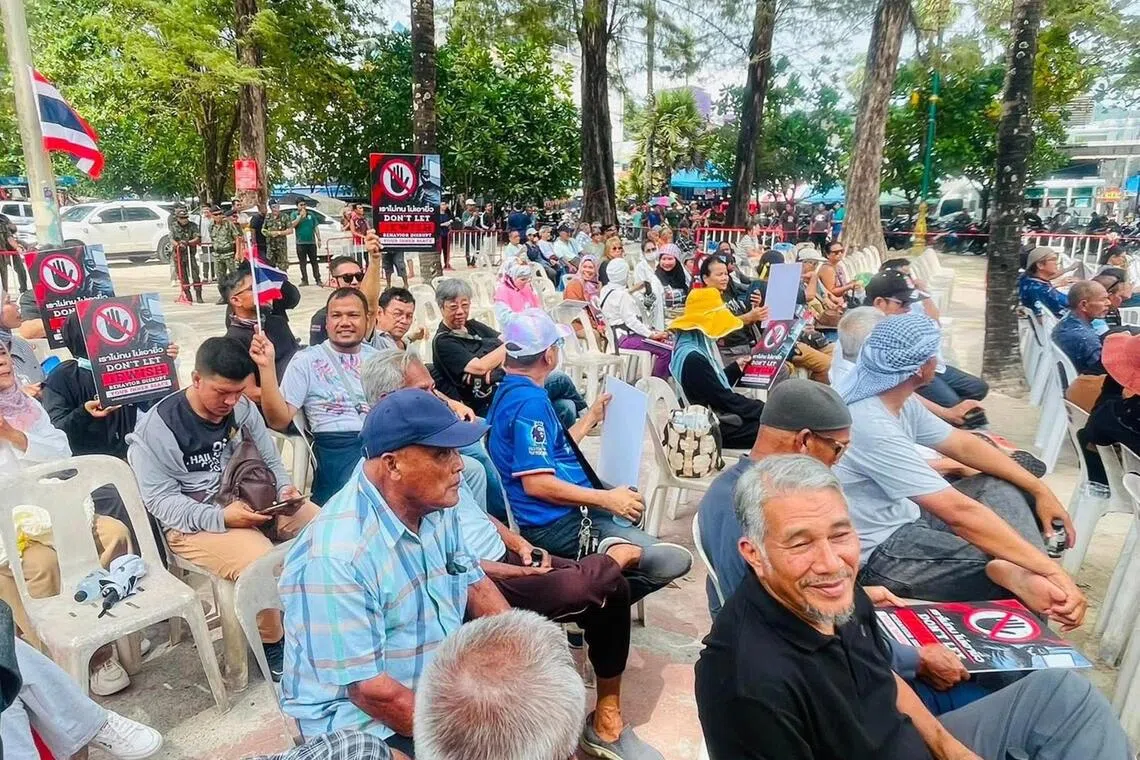
BANGKOK - Frustrated by what they see as a spate of incidents involving disrespectful behaviour by foreign visitors, Phuket residents gathered at Patong beach on Aug 28 to call for greater respect for Thai laws and culture.The “Save Phuket” event, attended by an estimated 200 people, took place as Thailand introduced tougher measures allowing the authorities to revoke the visas of foreigners who cause public disturbances, remove them from the country and potentially bar them from returning.A visible backlash against foreigners is emerging in Thailand – from a Phuket beach gathering to vigilante groups – as the government steps up efforts to crack down on foreigners who flout the law, raising questions about where legitimate enforcement ends and hostility towards foreigners begins.The Phuket beach event was organised by a group of local residents who say they want to give Thais a platform to air their frustrations, rather than target foreigners as a whole.The Facebook page for the group, which currently has at least 6,900 followers, carries posters in Thai saying “Phuket will not stay silent” and “Respect Thai law”.Saichon Nuchet (right) is a 42-year-old Phuket native and one of the organisers of the “Save Phuket” event which happened at Patong Beach, Phuket on Aug 28. PHOTO: SAICHON NUCHETOne of the organisers, 42-year-old Saichon Nuchet, told The Straits Times the event provides a platform for local Thais to voice their frustrations over encounters with disrespectful foreigners who flout the law.Saichon, a Phuket native, said the group also wants to prevent the island from gaining a negative reputation because of such incidents.“We do not want Phuket to be portrayed negatively in the news because of violence, disrespect towards business operators, violations of the law, refusing to pay for food or services, or certain individuals receiving special privileges.”Viral incidents fuel angerIn recent months, social media has seen a growing number of reports of confrontations between Thai business owners and foreigners, some of whom have been identified or described online as tourists from Israel and China, particularly in popular destinations such as Phuket and Koh Samui.The incidents have fuelled anger among some Thai citizens and, in some cases, prompted vigilante groups to take matters into their own hands.The government has also moved to tighten its response. Under new rules effective from Aug 28, the authorities can revoke the visas of foreigners who violate Thai law or engage in conduct considered harmful to public order, deport them and potentially bar them from returning.Thailand’s tourism minister Surasak Phancharoenworakul was quoted by local media as saying that the country remains open to tourists who respect its laws, people and culture.“At the same time, we do not welcome and will not tolerate tourists who disregard the law, lack morality, disrespect Thai people or cause trouble and disrupt our social order,” he said.One widely circulated case involves an Israeli man who allegedly offered a 500,000 baht (S$19,000) bounty on the owner of a petting zoo on Koh Samui.The episode followed a dispute on Aug 12, when an Israeli couple with two children claimed they were denied entry to the attraction.In another case on July 25, a Chinese woman alleged that she was restrained and forcibly removed from a Bangkok book fair. Thai attendees, however, claimed she had started a physical confrontation with event staff after jumping the queue.These incidents have contributed to a perception among some Thais that foreigners are increasingly behaving as though local laws and social norms do not apply to them.One such Thai citizen, 45-year-old Akarawut Kaisrisombut, decided to form a vigilante group called “Thai Mai Ton”, or “Thais Will Not Tolerate”, which travels around Thailand to check whether locals have been mistreated by foreigners and alert the authorities to investigate.Akarawut told ST that he started the group after witnessing Myanmar workers holding an informal assembly about two years ago in a Bangkok park and preventing local Thai citizens from entering the public space.“I thought, who are you to stop Thai people from entering?” he said, referring to a park in his country.“I welcome everyone who comes here with good intentions. But why should we surrender to people who break the law?” he said.Akarawut Kaisrisombut is a 45-year-old Thai citizen who formed a vigilante group called “Thai Mai Ton” or “Thais Will Not Tolerate”, which travels around Thailand to check whether locals have been mistreated by foreigners and alert the authorities to investigate. PHOTO: AKARWUT KAISRISOMBUTAkarawut believes some tourists behave brazenly because they’re visiting Thailand only for a short period.“They may see themselves as coming from powerful countries. In their mind, they believe they are tourists who bring money into Thailand, while Thailand is expected to serve them,” he added. His group, he said, has also received complaints about foreigners allegedly operating businesses or working in occupations reserved for Thai nationals, including food vending, traditional Thai massage and tour guiding.The Thai authorities have separately been cracking down on foreigners suspected of owning businesses or operating them illegally through Thai proxies.Social media amplifies tensionsKwanchanok Jaisuekun, a lecturer at Mahidol University’s Institute for Population and Social Research, said social media had increased the visibility of conflicts between Thais and foreign visitors.“In the past, some tensions may have remained local or been expressed indirectly. Today, social media can make an individual incident highly visible and allow people with similar grievances to connect and organise around it,” she said.But she cautioned that greater visibility did not necessarily mean such confrontations were becoming more common, or that Thailand was becoming more xenophobic.The growing foreign presence could nevertheless leave some locals feeling squeezed out of public spaces or economic opportunities, she said.Campaigns such as “Save Phuket” can provide an outlet for legitimate concerns, Kwanchanok said, but she warned that individual incidents risk becoming generalised into hostility towards entire nationalities or groups.“The challenge for Thailand is to address legitimate concerns about foreign presence, inequality and the enforcement of laws without allowing individual conflicts to become generalised hostility towards entire nationalities or groups of foreigners,” she noted.A speaker at The "Save Phuket" event at Patong Beach, Phuket on Aug 28. PHOTO: SAICHON NUCHETBoth Saichon and Akarawut insist their campaigns are not directed at any particular nationality.“We are not targeting anyone. Those who respect Thai law and culture and behave appropriately are doing the right thing. We can coexist without any problems,” said Saichon.Thailand remains heavily reliant on foreign visitors. According to the Tourism Authority of Thailand, more than eight million tourists visited between January and mid-May 2026 – with China the largest source market at more than 2.15 million visitors, followed by Malaysia and India. Last year, Thailand received about 33 million visitors.Thailand’s immigration bureau reported in March that about 30,000 Israeli nationals were living in the country. Some 420,000 Israeli nationals entered Thailand in 2025, of whom 405,700 subsequently departed, according to the bureau.Akarawut, however, believes Thailand should go further, calling for tighter rules on visa exemptions to better protect Thai citizens, even if that means fewer tourists.“We may have to suffer today to build a more sustainable future.”
Thai patience wears thin as backlash against ‘bad’ tourists grows
Full Article
Original Source
Read the full article at Straitstimes →KhanList aggregates and links to publicly available news content. We do not host full articles from third-party sources. Always verify important information with original sources.