
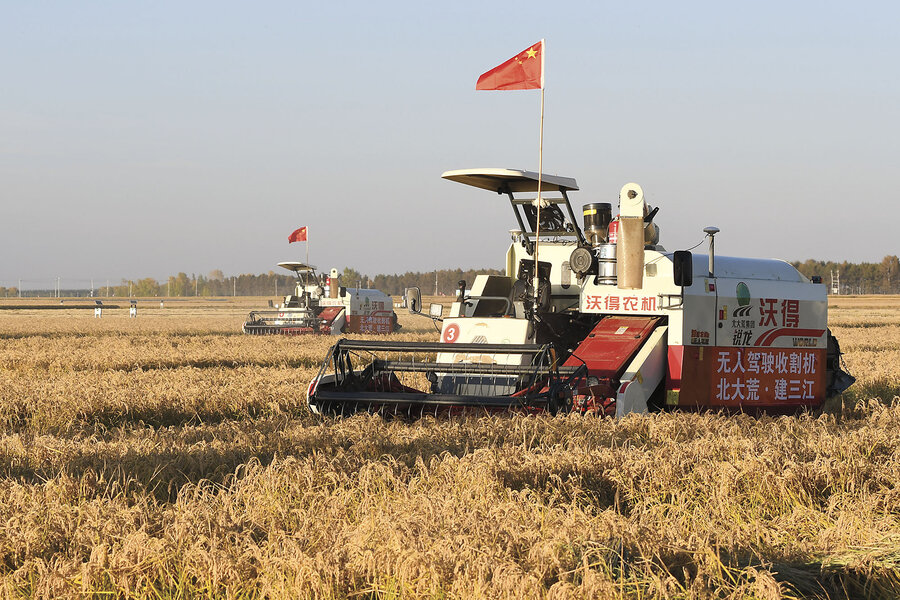
Jiamusi, China | Nov. 01, 2026, 5:05 a.m. ET | 4 min read The sun sinks low over China’s northeastern rice fields as combines with spinning metal teeth slice neat rows in the tawny stocks.It’s harvest time in Heilongjiang province, China’s breadbasket, where large commercial farms showcase modern efficiency. “From sowing and plowing to harvesting – it’s all unmanned,” says Liu Jianguo, a manager at the sprawling farm owned by Beidahuang Group, one of the country’s largest state-owned agribusinesses.The province’s dark, chunky dirt, rich with organic matter, comprises one of the world’s four major deposits of super-fertile black soil, or chernozem. Other belts are found in Ukraine, the Mississippi Delta, and the Pampas plain of South America. Deputy governor Cong Li says that 1 in every 9 bowls of grain in China comes from this province – and this year, thanks in part to farmers’ embrace of innovation, she expects a record harvest. Such bounty is never taken for granted in China, which must feed a sixth of the world’s population on less than 10% of its arable land. As wars in Ukraine and Iran and ongoing trade disputes disrupt global food flows, Chinese leader Xi Jinping has doubled down on liangshi anquan, or “food security,” making it a top strategic priority, on the same level as hardening China’s military or building up energy stockpiles. For Mr. Xi, that means self-reliance in grain production. The government’s goal is for China to grow 95% of the grains it consumes. Today, China has roughly achieved that for corn, rice, and wheat, but remains heavily reliant on imports for soybeans, barley, sorghum, and other key crops. Meanwhile, extreme weather and water scarcity are posing new risks to farming. Ann Scott Tyson/The Christian Science MonitorHan Tongjun works on a tractor on the factory floor of the Jiamusi Jichi Tractor Manufacturing Co. Ltd. in Jiamusi, China, Sept. 29, 2026. In meeting such challenges, Heilongjiang is key – the “ballast stone” of food security, as Mr. Xi put it on a 2023 visit.Today, huge posters show Mr. Xi declaring as much across the province. “China’s grain, China’s rice bowl,” reads one red-lettered banner in the heartland city of Jiamusi, with an image of Mr. Xi waving.For many Chinese, filling their bowls has been a lifelong quest. Meng Qingshan grew up farming in the flood-prone region of Jiansanjiang in northern Heilongjiang, near the border with Russia. His parents labored to reclaim local wetlands to grow wheat and soybeans. “I was the second generation – I drove a tractor,” says Mr. Meng, who now directs an agricultural machinery center. Mr. Meng’s parents survived the country’s devastating 1959 to 1961 famine, when grain production plummeted as a result of Mao Zedong’s radical commune movement and push to industrialize. They rode out the crisis by eating tree leaves, roots, and bark, and the occasional wild fruit, he says. For years, China relied on imported grain, and meat was a rare luxury.In the 1980s, China’s post-Mao leaders launched market-orientedeconomic reforms, allowing households to farm individual plots and sell their goods. The incentives helped bring about steady gains in per capita grain production.But that trend stalled in the late 1990s, as farmers increasingly turned from grain to cash crops, and the spread of cities, factories, and other land use reduced farmland overall. Soil degradation and erosion also hurt grain output. By 2003, per capita grain production had fallen to its lowest level in 20 years. Ann Scott Tyson/The Christian Science MonitorDrones fly over fields at the Qixing farm of the Beidahuang Group, one of China’s largest state-owned agribusinesses, in Jiamusi, China. Alarmed, Beijing in 2006 mandated that China’s cultivated land could not drop below 1.8 billion mou, or 296.5 million acres. Setting this red line, along with rising yields, helped grain production recover and make steady gains.Mr. Meng helped transform the black soil of Jiansanjiang into rice paddies, more than doubling the region’s grain output from the 1990s until today, he says. “This is critical for China’s food security,” he says.Farmers also learned to conserve nutrients in the black soil. Instead of burning straw after each harvest, they began mixing it back into the land and rotating crops. “Farmers in China can’t leave fields fallow the way U.S. farmers do, but they can alternate crops,” says Qin Xingguo, an official from the Ministry of Agriculture and Rural Affairs.By 2024, China’s wheat and rice stockpiles grew big enough to meet the needs of all 1.4 billion Chinese for more than a year, according to the state-run Xinhua News Agency. The government seeks to boost grain production further, from 715 million tons per year in 2025 to 725 million tons per year by 2030, and hopes new technologies and seed varieties will help increase yields.Agricultural drones whiz above a field in Heilongjiang, ready for spraying or fertilizing crops, lifting tools, and other uses. The drones are part of a suite of uncrewed farm vehicles – linked on a digital dashboard – that Chinese farmers are harnessing to make farming more efficient. Ann Scott Tyson/The Christian Science MonitorChu Haibo, deputy general manager of the Harbin-based ag-tech firm Heilongjiang Huida Technology, says the “entire way of thinking about farming is starting to change.” Experts say the labor-saving technology has another benefit for food security: It can potentially smooth the return of China’s younger generation to agriculture. Deepen your worldviewwith Monitor Highlights.Politics with respectGet political stories with respectful analysis.There‘s a world of new ideas in everyBooks newsletter.There‘s more to life, enrich yours withCulture & Learning weekly.Follow humanity‘s discoveries withScience & Nature stories in your inbox.Gain a spiritual perspectivefrom the stories in your inbox.Want to understand the deeper impact of critical events? Learn the Monitor‘s insight.Already a subscriber? Log in to hide ads. “The entire way of thinking about farming is starting to change,” says Chu Haibo, deputy general manager of Heilongjiang Huida Technology Co. Ltd., an ag-tech firm based in Harbin, the provincial capital. “If you make young people get sunburned, sweat, and spray pesticides, they’ll refuse” to return to agriculture, says Ms. Chu. “But if you give them a lot of good equipment, they become the boss." ALREADY A SUBSCRIBER? LoginReal news can be honest, hopeful, credible, constructive.The Christian Science Monitor was founded in 1908 to lift the standard of journalism and uplift humanity. We aim to “speak the truth in love.” Our goal is not to tell you what to think, but to give you the essential knowledge and understanding to come to your own intelligent conclusions. Join us in this mission by subscribing.
Technology is reshaping Chinese farms – and boosting its national security
Full Article
Original Source
Read the full article at Csmonitor →KhanList aggregates and links to publicly available news content. We do not host full articles from third-party sources. Always verify important information with original sources.