
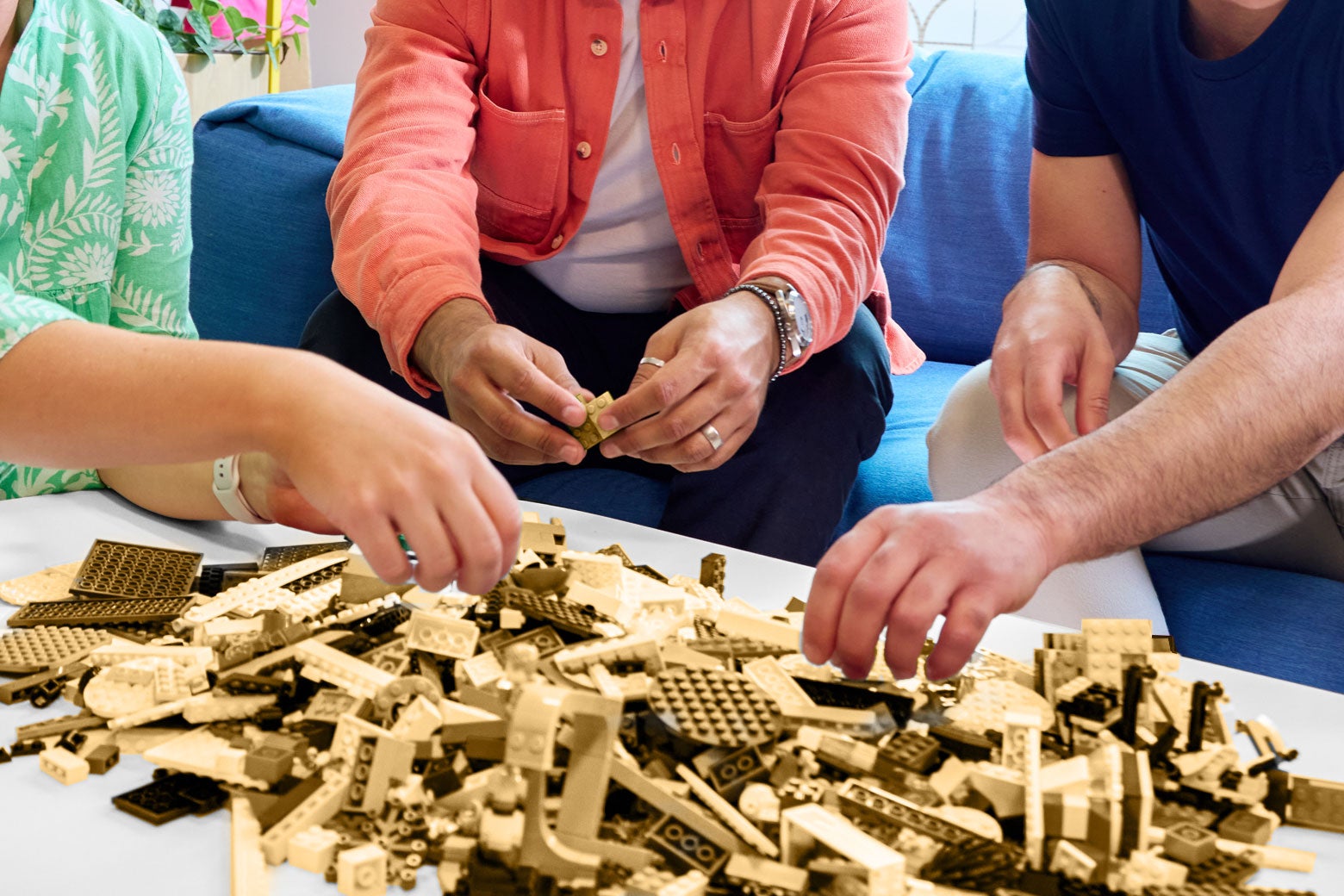
Downtime Leggo My Lego Lego has a surprising new strategy that turned its business around. It involves elaborate sets, hundreds of dollars, and “kidults” who just want to feel alive. By Enter your email to receive alerts for this author. Sign in or create an account to better manage your email preferences. Unsubscribe from email alerts Are you sure you want to unsubscribe from email alerts for Luke Winkie? Nov 01, 20265:45 AM Photo illustration by Slate. Photos by Lego. Sign up for the Slatest to get the most insightful analysis, criticism, and advice out there, delivered to your inbox daily. A Lego replica of the USS Enterprise—two feet long, composed of over 3,500 pieces—is perched on the living-room bookshelves of 44-year-old technology consultant Tom Mount. Columns of translucent blue bricks race down its twin thrusters, evoking the nuclear glow of the starship’s warp drive. Slate-gray plastic stands in for the titanium plating; a black stand keeps the spacecraft angled into the air, as if it soars through the interstellar void. The whole package comes complete with eight Lego figures depicting characters from Star Trek canon: Worf and his crinkled forehead, Geordi and his visor, Capt. Riker and his ruddy beard. Mount has been waiting to purchase a model like this from the very moment that he—like so many other men his age—started playing with Lego again after abandoning the hobby as a teenager. His hand-built Enterprise is a consecration of a prodigal fandom. It also cost him $400. “As soon as I saw it, I was like, ‘I’m an adult. I have a salary. I can save money,’ ” said Mount. “I’ve wanted this for 30 years. I don’t care that it’s 400 bucks. I budgeted for it. And some things in life require budgeting.” The Enterprise is the crown jewel of Lego’s Star Trek line, and unsurprisingly, it’s also more expensive than anything else in its category. (A replica of the ship’s command bridge, with reclining seats for Capt. Picard, retails for a more economical $199.) Still, compared to the other high-end Lego products, Mount did OK for himself. Consider, if you will, the newly released $650 Minas Tirith set—from Lord of the Rings—outfitted with alabaster ramparts and tearaway interiors; Gandalf, Pippen, and the dreaded Denethor in tow. Elsewhere, a $450 Hogwarts Castle awaits with copious nerdy detail. (The Chamber of Secrets is represented, as is a modular Whomping Willow.) A 10,000-piece Eiffel Tower, standing roughly the same height as a middle-school boy, goes for $630. A resplendent sculpture of three Pokémon icons—Charizard, Blastoise, and Venusaur—clocks in at $650. Do you just want Pikachu? Well, that’s $200. If you’re like me, you possess childhood memories of dumping plastic tubs of bricks onto bedroom floors, piecing together blocky starfighters and square-wheeled trucks with the help of more inventive friends. But at those price points, it’s clear that Lego is not targeting the juvenile fans of yore. These days, they’re catering to people like Mount—fully grown adults, with good jobs, ready to splurge for the privilege of fusing together the component parts of the Enterprise. More of them walk this earth than ever before. Adults, rather than children, now make up 25 percent of total Lego sales, part of a Neverlandian inversion of the toy market that has flipped the industry on its head. According to the research firm Circana, more than half of the toys purchased in the first six months of 2026 were bought by childless households. (Lego did not respond to me for comment.) All of this is by design. The story goes that in the late 1990s, the Lego Group—the company’s corporate moniker, founded in Denmark in 1932—was nearing bankruptcy after several fallow years. With the burgeoning video game industry hogging the spotlight, the parents of young children weren’t buying up conventional toys at nearly the same clip. (This was around the same time Lego Group began investing heavily in its theme parks and computer software; anything to diversify away from the bricks.) The company eventually solved this problem by emphasizing the tastes of adult Lego fans, a community that had existed for decades but had gone previously ignored by corporate leadership. The strategy worked. Walk into a Barnes & Noble today, and you’ll find Lego sets packaged in chic black boxes—with elegant scripting—as if you were taking home a pair of Louboutins rather than a scale replica of Diagon Alley. Some of the more serious-looking sets, like a depiction of the Roman Coliseum, are stamped with an 18-and-older disclaimer. (That designation was introduced in 2020. It strikes me as nonsensical. Surely any preteen could put together a $160 Lego Trevi Fountain?) But business is booming. The Lego Group just reported a 21 percent revenue bump in 2026 compared to the year prior. CEO Niels Christiansen chalked up the success to “growing fast with kids” while also “growing with adults.” This is probably why grown-up Lego sets are so expensive. On Nov. 1, the company will release one of their spendiest models to date—a $799 reproduction of the Sagrada Familia. How could Lego Group justify that price? The answer to that question is pretty complicated. First things first, Lego has historically cultivated a reputation as a premium brand, even when the product was positioned exclusively as a kid’s toy. I can recall a formative Christmas morning in the early 2000s when I unwrapped a Lego Star Wars ensemble for a hulking AT-AT. It cost $99.99. (Adjusted for inflation, the number is equivalent to around $180 today.) Furthermore, anyone browsing through the Lego storefront can find loads of cheapo sets available for purchase. About 650 items are listed in the “$25 and Under” category. (Highlights include “London Bus” and “Turtle With Water Lily Flower.”) And yet, despite those affordable avenues into the hobby, a feeling still pervades that Lego is more exclusionary than it was in earlier eras, and that’s because the company is producing more elaborate—and more prohibitive—sets than ever before. The YouTuber SpitBrix lays out the math in a video with the ominous title “Lego’s Affordability Crisis.” He notes that, when focusing on the raw number of pieces in a Lego set, price tags have remained pretty consistent. A 900-brick box in the 1990s cost roughly the same as it does in 2026, and so on and so forth. But SpitBrix offers some important context. Back in 2000, when Lego released a total of 402 sets, just four of them contained more than 1,000 pieces. Compare that to 2025, where Lego put out 850 sets, and 81 of them comprised 1,000 bricks or more. That’s a significant departure in Lego Group’s product mix. Large, lavish, Sagrada Familia–sized luxuries used to be a rarity, representing barely 1 percent of the company’s overarching catalog. Now, that number is closer to 10 percent. “It raised the average price of a set,” concluded SpitBrix. “When you’re in the store looking at Lego sets, you’ll absolutely see more high-priced sets than you’re used to, because sets that cost hundreds of dollars are literally 10 times as common as they were 25 years ago.” All of this gets back to the Lego Group’s fundamental consumer pivot. Adult Lego fans have disposable income, and are willing to honor their hobbies at a clip higher than the aforementioned $25-and-under aisle. Just as importantly, this Lego boom period is occurring at the exact same moment where traditional vectors of adulthood are being disrupted—when fewer people are starting families, and the median first-time homebuying age has ripened to an eye-popping 40 years old. Where, exactly, is the money supposed to go? The answer appears to be things like Lego. It recalls a conversation I had with 45-year-old Jordan Hurder, another later-in-life Lego fan who works for an outdoor outfitting company. He estimates that he’s dropped around $5,000 on Lego sets, which is the only luxury he really indulges in. “My wife and I don’t have children, but my brother has three kids, and he’ll sometimes ask how much I spend on this this stuff,” he said. “I have to remind him that we don’t have a mortgage, and that I know the number sounds ridiculous to him because he’s sending his kids off to summer camp.” Does that sentiment send a chill up your spine? If it does, know that Hurder is right there with you. “The rites of passage for adulthood aren’t attainable,” he continued. “Career advancement, income advancement, none of that really exists. So how do you reward yourself? Either you take a trip or buy a toy. I think the reward structure around adulthood is pitched much more towards those kinds of purchases than they were in the past.” I wish I could say that I didn’t relate to Hurder’s conclusion, but like so many other Americans, I, too, feel like I’m being squeezed in ways I never have before. My finances have been fragile for longer than I’d like to admit—a problem accentuated by the fact that I’m closer to the ceiling of my career earning potential than its floor. The world has gotten more expensive, no matter what the numbers say. All my wife and I can do is kick the can down the road on some of life’s most existential questions. Will we ever have kids? Could we ever own property? It’d be a lot easier to find the answers if our fortunes changed—if all the pressures bearing down on us dissipated. In the meantime, we find ways to cope. I’m writing this story in a room paneled with expensive designer board games. It’s not Lego for me, but just like Hurder, I have my own millennial fetish material; I have my own ways of feeling rich while staying broke. I’ve been monitoring this trend closely as I’ve rounded the corner toward middle age. The clarion call of Lego—or, at least, other hobbies originally intended for children—has seduced some of my friends back into the fold, and often, this trend is spoken about like it’s a tragedy. How best can one summarize the foreclosing of the American dream? The stark differences between the way our parents matured compared to their downwardly mobile millennial offspring? The death of domestic bliss? Well, that so many adults are willing to splurge on pricey Lego sets feels especially illuminating—some would say it epitomizes the humiliation, and infantilization, of an entire generation. (The term “kidult” has been coined to diagnose this novel form of arrested development. It’s usually wielded as a pejorative.) But Mount doesn’t see it that way. “I feel like my folks had a specific understanding of adulthood in mind. It was very serious. And I think as I’ve aged, I’ve held on to the way I’ve always had fun,” he said. From that perspective, maybe there’s no sin in being of child-rearing age and a Lego fan. Maybe it represents its own kind of self-actualization—one that’s native to the 2020s. And if this is to be the status quo—if adults continue to dominate the kids’ market—will that alter the way people play with Lego? I posed this query to Dave Kaleta, a kindergarten teacher who is also one of society’s foremost Lego artists—someone who never needed a step-by-step instruction manual to build impressive stuff. (His portfolio includes resplendent re-creations of Wayne Manor and the Emerald City of Oz. His fabulously gory depiction of a frog dissection was featured at the Victoria and Albert Museum in London.) Naturally, Kaleta honed his deftness with the bricks as a child. He’d put his sets together and take them apart, Frankensteining them into progressively more detailed inventions. This is what Kaleta finds lacking in the modern age of Lego. The Sagrada Familia is not engineered to have its component parts dumped into a bag and intermingled with foreign pieces—spurring on nascent creativity, its regal stained glass windows melding with the Great Hall of Hogwarts or some such thing. “They’re designed to be displayed in your home, which is not how I ever played with Lego as a kid,” said Kaleta. I suppose that means Lego isn’t a toy anymore. Kaleta told me that, these days, children who play with Lego tend not to dismantle their sets—that the collector-item philosophy has trickled down to the youth, and the good old-fashioned tub of miscellaneous bricks is a thing of the past—which filled me with a sorrow I didn’t completely understand. Nevertheless, I did want to witness the possibilities of modern Lego for myself. I purchased one of the cheaper sets, a blooming white lily—part of the company’s line of botanical models—and dumped the pieces on my coffee table. I pleated the petals behind one another; I carefully balanced the swooping green stem; I clicked together the sheer plasticware into a flowerpot. Old sense-memories flared in my gut, the tactile joys of my youth. How long had it been since I had snapped together these dimpled blocks? Twenty years at least, maybe more. For a moment there, I did feel like a kid again. And yes, I did have some fun. I wasn’t sure what to do after the assembly was complete. I brought the flower to my wife, and it lived on her vanity for a while. Currently, though, it’s sitting in an empty space on our bookshelves—amid the various baubles of adulthood; tinted vases, unburned candles, novels I’ve been meaning to read for years. The Lego lily has joined our mantel of stuff. It may never get touched again. Design Millennials Games Hobbies
Lego Is Becoming a Brand for Adults. It’s Not Actually As Sad As You Think.
Full Article
Original Source
Read the full article at Slate →KhanList aggregates and links to publicly available news content. We do not host full articles from third-party sources. Always verify important information with original sources.