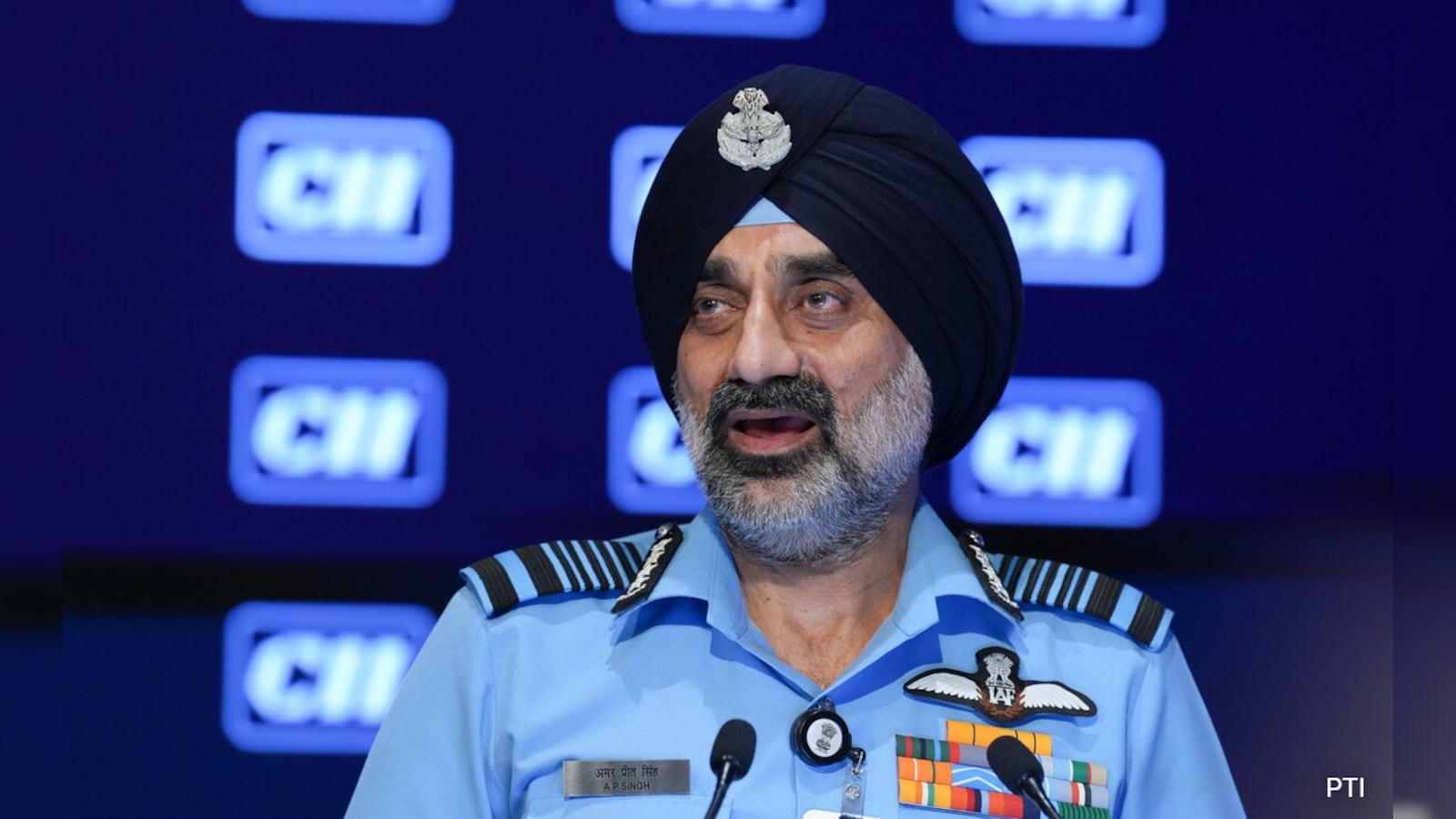
New Delhi: IAF chief Air Chief Marshal A P Singh on Thursday pitched for achieving greater self-reliance in building unmanned aerial systems and other critical defence technologies, as he emphasised that "technology delayed is technology denied" and there is no point having something which comes after others have already got it.In his address at an event here, he also said there are "discussions happening between us and the Ministry of Civil Aviation, and other ministries involved" so that "we finally should be able to recognise a drone, whether it is a bona fide drone or a rogue drone"."We should be able to have no fratricide, in terms of we shooting down our own drones or taking down something that is meant for us," he said.At a workshop hosted here by the Society of Indian Defence Manufacturers (SIDM), and attended by various defence military and industry experts, the air chief marshal also spoke about integration of manned platforms and drones and other unmanned aerial systems (UAS), which would share the same airspace."Integration is very important. We have manned platforms and long-range vectors which will continue to use the same airspace where the drones are going to come in. I am talking about a whole range of drones, from a small micro or mini drone to a UAS which is like a full aircraft, but unmanned."Everybody is going to use the same airspace. So man, whether in the loop, on the loop, at least in planning, in terms of control, feedback system, situational awareness, we need to know each other's positions, and understand how an airspace is going to be used, whether it is procedural control or active control," he said.The IAF chief added that if drones are to be miniaturised, and if their weights would go down, even the payloads to be used, whether a weapon or a camera or any other payload, also has to be miniaturised."And while doing this, we have to get down to the absolute... I mean to say, every brick has to be made in India. Actually every brick should be developed in India, then only we can say, we are fully Atmanirbhar. If there are some components for which we are still relying on some other country then obviously we can be fall prey to that country, throttling those supplies," he said.In his address, the IAF chief, however, emphasised that technology development should be swift as with the advent of disruptive technologies, things are changing fast and every day some new thing is coming out."So, obviously that worry which was told that we should not miss the bus, we should not be left behind. It's something that should be guiding us, pushing us all the time. Again, I'm repeating some of my favourite statements, technology delayed is technology denied. There is no point having something which comes later than when others have got it and gone beyond it. So, we need to push ourselves to make sure that these things happen in time."And not only just technology, technology staying in a lab. If we have the technology, but it's not gone beyond lab, then also, no point," he said.Air Chief Marshal Singh also underlined the "multiple challenges" in the defence sector when it comes to technology development and said, "it can't be solved by one one agency, one person, one group of people." "All of us have to come together. It has to be a whole-of-nation approach that we call, whether we are users like in this case, or if you're talking about defence, drones, then it is the defence industry, defence forces, whether we are government, making the rules and industry, researchers, regulators, academia, incubators, investors, QA/QC (Quality Assurance and Quality Control) agencies, all of us, all of us have to join hands to ensure that whatever unmanned system, whatever drones we make or the counter drone systems that we make, are safe, secure, reliable, scalable, operationally relevant and of course economically viable," he said.On drone technology, he said, there are two factors -- first, each drone cannot carry the weight of attack, the way a manned platform, a big platform can carry. One need to send them in largen numbers to attack, and second is that the failure rate is very high as of now. So, one doesn't know how many being launched will reach the target for whatever purpose they were launched for.So, the certification agencies have to play a "big role" in whatever the requirements are there in labs to test them and also ensure future growth."That means all other technologies that are coming in, which are required to make the mission success, whether it is stealth, whether it is some countermeasures to make it survivable in the battlefield, all technologies have to develop along, and get miniaturised, for them to succeed," he said.On cyber security, the air chief marshal said, it is a very important requirement to have "our sovereign stacks, secure networks storage and also data privacy"."Then we should be able to make changes whenever we want, we should be able to encode anything, decode anything. And, of course, indigenous AI algorithms will be required to be developed along with that. So, all this will only give us total self-reliance or Aatmanirbharta," he said.(Except for the headline, this story has not been edited by NDTV staff and is published from a syndicated feed.)
"Technology Delayed Is Technology Denied": Air Force Chief Pushes For Self-Reliance
Full Article
Original Source
Read the full article at Ndtv →KhanList aggregates and links to publicly available news content. We do not host full articles from third-party sources. Always verify important information with original sources.