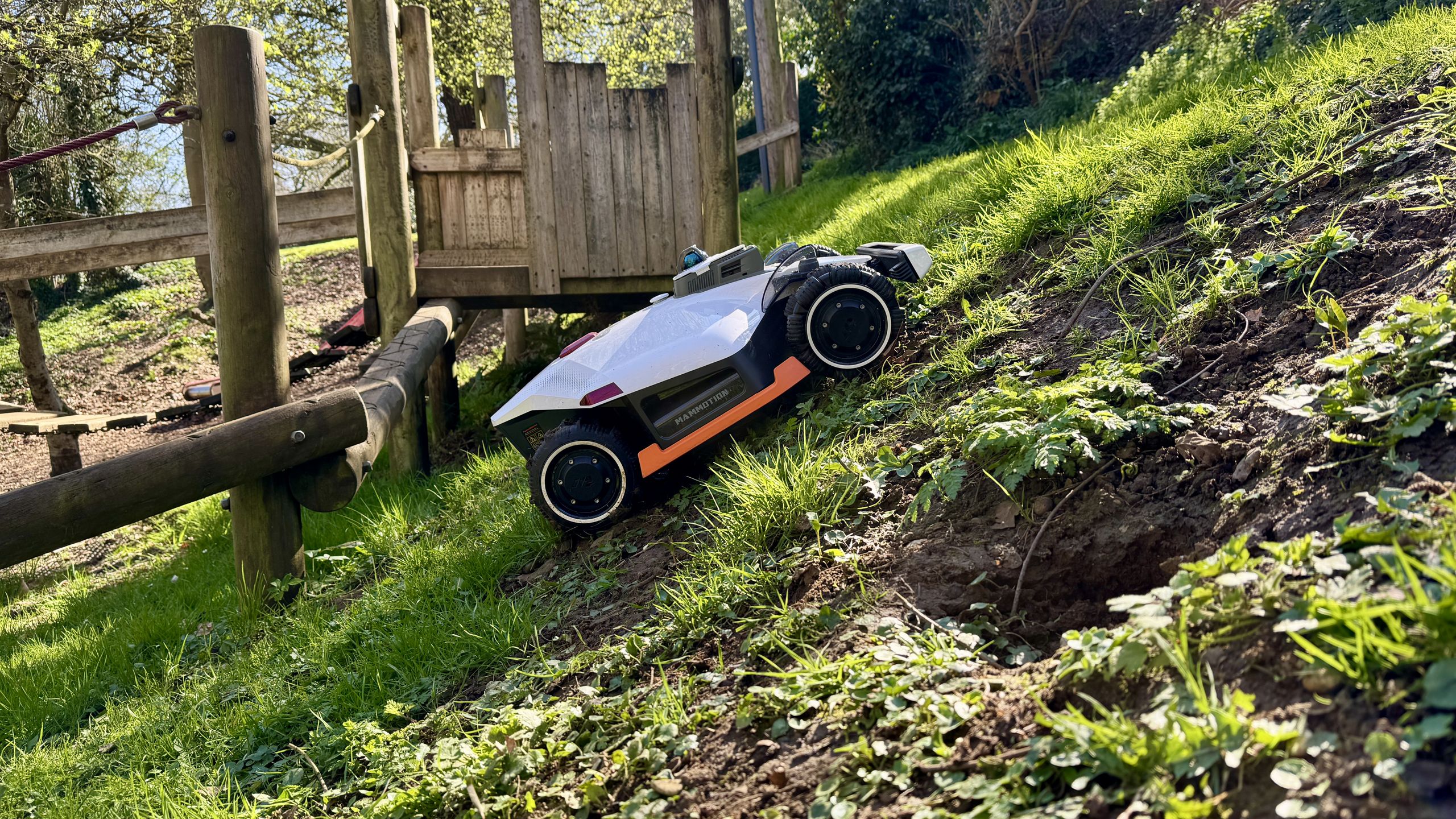
Making lawnbots mainstream isn't the uphill battle it once was for manufacturers (Image credit: Future) Robot lawn mowers are emerging as one of the most exciting smart-home categories. The concept has been around for a while, but in the past two years we've seen advances in technology that are making them more helpful and more user-friendly than ever. Finally, the barriers to entry are coming down, and lawnbots are starting to look like a feasible option for even the least tech-minded amongst us.To find out more about what's going on in this growing space, I spoke to KK Yin, marketing director at major lawnbot brand Mammotion. We chatted about the most impactful shifts in lawnbot technology, the hottest trends, and the hurdles the industry still needs to overcome.Cutting-edge edge cuttingFor KK, the big feature that hasn't quite been nailed yet is edge-cutting. Even if you have a great robot mower that does a stellar job trimming your grass, its usefulness is limited if you then have to get out a trimmer to take care of the edges. "Edge trimming remains one of the biggest challenges, especially along walls," says KK. "The key is balancing cutting performance with safety."The key is balancing cutting performance with safetyIf you're trimming along the edge of a flat path, it's relatively easy — certain mowers are designed to straddle the path edge, with the blades underneath trimming the grass at the boundary line. However, that doesn't work when trying to trim next to a wall. "The lawnmower can get as close as possible, but the cutting disc being set back from the mower's edge to maintain a safe clearance prevents the mower from cutting close enough to walls," KK continues.Lots of brands have been working on a solution, and it typically takes the form of an edge-trimming module that attaches to the side of the bot, with smaller blades in a protective casing. An edge-cutting attachment on a Roborock lawnbot (Image credit: Future)On the Luba Mini is an edge-cutting disc that can trim as close as 5cm (1.97 inches) from a wall — a distance KK admits might not be close enough. "Five centimeters is not very far from the wall, but still some users want us to make it perfect so it can cut maybe even down to one centimeter," KK says."We're exploring more flexible solutions," he continues. "For example, when mowing alongside a wall, the cutting disc could potentially extend slightly out of the mower's body for a cleaner edge cut. In open areas or during ride-on-the-edge mowing, it would retract to maintain a safe clearance beneath the mower. So that is the direction and also the challenge in the future."Sign up for breaking news, reviews, opinion, top tech deals, and more.Tackling tricky terrainAnother major lawnbot trend that's been emerging over the past year or so is all-wheel drive (AWD). This helps lawnbots tackle tricky or uneven terrain, as having all the wheels individually powered means that if one or two end up off the ground, or struggling to get traction, the others can help the robot escape without requiring manual intervention.AWD can also help the lawnbot retain its grip when scaling especially steep lawns. KK notes that in the European market, and Germany especially, lots of houses stand on slopes, where this boosted climbing ability comes in handy.All-wheel drive is usually indicated by an 'AWD' on the product's name, and it appears in Mammotion's advanced Luba line — you can see the LUBA 3 AWD scaling an astroturf mountain in the video above.The brand has also been looking at upgrading its bots' climbing ability and mowing speed, and is keen to figure out what the next advancement might look like. "We can see some other companies are exploring other things like independent steering," says KK. "Maybe that is a good solution for difficult terrain. So we are also thinking about how to combine this technology."Better tech in smaller botsInitially, Mammotion kicked off its lawnbot journey with its premium Luba series. Later on, the Yuka Mini arrived — a smaller, more affordable bot that's designed for yards 500 to 800 square meters in size. It proved to be the big winner in Europe during the recent Amazon Prime Day sales."I think when we started, our premium product line helped us build trust in our technology — things like the all-wheel drive and the positioning system and the efficiency. So customers believed our brand could bring some of that technology to an entry-level lawnmower," muses KK. The compact Yuka Mini is a good fit for smaller, European yards (Image credit: Future)The Yuka Mini is a good fit for European yards, which on average are 300 to 500 square meters in size. "Many robot lawnmower brands spend a lot and have a different product strategy for European regions, because many of the users have already accepted this innovative product for their lawn care. For example, they know about the positioning systems and how all-wheel drive compares with rear-wheel drive. They want their robot lawnmower to do more things — not only mowing, but also edge trimming."In the US, where the average lawn size is much larger than in Europe, the focus is a little different. "I think most US users still prefer a ride-on or traditional lawnmower. I think they're still looking for an efficient robot mower that can cover their large lawn," says KK. "The US is at a different stage, and what customers require is different.No-fuss installationNavigation tech is perhaps the area that has moved on most quickly and has had the most impact on lawnbot usability. It was only a few years ago that boundary wires were required; now they're all but obsolete.Initially, the technology to take over was RTK. This is satellite-based positioning, and it requires a separate RTK receiver to improve the accuracy of the satellite data. Not everyone wanted to set up a receiver in their yard, leading to a shift to centralized receivers that could serve massive areas at once. Mammotion calls this NetRTK.Either way, the system relies on satellites, which means it has some limitations in yards where there is coverage from trees or buildings. Most recently, we've started to see LiDAR being used. This is the navigation approach used in robot vacuums, and just like with RTK, there are pros and cons when used in lawnbots. LiDAR works by bouncing light off objects to build up a picture of its surroundings, which is great when there are objects around but less useful in wide, open spaces with nothing to bounce off. We're seeing a shift away from having to install an RTK receiver in your yard (Image credit: Future)"You know, like we always say, maybe laziness is the best way to improve the technology!" says KK. "For our users, if they're happy with the intelligence of the robot lawnmower, then they want an easier installation, or even no installation at all. So that's why they really like our NetRTK, because they don't need to install an antenna. Or some users will choose LiDAR, which doesn't need an antenna at all."The real shift is less to do with using one specific navigation approach over another, and more about moving to a situation where multiple navigation technologies can work alongside one another."We want to think about the final result of the positioning system," says KK. "Many users don't want to compare which positioning method is good. They just use it; that's enough. They don't need to know more about it. So that's why we came up with Tri-Fusion, which combines the advantages of RTK and LiDAR and even AI vision. We believe this can cover all environments for a residential user."Users want an easier installation, or even no installation at allA few robot mower companies have started experimenting with similar concepts, where the bot can swap between different approaches depending on the situation. If satellite signal drops out under some trees, LiDAR can swoop in to save the day and get the lawnbot back on track, for instance. Cameras (often backed by AI) form the third pillar, enabling the bot to recognize objects and understand if it should mow close to them or steer clear.There are problems still to solve in the world of robot mowers, but let's not forget that just a few short years ago, we were still painstakingly laying boundary wires and watching the lawnbot bounce haphazardly between them. Now, the issue is whether a bot can trim quite close enough to the edge of a wall, and if it's smart enough to tell a soccer ball from a lounger. We've come a long way.Brilliant botsWe've tested plenty of impressive lawnbots at TechRadar. Here's a taster of some of our favorites — hit the View details button for a link to our full review for each. Follow TechRadar on Google News and add us as a preferred source to get our expert news, reviews, and opinion in your feeds. Ruth is TechRadar's Collections Editor, responsible for masterminding TechRadar's approach towards the new Collections format — a themed, curated selection of product recommendations designed to provide readers with an exciting new way to shop for the very best new gadgets and gizmos.
'Maybe laziness is the best way to improve the technology' — I chatted to a lawnbot exec about the tech and trends taking robot mowers mainstream
Full Article
Original Source
Read the full article at Techradar →KhanList aggregates and links to publicly available news content. We do not host full articles from third-party sources. Always verify important information with original sources.