
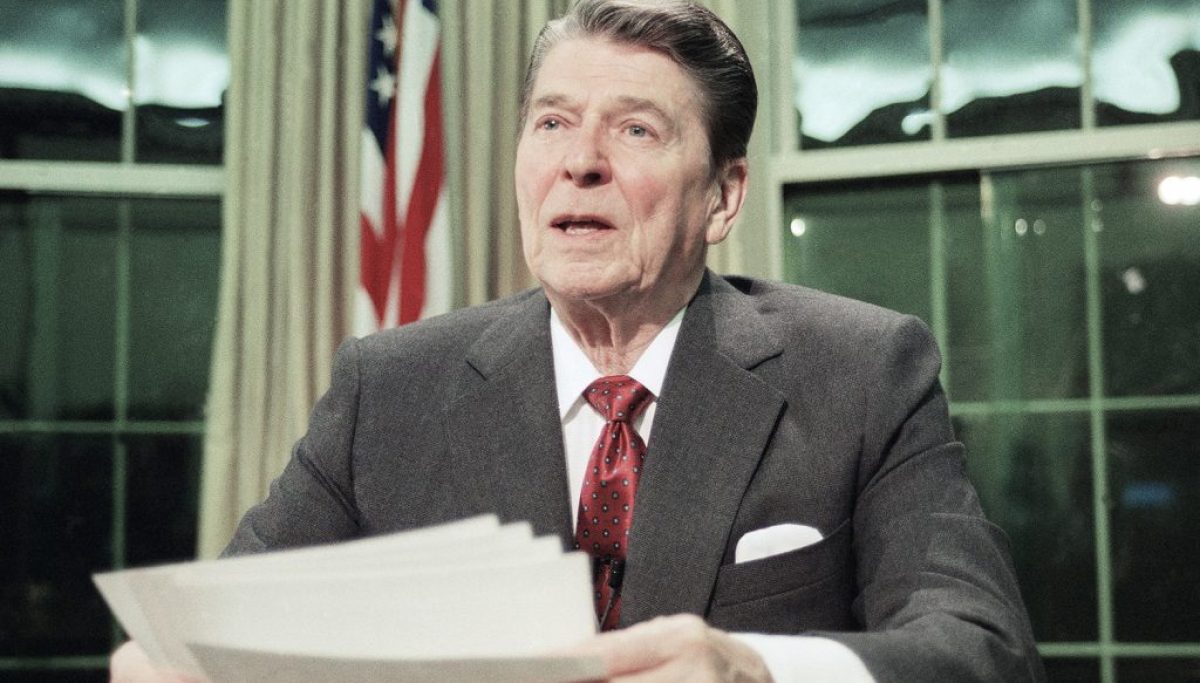
The latest midterm debacle is humiliating for the Republican Party, and the question now is how to rebound. Staying on the road of the past two years is plainly what led to the defeat. But adjust to what, and toward where?The party need not search far. About 40 years ago, President Ronald Reagan set a successful model for leading this great country.Much has changed since then. The Soviet Union is gone, China is rising, new waves of globalization and immigration are reshaping the world, new science and technology are transforming daily life, the baby boomers are retiring, and Generation Z is taking the stage. Reaganism is not a panacea. But the core philosophy behind his strategy remains valid: Steer a middle course to better fulfill the mission, and unify the country and its people. It is striking that Western and Eastern traditions uphold the same primary virtue, called the golden mean, moderation, or balance. Aristotle taught it in Greece, and Confucian thought placed it at the center of governance. The difficulty is that people often praise moderation but rarely understand it, and so struggle to practice it.The Chinese philosopher Feng Youlan, who once taught at the University of Pennsylvania, offered a vivid explanation. Suppose a traveler plans to go from Washington, D.C., to New York City. If he stops in Philadelphia, he falls short of his goal. If he continues on to Boston, he overshoots it. Both violate the golden mean, which requires him to reach New York, no more and no less.Two misunderstandings follow from this. Some people think the golden mean represents fence-sitting, a vague refusal to commit. Others think it means softness and listlessness, a lack of power to act. Both are wrong. The golden mean rests on a clear objective: in Professor Feng’s example, New York City, not some other place. Once the destination is set, the action must be resolute: summon every strength to arrive quickly and on time. Moderation is about the right goal, pursued with full force.Reagan practiced exactly this, in strategy, tactics, humor, and courage.About strategy. On the Cold War, Reagan rejected both extremes of the era. He would not accept detente’s permanent coexistence with Soviet power, which stopped in Philadelphia. Nor would he gamble on reckless confrontation, which ran on to Boston. His destination was clear: the end of the Soviet threat without a catastrophic war. He pursued it with an arms buildup and moral clarity, calling the USSR an “evil empire,” while also opening direct talks with Mikhail Gorbachev. Pressure and negotiation were two tools for one goal. The result was the INF Treaty of 1987 and, within a few years, the end of the Cold War.Tactically, in 1981, Reagan wanted large tax cuts and a stronger military, and he faced a Democratic-controlled House. A purist would have refused to bargain. Reagan worked with conservative Democrats and accepted compromises to pass the core of his program. When deficits grew, he agreed to tax increases in 1982 and 1984 rather than cling to doctrine. In 1986, he signed a bipartisan tax reform bill that lowered rates and closed loopholes. He also signed an immigration reform in the same year that offered legal status to many undocumented immigrants while tightening enforcement. One may debate the results of each, but the approach was consistent: Fix the objective, then find the votes to reach it.And he did it with humor. After being shot in 1981, Reagan joked to his surgeons that he hoped they were all Republicans, and they replied that today everyone was a Republican. In the 1984 debate, he defused the age issue by promising not to exploit his opponent’s “youth and inexperience” for political purposes. His humor was often at his own expense, which lowered the temperature, made opponents human, and let him hold firm positions without being seen as an ideologue or a bully. The golden mean is neither grim nor boastful.Consider courage. In 1981, he fired more than 11,000 striking air traffic controllers who had defied the law, a decision that carried real political risk but showed the country that the rules applied to everyone. In 1987, standing at the Brandenburg Gate, he challenged Gorbachev to tear down the Berlin Wall, over the objections of cautious advisers. Moderation never meant timidity for him. It meant knowing where he was going and having the nerve to get there.TRUMP BLAMES EVERYONE BUT HIMSELF. SO WHAT ELSE IS NEW?The lesson for today’s Republicans is not to copy Reagan’s policies from the 1980s. It is to recover his wisdom and approach. Decide what the destination is, and make it one that most Americans can recognize as their own, not merely the preference of the party’s most vocal wing. Then pursue it with discipline, humor, and resolve. A party that treats every compromise as betrayal will stop in Philadelphia, or find itself in Boston, but will not get to New York.Reagan won two landslides because he made ordinary Americans, including many Democrats, feel that he spoke for the whole country. The next generation of Republican leaders should think back on Reagan’s example and walk the same path. That is how to make America great again.David W. Wang (@DavidWWang203) is a senior international business executive, geopolitical affairs consultant, analyst, and writer based in the Washington, D.C., metro area.
Take a pause, think back on Reagan
Full Article
Original Source
Read the full article at Washingtonexaminer →KhanList aggregates and links to publicly available news content. We do not host full articles from third-party sources. Always verify important information with original sources.