
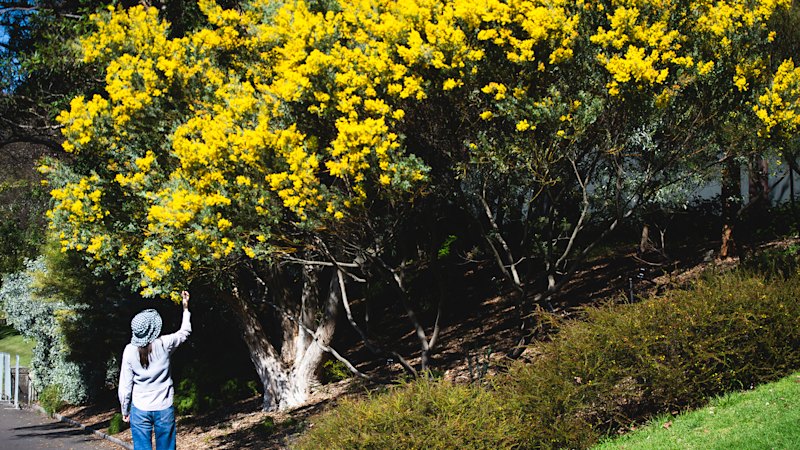
Extravagant displays of magnolias in bloom once signalled the start of spring in Sydney, but in recent years they have come in earlier and earlier as winters fail to produce the days of deep cold and attendant frost. This year they arrived almost a month early, says Royal Botanic Garden Sydney chief scientist Professor Brett Summerell.The dazzling beauty of Sydney’s floral displays is arriving earlier each year due to climate change.Steven SiewertThe paper daisies and wattles burst into colour soon afterwards.“It keeps getting earlier every year, but this year it was much earlier,” Summerell says.Sydney has just experienced its warmest winter in 167 years of records, according to Weatherzone meteorologist Ben Domensino, and can expect the warmest start to spring in more than 50 years, with temperatures predicted to reach between 24 and 27 degrees this week.“I grew up skiing at Selwyn snowfields and remember having to dig our front doors out at Cabramurra,” said Mia “Miff” Rennie, a member of the advocacy group Protect Our Winters. “That’s now a thing of the past. I have seen first-hand how quickly our winters are changing and how quickly we need to respond so future generations can continue to experience the magic of winter that I grew up with.”But the broader cause of the heat is climate change.Australia’s area-averaged mean temperature in July was 1.14 degrees above the 1961-90 average, the warmest since 2023. All states and territories had above-average mean temperatures in July. Tasmania and Queensland were within their top seventh- and tenth-warmest July on record since 1910, respectively.Western Europe enters autumn having been battered by a rolling series of heatwaves and its hottest ever June and July period.The Mediterranean Sea has been supercharged with so much heat that it is expected to keep regional temperatures higher than average over coming months, prompting warnings of increased flood risk in some countries.“September and October are the Mediterranean’s flash-flood season: the sea is at its annual warmest after three months of heating and the first cold troughs arrive overhead,” Ioanna Vergini, founder of the forecasting platform WFY24, told Euronews Earth.Over the northern summer, 634,022 hectares of land burnt across the EU, more than double the long-term average, prompting the evacuation of more than 300,000 people and shattering heat records.In the United States and Canada, wildfires burnt at least 25 per cent more land than the 10-year average and more than double the land area decades ago.Scientists are now exploring how the thawing of permafrost may have contributed to the landslide and flood disaster that cost thousands of lives in Nepal and China last week.The most intense El Nino event so far recorded is now brewing in the Pacific Ocean, charging waters with intense heat that will be released into the atmosphere over coming months, potentially leading to even higher temperatures in Australia this summer and next.But according to Professor Mark Howden, director of the Australian National University’s Institute for Climate, Energy and Disaster Solutions, the higher than usual temperatures experienced in Australia over winter and forecast for spring are unlikely to have yet been significantly altered by the El Nino.“What’s going on in Australia [so far] fundamentally is the underlying temperature increase due to climate change.”As spring begins, the NSW government has announced a massive investment in drone surveillance, and for the first time has installed two tagged shark listening stations in Sydney Harbour. The other 37 are at ocean beaches up and down the coast.A new shark listening station is installed in Sydney Harbour in August.NSW governmentThe stations, one near Balmoral in Middle Harbour and one at Lady Bay in the eastern suburbs, will cover the movement of tagged sharks, particularly bull sharks in the harbour.The sharks are caught on SMART drumlines, then tagged and released. When they swim within about 500 metres of a listening station, the SharkSmart app is pinged.Get to the heart of what’s happening with climate change and the environment. Sign up for our fortnightly Environment newsletter.Nick O'Malley is National Environment and Climate Editor for The Sydney Morning Herald and The Age. He is also a senior writer and a former US correspondent.Connect via email.Caitlin Fitzsimmons is the environment and climate reporter for The Sydney Morning Herald. She was previously the social affairs reporter and the Money editor.Connect via email.From our partners
Sydney set for spring sizzle after warm winter
Full Article
Original Source
Read the full article at Smh →KhanList aggregates and links to publicly available news content. We do not host full articles from third-party sources. Always verify important information with original sources.