
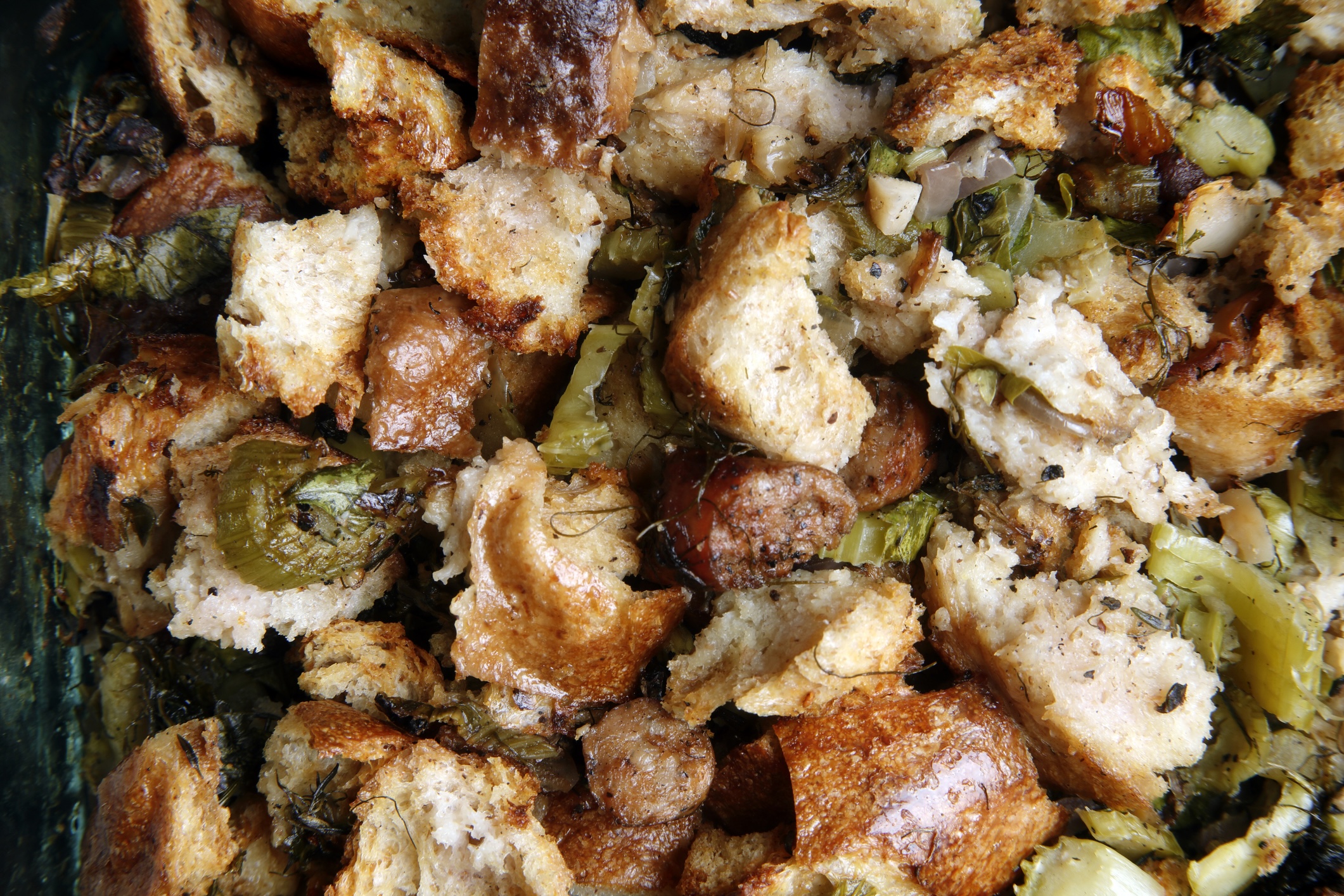
recipe Stale bread, sausage, vegetables and stock make an easy, cozy dinner — especially with a fried egg on top Published September 6, 2026 10:30AM (EDT) Close-up dish of cooked stuffing (Steve Cicero / Getty Images) Back when Twitter was still the kind of place where a stray observation could become communal property by lunchtime — before the app hardened quite so completely into a highly polarized, hyper-monetized digital town square populated by tech founders and crypto traders flashing what’s beneath their metaphorical trench coats — one particular idea seemed to resurface every so often: You can simply buy yourself a birthday cake. The version I remember best was comedian Andrew Nadeau’s: “Turns out you can just buy a birthday cake anytime and eat it yourself. Nobody checks.” And, in the Twitter style of the time, once somebody landed on the joke, everyone else began taking little runs at it: refining the wording, extending the premise, adding nachos or Diet Coke or the marvel of having “adult money.” The revelation remained essentially the same. There is no birthday-cake authority. No one at the bakery asks for identification. No clerk leans across the counter and demands proof that a candle-worthy occasion has actually occurred. Over here on the savory side, I’m equally evangelical about freeing stuffing from Thanksgiving. If stuffing had never been claimed by Thanksgiving, I suspect we’d think of it the same way we think of the other dishes in its particular stable: foods built from beautiful torn bread and not terribly much more. Strata. Panzanella. Things that are hearty and comforting, endlessly accommodating and somehow greater than the sum of their decidedly humble parts. Freed from its holiday obligations, though, stuffing has all the makings of a weeknight pantry star — the sort of thing that belongs in the same mental category as rice bowls, bean soups and curries pulled together with a can of coconut milk. Instead, it wears the somewhat double-edged crown of holiday darling: beloved enough to inspire fierce family loyalties, but so firmly associated with one particular feast that we mostly forget about it for the other eleven months of the year. Stuffing is made for weeknight dinners precisely because it is so good at absorbing the odds and ends that accumulate by midweek, without requiring another trip to the supermarket. Stale bread stops being waste and becomes an asset. And it doesn’t ask for much to get started: some kind of fat — butter, olive oil, the drippings from a package of pork sausage — and some kind of allium, even if tonight that means garlic powder or dried onion rather than anything freshly chopped. From there, you’re mostly deciding how hearty you want dinner to be. Pork or soy sausage gives the whole thing some ballast. Vegetables of nearly every persuasion happily disappear into the mix. Herbs seem to sing a little louder once they’ve been tossed with torn bread, good chicken or vegetable broth and enough fat to encourage the whole thing to go bronzed and crisp on top in a friendly little casserole dish. Want more great food writing and recipes? Sign up for Salon’s free food newsletter, The Bite. That said, while I’m zealous about the form, I’m not remotely legalistic about it. Don’t want to soak the bread in stock and bake the whole thing? Keep it in the skillet and let the torn pieces toast in the fat instead. Put a fried egg on top while you’re at it. Use hot Italian sausage, Mexican or Spanish chorizo, longganisa, or no sausage at all. Add three kinds of onion. Throw in fennel seed, red pepper flakes, an obscene amount of parsley, the zest of an entire lemon or a few dashes of soy sauce. Yes, really. Crumble goat cheese over the top. Shower it with Parmesan. (And yes, technically what I’m describing here is dressing, since we won’t be stuffing it into anything. I tend to use the words interchangeably, which I blame partly on a still-lingering affection for the boxed stovetop variety, whose name has perhaps permanently collapsed the distinction in my brain.) The point is not to recreate Thanksgiving dinner on a Tuesday. The point is to notice that stuffing, stripped of its ceremonial duties, is an exceptionally forgiving way to turn bread and whatever else you have into dinner. My own conversion happened on a Thursday night, with half a pan of Trader Joe’s cornbread rapidly approaching the point of no return and maybe four tablespoons of Mexican chorizo left in the bottom of a tube. I crumbled both into a skillet with green onion, a couple of carrots, some fresh fennel and red bell pepper, then started rummaging through the spice cabinet: onion powder, garlic powder, red pepper flakes, fennel seed. For the binder, I whisked together an egg, a little buttermilk and chicken stock that I’d fortified with an extra spoonful of Better Than Bouillon and an absurd amount of black pepper. Into a casserole dish it went, where the top crisped and the center went soft and savory. I showered the whole thing with cotija and lemon zest and served it alongside one of those zesty slaw kits, also from Trader Joe’s. It was not an elegant meal, exactly, but I remember feeling immensely industrious. It’s a wonder what a casserole dish and a crisp side salad can do for one’s soul, especially on a weeknight. It was improvised, deeply untraditional and exactly the kind of stuffing I wanted to eat again. The rules (there aren’t many) Start with the bread. Much like bread pudding — another of my favorite loaf-based forms — almost anything works here, especially if it’s stale enough, or toasted enough, to give you some real texture. Hunks of sourdough or Texas toast, torn cornbread muffins or classic white sandwich bread, Hawaiian rolls or challah: all solid choices. The key is the shape. You want a real torn chunk, something closer to an unruly crouton than a breadcrumb. Choose your fat. This is less about rules than deciding what kind of flavor you want to work into the bread. Grassy, rich olive oil; creamy salted butter — or nutty brown butter, if you’re feeling fancy — and savory pork fat are all winners in my household. Sometimes I mix fats, which is wholly unnecessary but can feel strangely luxe when you’re otherwise scrapping it out with the last tablespoons of whatever is left in the fridge. The only ones I tend to avoid are neutral vegetable oil, which can make the whole thing feel a little filmy, and coconut oil, unless that is a flavor you specifically want to chase. Add aromatics and vegetables with casserole logic. Think about what already plays nicely in warm, savory baked things: bright pops of bell pepper or scallion, jammy onions or shallots, fennel or celery, fresh-shaved corn, wilted greens, even root vegetables like carrots or sweet potatoes. If you can imagine it folded into a strata, gratin or savory bread pudding, chances are it has a home here, too. Give it just enough moisture. If you’re baking your stuffing, some combination of stock, egg, cream or buttermilk helps pull everything together. The goal is a quick dip, not a hot-tub soak: enough liquid to soften the interior of the bread while leaving plenty of edges available to crisp. If you’re going the quicker skillet route (essentially a bread stir-fry, which is a phrase I have now decided to stand behind) you can skip this step entirely. Give it some ballast. If this is going to be dinner rather than a side dish, I like something savory and substantial tucked throughout. Sausage — pork or soy — is an obvious choice, but deeply seasoned, aggressively browned mushrooms do the job beautifully, too. Cheese, a fried egg or whatever last little fridge treasure needs using up can come along for the ride. And then: zest and herbs. This may be the closest thing I have to a real rule. Stuffing is rich, savory and beige-adjacent by nature; lemon zest and a fistful of fresh green herbs wake the whole thing up. Parsley, chives, dill, sage, thyme — use what you have, and probably more of it than you initially think you need. If you’re looking for somewhere to start, start here: Chorizo and cornbread weeknight stuffing Ingredients 2 to 2½ cups stale cornbread, torn into 1-inch pieces, roughly 2 to 3 large slices 2 ounces Mexican chorizo, about 4 tablespoons 1 small carrot, finely diced ¼ small fennel bulb, finely diced ¼ red bell pepper, finely diced 2 scallions, thinly sliced, white and green parts separated ½ teaspoon onion powder ½ teaspoon garlic powder ¼ teaspoon fennel seeds, lightly crushed Pinch of red pepper flakes, plus more to taste 1 large egg ¼ cup buttermilk ⅓ cup chicken stock, plus more as needed ½ teaspoon Better Than Bouillon chicken base, optional Freshly ground black pepper 2 to 3 tablespoons crumbled cotija Finely grated zest of ½ lemon Olive oil or butter, as needed Directions Heat the oven to 375 degrees. Lightly grease a small baking dish, about 1½ quarts. Cook the chorizo and vegetables. Heat a medium skillet over medium heat. Add the chorizo and cook, breaking it into small pieces, until its fat begins to render, 2 to 3 minutes. If the pan seems dry, add a little olive oil or butter. Add the carrot, fennel, bell pepper and scallion whites. Cook, stirring occasionally, until the vegetables begin to soften, 5 to 7 minutes. Season the mixture. Add the onion powder, garlic powder, fennel seeds and red pepper flakes. Cook for about 30 seconds, until fragrant, then remove from the heat. Make the custard. In a medium bowl, whisk together the egg, buttermilk and chicken stock. If using Better Than Bouillon, whisk it into the stock first. Season generously with black pepper. Combine. Place the torn cornbread in a large bowl and add the chorizo mixture. Pour the egg mixture over the bread and toss gently until evenly moistened. Let sit for 2 to 3 minutes. The bread should be softened but not saturated; if it still seems dry in the center, add additional stock a tablespoon at a time. Bake. Transfer the mixture to the prepared baking dish without packing it down too firmly; those uneven bits of bread are what will get crisp. Bake until the center is set and the top and edges are deeply golden, 20 to 25 minutes. Finish and serve. Scatter the cotija, scallion greens and lemon zest over the hot stuffing. Add another generous grind of black pepper and serve immediately. Related Topics ------------------------------------------ Related Articles
Stuffing deserves a life beyond Thanksgiving
Full Article
Original Source
Read the full article at Salon →KhanList aggregates and links to publicly available news content. We do not host full articles from third-party sources. Always verify important information with original sources.