
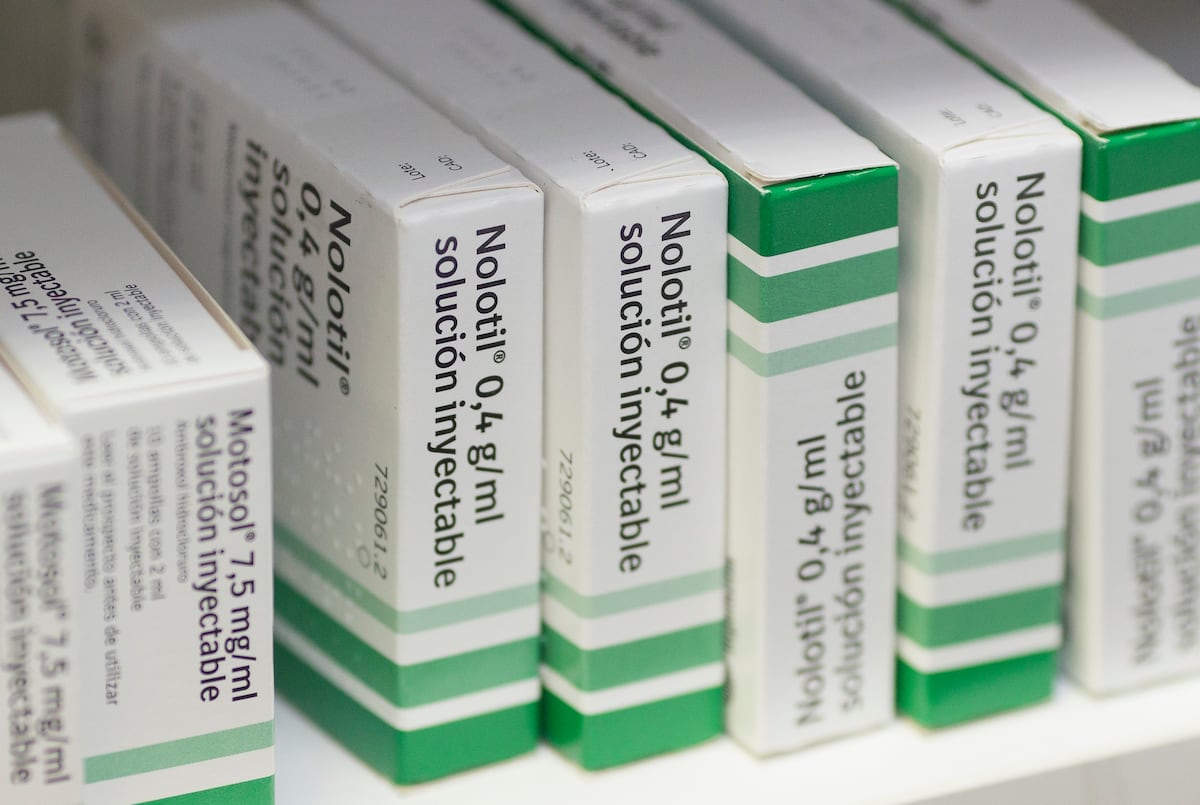
A presentation at the recent congress of the Spanish Society of Hospital Pharmacy (SEFH) reveals previously unknown data highlighting safety concerns, especially among UK citizens, about a common drug called metamizole (also known as dipyrone and sometimes called “Mexican aspirin” in the United States, where it is banned). That molecule is the active ingredient in Nolotil — Spain’s best-selling branded drug, regularly prescribed for pain and high fever. The new findings, which were also presented at the most recent European congress in the field, are based on data from an internal report produced in 2019 by the government of Spain’s Valencia region that was never published, and to which EL PAÍS has now obtained access. Back in 2018, the Spanish Health Ministry issued a warning regarding the misuse of metamizole following reports in British news outlets that a dozen UK citizens had died after taking metamizole in Spain. The possibility that genetic factors make adverse reactions more common in some populations is at the center of recurring debates, although there are practically no solid comparative studies. In 2018, the Spanish Medication and Health Products Agency (AEMPS) noted the existence of “a years-long debate around a greater sensitivity among the population of northern Europe,” although this risk has not been confirmed.The 2019 internal study that has now come to light, Prevalence of agranulocytosis from metamizole in European populations residing in Alicante province (2016-2017) analyzed severe adverse reactions reported during the course of those two years in the coastal areas of Denia, Villajoyosa, Torrevieja, San Juan and Orihuela, in the province of Alicante in eastern Spain. These areas have a high presence of foreign residents and together had 916,000 registered residents at the time, of whom 62,000 were originally from the United Kingdom (6.7%) and 28,000 from other northern European countries.The study reveals that nine people died in that two-year period from “agranulocytosis caused by metamizole,” seven of them British and two Spanish. This is the drug’s best-known severe adverse effect: a drastic reduction in granulocytes — a type of white blood cell — which can be fatal, particularly in vulnerable people like the elderly or those with suppressed immune systems. In total, the study identified 41 patients who were hospitalized with agranulocytosis due to metamizole, of whom 26 were British, 11 Spanish, one Danish, one Dutch, one Swedish and one Moroccan.British vs Spanish patientsTo carry out the analysis, researchers cross-checked hospital discharge databases and outpatient consumption of the drug in people over 45 during 2016 and 2017, and reviewed medical records individually to confirm that affected patients had taken metamizole in the month before hospitalization. To narrow the relationship with the drug, patients whose immune suppression could have other causes — infections, medications, oncological conditions — were excluded.A key point of the study is the comparison of the relative risk of suffering agranulocytosis from Nolotil for British patients versus Spanish patients. The study used two different methods. The first one found that among Spaniards there were 0.33 cases per 100,000 DDD (defined daily doses), a rate that soared to 39.8 cases among people from the United Kingdom, representing a 120.7-fold higher risk.The second method uses the number of agranulocytosis events per 1,000 patients who had taken metamizole. Among Spanish nationals the rate was 0.084 cases per 1,000 treated patients (almost one in every 12,000), while among Britons the figure rose to 6.62 (one in every 151). That represents a 78.8-fold higher relative risk.Ongoing controversyThe study provides relevant information on a controversy that has been open for decades. Metamizole was first marketed in Germany in 1922 and remains widely used there and in Austria, Italy, Portugal, Russia and Turkey, among others. In Belgium and the Netherlands it is still approved but its use is highly restricted. In contrast, France, Sweden, Denmark, the United Kingdom, Ireland, the United States and some 30 other countries have withdrawn it because of its link to agranulocytosis.In Spain, the AEMPS maintains that “the available information does not allow ruling out or confirming a higher risk in populations with specific ethnic or genetic characteristics.” The agency also argues that the benefit-risk balance for metamizole remains positive.In the last decade, however, Spain has recorded repeated warnings about problems from metamizole use in people from northern Europe. Most have come from hospitals in areas with a high foreign presence (Costa del Sol, Denia...), whose centers have adopted specific measures to prevent risks. These cases have led to several lawsuits, most of which are still pending.In 2018 the AEMPS recommended not using the drug for longer than one week and advising against it in transient populations. “The recommendation referred to tourists, when [the risk] is actually with people from these countries who are residing here,” criticized the study’s author, José Luis Marco Garbayo, at an SEFH event; he has declined to be interviewed by this newspaper.A new chapter unfolded between 2023 and 2024, when the European Medicines Agency (EMA) reevaluated the drug’s safety after Finland decided to withdraw it. The EMA concluded that the drug’s benefits still outweighed the risks, although it pushed for changes to package leaflets to facilitate detection of complications.“A serious problem of transparency and reporting”Regarding the Valencia government’s internal report, the AEMPS downplayed its conclusions in writing: “It has important limitations since it is not analytical but descriptive. It does not allow calculation of incidences or relative risks, which is crucial to evaluate the safety profile.” The agency adds that “neither the study design, nor the method for calculating frequency measures, nor the estimation of the relative risk, nor the absence of control for other biases allow the offered conclusion to be drawn.”The AEMPS highlights another study of its own, published in 2024 in the European Journal of Clinical Pharmacology, whose main conclusion is that “agranulocytosis was very rare, but more common with metamizole than with other analgesics (more than four times higher).” The paper, however, qualifies that the small number of cases analyzed prevents ruling out that the observed differences were due to chance. In any case, this study does not distinguish the population by country of birth, which prevents it from shedding light on whether there is a higher risk among the British population.Vicente Palop, of the working group on medication use at the Spanish Society of Family and Community Medicine (semFYC), is critical of the management of the drug’s safety. “There is a serious problem of transparency and reporting. We do not know the real impact of adverse effects. And not only in the northern European population, but also among Spaniards. While other countries act firmly, like Finland, the AEMPS seems to prefer to ignore or discredit reports that point to the problem instead of promoting the measures necessary to determine its true magnitude,” he censured.Sign up for our weekly newsletter to get more English-language news coverage from EL PAÍS USA Edition
Study reveals nine deaths, seven of them British patients, from common painkiller used in Spain
Full Article
Original Source
Read the full article at English →KhanList aggregates and links to publicly available news content. We do not host full articles from third-party sources. Always verify important information with original sources.