
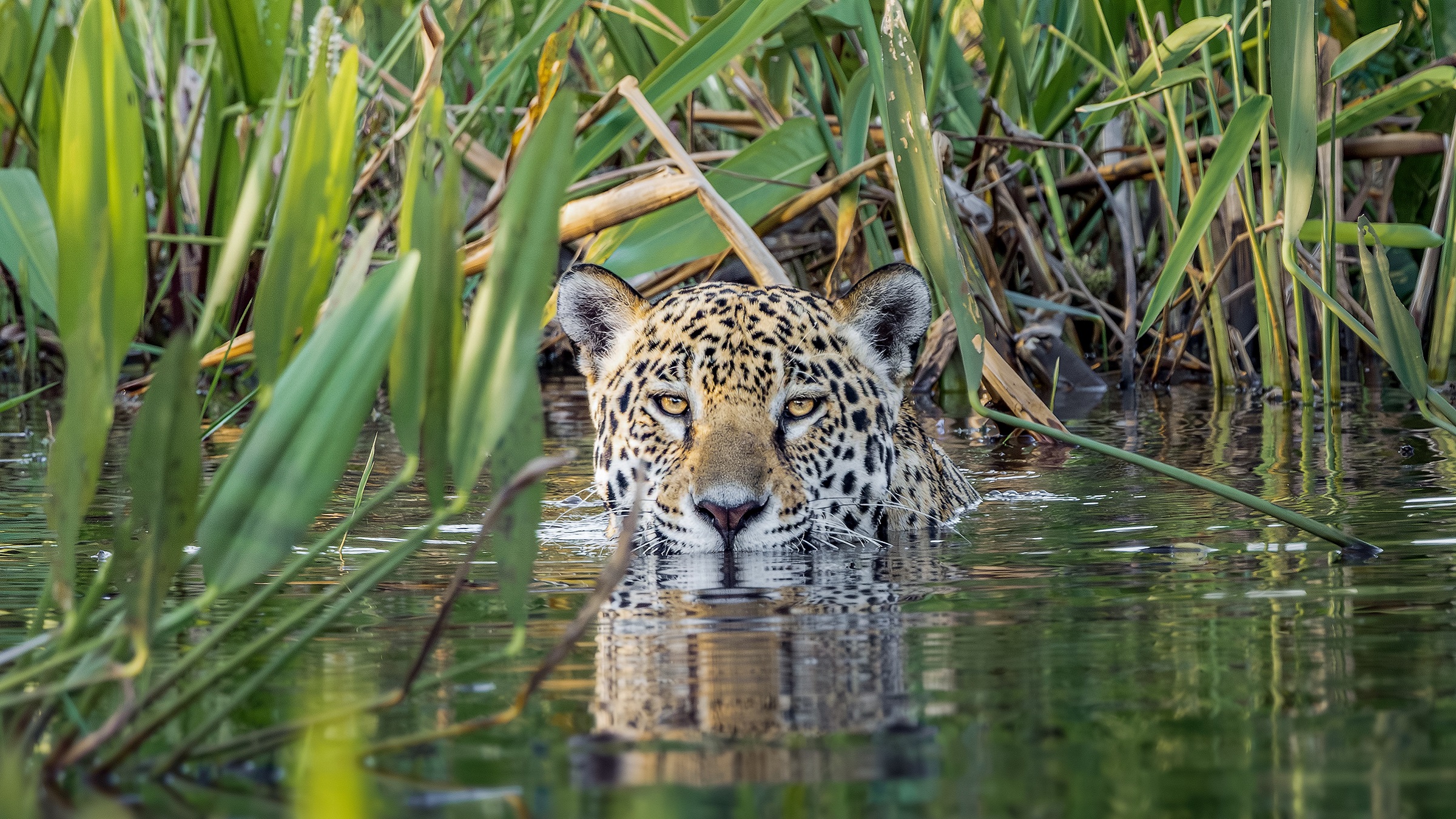
A new study mapped 307 core areas and 176 corridors for jaguars across the Americas using movement data from 172 GPS-collared cats.Habitat fragmentation isolates regional populations, accelerating the loss of genetic diversity and leaving the species increasingly vulnerable.A coalition of South American organizations launched an $80 million initiative to protect and reconnect vital freshwater ecosystems across the Paraná River Basin to address these fragmentation threats. Residents of a neighborhood in Foz do Iguaçu, in southern Brazil, alerted authorities after spotting a jaguar (Panthera onca) roaming the streets in June 2026. One family was even more surprised when, one morning, they heard a loud commotion and found the animal on their porch. Following a major mobilization involving police, environmental agencies and organizations specializing in the species, the male jaguar was sedated and temporarily taken to a wildlife refuge. A few weeks later, the animal, named Tape’ỹ — a word meaning “the one who lost his way” in the Indigenous Tupi-Guarani language — was released into Iguaçu National Park, near where he had been found. “Jaguars need large areas of habitat to survive. And it’s not enough for these areas to exist: They must be connected, allowing animals to move around, find mates and maintain gene flow between different populations,” says Yara de Melo Barros, executive director of the Onças do Iguaçu Project, one of the organizations involved in Tape’ỹ’s rescue and release. Iguaçu is part of the so-called Green Corridor, which crosses the Brazil-Argentina border and is home to about one-third of the fewer than 300 jaguars still surviving in the Atlantic Forest. It is an important habitat for the species, but highly fragmented and almost completely cut off from the rest of the biome, according to the most comprehensive assessment to date of connectivity across the jaguar’s range throughout the Americas, recently published in the journal Global Change Biology. Tape’ỹ being examined after his rescue in the streets of a neighborhood in Foz do Iguaçu. Image courtesy of Onças do Iguaçu. According to the study’s lead author, Guilherme Costa Alvarenga, a researcher at the Wildlife Conservation Research Unit at the University of Oxford and the Amazonian Feline Ecology and Conservation Research Group at the Mamirauá Institute for Sustainable Development in Tefé, Brazil, the only previous study to analyze wide-range connectivity areas for jaguars was conducted 15 years ago. “Much of the landscape has changed during that time, and the previous study didn’t use any sort of biological data for the prediction, such as camera traps or GPS collars, relying solely on experts’ knowledge, which was accepted at the time, considering the limited data available,” Alvarenga said. “First, we wanted to understand how isolated jaguar populations are across the entire continent. Second, based on collar data, we wanted to identify potential locations that could serve as ecological corridors connecting these populations, if any still existed.” The study used movement data from 172 GPS-collared jaguars captured and monitored in eight countries: Argentina, Belize, Brazil, Colombia, Costa Rica, Mexico, Paraguay and Peru. Alvarenga and his colleagues combined this data with satellite imagery to try to predict how jaguar populations are connected across the species’ entire range. Or not. The moment Tape’ỹ was released in Iguaçu National Park. Image courtesy of Onças do Iguaçu. Guilherme Alvarenga setting a camera trap during fieldwork in the Amazon. Image courtesy of Bernardo Oliveira/Instituto Mamirauá. Core areas The largest feline in the Americas, the jaguar has lost about half of its historical range, according to the study. The species has gone extinct in El Salvador, and there is no longer evidence of its presence in Uruguay. The Maya Forest is home to a large, stable population, the researchers found, while local conservation efforts have also helped jaguar numbers increase in the border region between Mexico and Arizona in the United States. However, South American countries hold the largest remaining populations of these cats, researchers say. Brazil has the world’s largest jaguar population. The study identified “307 core areas for jaguar movement,” covering more than 7.75 million square kilometers (2.99 million square miles). The largest and highest-ranked of these, spanning 6.5 million km2 (2.5 million mi2), extends across four South American biomes: The Amazon, Llanos, Chaco and Pantanal. “The Amazon still offers jaguars an opportunity that most other big cats have lost,” said conservation scientist and a co-author of the study Samuel Cushman, a professor in the Department of Biology at the University of Southern Denmark. “But a strong core area is not enough. Without corridors between populations, isolated populations will slowly disappear.” The assessment identified 176 corridors connecting core areas and 507 additional potential corridors between 905 protected areas and Indigenous territories. The researchers note, however, that connectivity is not continuous across the species’ entire range. Northern jaguar populations in Mexico and Central America, for example, showed several connectivity gaps. “The lack of connectivity is mainly caused by areas transformed by agriculture and livestock farming, especially soybean plantations and cattle pastures,” Alvarenga said. “When space becomes limited and individuals remain isolated, they begin breeding with relatives, losing genetic diversity. This increases their susceptibility to genetic diseases and reduces their ability to adapt to climate change, putting them at risk of local extinction.” One of the study’s goals is to help governments and environmental organizations identify where conservation efforts can do the most to strengthen connectivity between populations in the future. “We may have a population that is recovering, as is happening in Iguaçu, but that doesn’t mean it is safe,” said Brazilian conservation biologist Yara Barros, who was not involved in the study. “If that population remains isolated, it becomes more vulnerable to the loss of genetic diversity and to events that could jeopardize its survival. That is why protecting forest remnants and restoring connections between them is so important.” Ranking of core habitat areas for jaguars across the species’ current range. The strength of core areas is expressed as density of movement. The side maps highlight the 10 highest-ranked core areas numbered by priority. Image courtesy of Alvarenga et al. (2026). A water cat By analyzing the movements of GPS-collared jaguars, the study also identified landscape characteristics that attract or repel the animals. According to the Oxford researcher, jaguars tend to avoid areas with high human population density, extensive human-driven landscape degradation and intensive cattle farming. On the other hand, they seek environments with higher vegetation productivity — more fertile and richer areas with greater food availability and, consequently, more prey — as well as locations closer to water. “This last pattern has already been reported in several studies,” Alvarenga said. “Jaguars are the exception among cats: Of all the big cats, they have a particularly close relationship with aquatic environments. They use water to hunt, and there are reports of individuals, in the Brazilian Pantanal, diving underwater to prey on caimans.” Water is so important to the species’ survival that four South American conservation groups have joined forces to restore, protect and connect 1,200 km2(460 mi2) of the Paraná River Basin, a vital habitat for jaguars that extends through Argentina, Paraguay, Brazil and Bolivia. Map showing areas to be restored and protected along the Paraná River Basin by four South American organizations. Image courtesy of Jaguar Rivers Initiative. With the jaguar as its symbol, the Jaguar Rivers Initiative was founded by Fundación Rewilding Argentina, Nativa: Naturaleza Tierra y Vida (Bolivia), Fundación Moisés Bertoni (Paraguay) and Onçafari (Brazil). The investment for its first three years amounts to $80 million. In September 2026, the initiative conducted its first fieldwork expedition: A boat journey involving 20 researchers, departing from Corumbá, in Brazil’s Mato Grosso state, and traveling along the Paraguay River to Argentina. “Our idea was to understand how effective this connectivity is and how new threats could create additional challenges for us in pursuing this ambitious goal,” said Paola Bocardo, Onçafari’s director of forests. “We consolidated some measurements and protocols that we will use over the coming years and carried out an initial mapping of wildlife and all the threats. Equally important, we collected water samples.” Among the surprises Bocardo mentioned from the first expedition was large industries along the river’s banks using its water after leaving Brazilian territory, where environmental laws are stronger. “We saw those enormous water pumps, with several pipes drawing a considerable volume of water from the river,” she told Mongabay. Another unexpected finding was the small number of caimans spotted. As a result, the initiative decided to monitor these reptiles and include them among the key species tracked by Jaguar Rivers. In addition to the jaguar, the initiative focuses on the giant river otter (Pteronura brasiliensis) and three fish species: Golden dorado (Salminus brasiliensis), spotted sorubim (Pseudoplatystoma corruscans) and streaked prochilod (Prochilodus lineatus). Water sample collection during a Paraguay River boat trip. Image courtesy of Sebastián Navajas/Jaguar Rivers Initiative. A future for jaguars Farther south on the continent, the wetlands of Gran Iberá Park, in northeastern Argentina’s Corrientes province, depend on water flowing from Brazil through the Paraná River Basin to sustain a precious population of just over 50 jaguars. The species had not been seen in the region for 70 years, after hunting and habitat loss drove it to local extinction. Then, in 2021, Rewilding Argentina released three jaguars there — a mother and two cubs. “Seeing so many jaguars, with new cubs born every year, fills us with hope and joy after 20 years of work alongside local communities, authorities and our team. It also deepens our commitment to helping them disperse and recover in other ecosystems across the Paraná River Basin,” says Sofía Heinonen, executive director of Rewilding Argentina. To ensure these cubs thrive and others can be born and have a chance in the future, not only in Argentina but also in countries where the species still survives, Alvarenga is already outlining the next steps in his research. “This mapping was a first step,” he says. “Now we will go into the field to see whether jaguars actually use these corridors, talk to communities and assess the level of restoration needed in these areas.” Aerial view of the Paraguay River. Researchers were aboard a boat for 20 days doing fieldwork. Image courtesy of Henry Maillet/Jaguar Rivers Initiative. Banner image: Aroeira, a female jaguar monitored by Onçafari in the Brazilian Pantanal. Image courtesy of Lucas Morgado/Onçafari. Study suggests there are more jaguars in the Amazon than previously thought FEEDBACK: Use this form to send a message to the author of this post. If you want to post a public comment, you can do that at the bottom of the page. Credits Topics
Study maps jaguars across the Americas to help their populations rebound
Full Article
Original Source
Read the full article at News →KhanList aggregates and links to publicly available news content. We do not host full articles from third-party sources. Always verify important information with original sources.